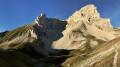
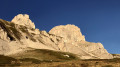
Obiou via the cat flaps and the chimney of the Petit Obiou

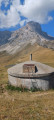
This fun and spectacular variation on the magnificent ascent of the Grande Tête de l’Obiou allows you to complete a circular loop, climbing up the splendid Cheminée du Petit Obiou wedged between the stone pillars of this wild summit, then squeezing through the two narrow passages on the east face of the Grand Obiou.

A few short sections of easy climbing (maximum 3c) and a route largely off the beaten track lend the hike a sense of wild adventure.

Details

3941864
Creation:
Last update:
Last review:
  • Walking
    Activity: Walking
  • ↔
    Distance: 9.93 km
  • ◔
    Duration according to the author: 6 hrs 
  • ▲
    Difficulty: Extremely difficult

  • ⚐
    Back to start: Yes
  • ↗
    Ascent: + 1,326 m
  • ↘
    Descent: - 1,317 m

  • ▲
    Highest point: 2,773 m
  • ▼
    Lowest point: 1,562 m

Photos

Description of the walk

Information on how to reach the starting point, as well as details regarding difficulties, alternative routes and precautions to take, are summarised in the ‘Practical Information’ and ‘During the Hike’ sections. Any difficult hike requires preparation, and this extremely difficult hike demands thorough prior research. The standard route up the Grand Obiou offers an easier route.

(S/E) From the car park, continue along the forest track to the south, passing through a cattle grid, then take the first path on the right to climb up a ridge dotted with pine trees. The path turns west and continues beneath the northern ridge of the slope to the small rocky pass in the Vallon, where it descends briefly. Shortly afterwards, at the IGN elevation of 1912 m, it splits into two. Take the left branch to quickly reach the foot of steep slopes that are half grass, half scree (see this photo and this one and their annotations).

(1) Climb the steep slopes of the Pré du Chourum, due south, following the line of steepest gradient, to reach the shoulder beneath the Petit Obiou which separates the Pré du Chourum from the Pré Chevalier, above (west of) the rock marked 2262 m.

(2) Head west along the ridge towards the base of the Petit Obiou, then turn left towards the south to follow the foot of the cliffs along some fine rocky steps. When the cliff turns westwards, climb a few loose steps before continuing along the cliff face to the south. A few blue arrows appear at the foot of the cliff, indicating the start of the chimney.

Warning! Do not use the chimney while other hikers are present. If in a group, climb while staying very close together to reduce the speed of the loose rocks that will inevitably come loose under the footsteps of those in front.

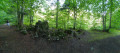
(3) Use the rocks to the left of the chimney to pass the blue arrow and climb up the right-hand side towards the chimney, which faces generally west. A fine set of spiral steps invites you to take a detour northwards beneath the rock pillars to view the faces.

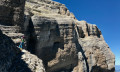
Return to the chimney, which narrows to form a smallgrade 3 climbing wall. The holds are solid and obvious.

Once past this section, climb up the less steep gully until the chimney opens out onto a rocky plateau.

Head north-right to visit a small spur overlooking the Combe du Petit Obiou, offering a close-up view of the cliffs of the two Obious.

(4) At the promontory, turn back and head south towards the plateau incorrectly named Roche Pertusa on the IGN map. Continue along the ridge line westwards until you reach the Col de l’Obiou (unnamed on the IGN map). At the pass, look out for the Latin cross formed by the entrance to the first narrow gap in the cliff.

Continue along the ridge of the pass via the standard route path towards the west and the base of the Grand Obiou cliff. The path goes round a large boulder on the ridge and then veers south-west. A cairn marked with a piece of wood indicates the start of a stony path that climbs north-west towards the foot of the cliff and the Latin cross spotted earlier (it is no longer visible at this point). Follow this path to the foot of the first chimney.

(5) Beneath the rock fissure, climb a few steps to the right to reach the entrance to the narrow passage. Climb up the gap to its end and ascend the smallgrade 3 climbing wall on the right, which has handholds like stair steps, to emerge onto a ledge. Continue along this ledge northwards until you reach a point approximately 40 m below a rock tower detached from the cliff.

Climb up to the right of this rock tower and go round behind it for 100 m towards the south to admire the view and the start of the Voie des Feuillets (a climb requiring suitable equipment). Turn back and head north-north-west at the foot of the cliff, continuing until you come within sight of a tower standing apart from the Obiou promontory.

Continue north past this tower to view the Rattier and the Casses Rouge and de l’Obiou, then head south again beneath the tower. A small cairn marks the spot where you climb onto the rocks to reach the foot of the second gap, characterised by a large boulder wedged in its centre.

In this gap, you must stow your poles in your rucksack and push it in front of you.

(6) Enter the chimney by passing under the first wedged boulder (grade 3 climbing). A second, slightly easier section is also under a boulder, then narrow fissures allow you to haul yourself up and exit the chimney heading south. Pass through a short couloir before reaching the Obiou summit plateau and the summit.

(7) From the summit, follow the standard route, well marked with cairns and red markings, which descends initially southwards, then makes a wide circular loop to the west before heading eastwards along the Vire de la Cravate, which passes beneath a few balcony-like rocks. Shortly after these rocks, and a climb up a ridge, descend a steep staircase to go round the ridge and cross a narrow gully before continuing the descent over stepped slabs (use the rocks on the right for support if you are unsure about scrambling). At the end of the slabs, a short rocky traverse takes you back to the path and the Col de l’Obiou.

From the pass, follow the cairned path marked in red which zigzags down the upper part of the steep Petit Obiou gully. A few steps make the descent easier. Several paths are cairned and marked; it doesn’t matter which one you take. To the right of the gully’s centre, a rocky ravine allows you to descend directly down the slope.

(8) Follow this ravine along the rocks on its left bank to reach a virtually level path. Take the right-hand branch (east) to cross over to the Petit Obiou cliff and reach the entrance to a cave.

(9) Explore the cave, the floor of which is covered in ice – you’ll need a head torch to see it; a mobile phone’s light isn’t strong enough. Then turn back to rejoin the same path, take the left-hand branch (west) and continue the descent northwards along the normal route. At a ridge, and before a few hairpin bends, a faintly marked path branches off to the right into the scree.

(10) Take this path, which is more clearly visible in the middle of the valley, to descend eastwards towards the foot of the Petit Obiou cliff, over loose scree. At the foot of the cliff, follow the track heading north-northeast to go round the Petit Obiou. Once out of the scree, the path joins the trail taken on the way up.

(1) Follow this path to the car park (S/E).

Waypoints

  1. S/E : km 0 - alt. 1,562 m - Combe de la Fontaine car park
  2. 1 : km 2.19 - alt. 1,949 m - Base of the Pré du Chourum sinkhole
  3. 2 : km 2.86 - alt. 2,246 m - Shoulder below the Petit Obiou
  4. 3 : km 3.26 - alt. 2,310 m - Base of the Cheminée du Petit Obiou
  5. 4 : km 3.65 - alt. 2,442 m - Promontory above the Combe du Petit Obiou
  6. 5 : km 4.26 - alt. 2,634 m - First cat flap
  7. 6 : km 4.7 - alt. 2,739 m - Base of the second cat flap
  8. 7 : km 4.81 - alt. 2,763 m - Summit - Grande Tête de l'Obiou
  9. 8 : km 6.07 - alt. 2,407 m - A gully running straight down the slope
  10. 9 : km 6.19 - alt. 2,404 m - Grotte Glacée
  11. 10 : km 6.75 - alt. 2,241 m - Top of the Combe du Petit Obiou path
  12. S/E : km 9.92 - alt. 1,562 m - Combe de la Fontaine car park

Notes

?️ Park at the Combe de la Fontaine car park, N 44.784348° / E 5.875375°. By clicking on this Waze link, you can enter these coordinates directly into your favourite navigation app. From the car park, a track suitable for vehicles but with restricted access leads to the starting point.

? There are no water sources along the route, so make sure to bring enough water (1.5 litres per person).

? The climbing sections are impassable for dogs.

?‍♀️ The difficulty of this hike (“extremely difficult”) is significantly greater than that of the standard Grand Obiou route. The section between (1) and (4) is entirely on very steep slopes where any fall would have serious consequences.

? This hike absolutely requires completely dry weather. Even the slightest shower makes it impracticable without safety equipment (rope, harness, slings, quickdraws).

? The hike is short and not suitable for camping unless you wish to watch the sunrise or sunset from the summit (several dry-stone shelters are present on the summit plateau).

? Standard hiking kit must be supplemented with a helmet (in the section from (2) to (4) due to chamois, and then from (5) to (7) in the narrow passages due to other hikers). Telescopic poles are essential (you need to be able to stow them in your rucksack in the narrow passages) and make the hike considerably more comfortable. An ice axe (nothing to do with snow) is, however, more useful than poles between (1) and (4).

⏰ An early start will allow you to enjoy beautiful light, but above all to avoid baking in the sun on the east-facing cliffs.

? The IBP statistics for the route give an index of 156HKG, a distance of 10.35km, a total elevation gain of 1366m, a walking time of 4:12:47 and an average speed of 2.67km/h.

? Navigation is straightforward, but half the route is off-trail.

? There is only one emergency number in France: 112. Other numbers (15, 17, or direct numbers…) have no priority on mobile networks, do not connect via other operators’ networks when there is no signal, and in the event of an overload of calls, ongoing communications are cut off to prioritise 112. So forget about them as soon as possible; they are dangerous and no longer serve any purpose (contrary to what some outdated training materials claim). If you cannot speak or hear, use 114 to communicate via text message. 112 works on any mobile phone (and landlines, of course), including on a locked phone and even if the SIM is blocked (however, since 2004, France has been in breach of European recommendations and blocks calls to 112 when there is no SIM in the phone. This blocking required special investment, as the GSM standard naturally allows calls without a SIM card. Taxpayers will appreciate this particularly clever use of public funds).

⚠️ Please note: if your call is cut off, it is up to you to call the emergency services again: they have no way of contacting or locating you. Remember to note down your GPS coordinates before calling, as the French government has not deigned to equip emergency centres with AML (Advanced Mobile Location) technology, despite this having been made mandatory by the EU since 2018.

? In the mountains, switch your phone to 2G: the range of this technology is 4 to 8 times greater than that of newer technologies, and power consumption is significantly lower. Remember to switch off your Wi-Fi, which drains the battery quickly and serves no purpose outside homes and offices. ? Be aware that your phone’s GPS geolocation works even in flight mode (GPS has nothing to do with mobile communications).

?Checklist
☑︎Essential in addition to standard hiking gear
☑︎helmet
☑︎head torch (if setting off early and to explore the ice cave)
☑︎water bottle > 1.5 L

optional
☐telescopic walking poles (must fit in your rucksack)
☐30m rope and harness (to reassure those who are less confident)
☐ice axe (for steep slopes)

☒not required
☒nut and bolt sets, quickdraws (unless you plan to climb via Les Feuillets)

⚠️ As a general rule, treat IGN topographic maps with a pinch of salt (in my experience, the institute never corrects reported errors, even after serious accidents caused by these errors – see my profile for further details and an example). The base maps of the IGN topographical map date back more than 25 years and have not been updated since (!). The free OpenStreetMap, updated by volunteers, is usually much more up to date; it is preferable to consult its OpenTopoMap version, which is easier to read.

Worth a visit

? The mountain pastures near the Col des Faïsses are mainly frequented by herds, and vultures are often seen circling the slopes of the Obiou. Chamois are mainly found around the Petit Obiou.

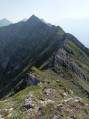
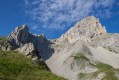
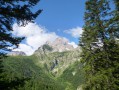
? The views are simply breathtaking throughout the hike:

? Several alternative routes are possible. If you are in a hurry, or if you do not wish to climb via the Petit Obiou chimney, it is possible to take only the Chatières route. In this case, follow the standard route up Grand Obiou to the Col de l’Obiou between (4) and (5) (point 7 of the standard route), then head to the first chatière at (5) to continue the rest of the hike.

A short extension involves exploring the top of Pré Chevalier before climbing the Petit Obiou chimney at (3). The stone spires dominating the slopes there are even more impressive than those preceding the chimney.

? Explanation of a few terms:

  • a ‘casse’ is a Dauphiné term for scree (e.g. Casse Rouge or Casse de l’Obiou).
  • A sinkhole (pronounced ‘shou-rein’) is a cave forming a tunnel through the mountain. The term is used exclusively in the Dévoluy. To my knowledge, there is no sinkhole in the Pré du Chourum.
  • A combe is the upper part of a valley, often dry, above a ravine; by extension, the word refers to any small valley.
  • The Tête de l'Obiou takes its name from the Savoyard word obiou, which means ox.

Reviews and comments

4.7 / 5
Based on 5 reviews

Reliability of the description
4.8 / 5
Ease of following the route
4.2 / 5
Route interest
5 / 5
bouvierjr
bouvierjr ★

Thanks for the feedback.

I can confirm that the difficulty of descending via the normal route in even slightly difficult conditions quickly becomes a real problem... see this album.
We didn't climb Obiou that day, but only climbed the Fuvelle staircase. The humidity and cold had covered the north walls with frost, and descending from the Obiou pass had become a real adventure.

Machine-translated

Koons38
Koons38

Overall rating : 4.7 / 5

Date of your route : Aug 30, 2025
Reliability of the description : ★★★★★ Very good
Ease of following the route : ★★★★☆ Good
Route interest : ★★★★★ Very good
Very busy route : Yes

An exceptional hike thanks to its figure-eight route, the landscapes, the cat flaps...
The description is accurate, and the photo album is a bonus, even if we didn't end up needing it that much.

The section around Petit Obiou (between points 1 and 3) is off-trail, but we had no difficulty, aided by the description, the blue arrow and the GPS track. Fortunately, the fog lifted at that point!

This hike deserves its "extremely difficult" rating: you need good footing (and hands in the chatières, of course), but it's not that technical in the end. On the other hand, the descent via the normal route seems really dangerous in wet weather, especially one section with slabs.

Thank you for sharing!

Machine-translated

fletcher_fr
fletcher_fr

Overall rating : 5 / 5

Date of your route : Sep 23, 2024
Reliability of the description : ★★★★★ Very good
Ease of following the route : ★★★★★ Very good
Route interest : ★★★★★ Very good
Very busy route : No

I completed this hike on Thursday 19 September 2024, avoiding the Petit Obiou on my first visit to the Dévoluy.
A magnificent and unusual landscape for me, being used to the Isère and Savoie regions.
The second gap is more physically demanding than the first, but I couldn’t resist the urge to go under the last boulder wedged at the exit.
Be careful on the very steep descent after the cravate and below the pass.
Thanks for this hike!

Machine-translated

Charlie 38
Charlie 38

Overall rating : 4.7 / 5

Date of your route : Jul 15, 2024
Reliability of the description : ★★★★★ Very good
Ease of following the route : ★★★★☆ Good
Route interest : ★★★★★ Very good
Very busy route : No

A wonderful hike, with stunning scenery.

Le Dévoluy really is a special and unique place.

The first section, leading up to the foot of the Petit Obiou, is already quite a climb.
It drains your energy right from the start, and yet this is only the beginning.

We had a bit of trouble finding the blue markings at the foot of the Petit Obiou chimney, but once we found the arrow, the path was fairly obvious. It remains, to say the least, physically demanding.
I can confirm that a helmet is essential throughout the entire route, and even more so at this point.
The rocks shift and come loose easily – ‘you must be very careful’.

Once you’ve passed the Col des Obiou, carry on to the tiny cross that sits in a small gap.
Carry on to the top to spot the small “cairn”.
Once you reach this point, you’re really into 3c climbing.
The two narrow passages are tight and large rucksacks won’t fit through.

Once out, you reach the summit easily, but you’ll be thoroughly exhausted.

I can confirm that this is indeed “a hike to be classified as extremely difficult.”
Do not attempt this without (a helmet, experience, and good physical fitness)

Thank you for this magnificent route.

Machine-translated

Stéphane R
Stéphane R

Overall rating : 4 / 5

Date of your route : Jul 27, 2023
Reliability of the description : ★★★★☆ Good
Ease of following the route : ★★★☆☆ Average
Route interest : ★★★★★ Very good
Very busy route : No

A truly exceptional route, thanks to its course, its scenery and its wild, untamed character.
A word about the section between IGN point 2262 and the start of the Petit Obiou chimney, where I rushed a bit and consequently got lost: there really is no path; there are multiple chimney starts, and depending on the height at which you traverse the face, the views are not the same as in the photos. I ended up taking an obvious chimney, in the shade in the morning, long and fairly steep (no vertical climbing and quite exposed for two-thirds of the ascent), only to find myself in a dead end on the Petit Obiou valley side...
After a partial and complicated descent, I eventually continued the traverse of the face and took the correct chimney halfway up, without knowing whether it was the right one or not. I went by the chamois droppings... This chimney is, in fact, much easier to climb than the first one.
So you really must take the time to read the route description carefully, and not climb too far up the face before you come across that famous blue arrow. And a helmet is essential – a chamois didn’t miss the chance to greet me by throwing stones at me.
What followed was pure joy: reaching the pass, the fun little passages, the view from the summit, the descent back to the pass via the normal route, the famous steps below it, the cave... A magnificent hike, thanks for the guide!

Machine-translated

BLT DJM
BLT DJM

Overall rating : 5 / 5

Date of your route : Oct 23, 2022
Reliability of the description : ★★★★★ Very good
Ease of following the route : ★★★★★ Very good
Route interest : ★★★★★ Very good
Very busy route : No

A hike that can genuinely be classified as "extremely difficult", with several sections that border on mountaineering, but which can be tackled without specialist equipment.
The description is very precise and makes the route easy to follow in a landscape typical of the Devolard area.
Despite the rain from the previous days and the strong wind during the outing, it went smoothly without any real danger as the holds are quite good. The approach to the second section of the chatières is daunting but, in the end, it goes well.
The return via the normal route makes it clear that the Obiou is no trivial outing, even via the ‘easiest’ route.
I confirm what the author says: this route is to be avoided if it’s raining… and in that case, even the standard route up the Obiou should be avoided.

Machine-translated

Other walks in the area

For more walks, use our search engine .

The GPS track and description are the property of this route's author. Please do not copy them without permission.