The Orgues de Valsenestre and return via the Combe Oursière

A hike in several stages:
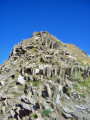
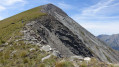
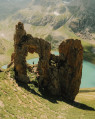
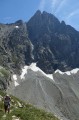
- The Orgues de Valsenestre (or the ‘great library’), a geological curiosity featuring a multitude of perfectly aligned vertical strata.
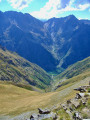
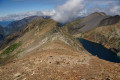
- The Col de Côte Belle, offering panoramic views over the Font Turbat valley.
- A return via the balcony path to the small hanging valley of Combe Oursière.
- Finally, you’ll cross a forest of ‘crooked’ larch trees (larch trees bent by the weight of the snow).
... Not forgetting the Hobbit house

Important: please read the practical information carefully.

Details

2549550
Creation:
Last update:
Last review:
  • Walking
    Activity: Walking
  • ↔
    Distance: 7.98 mi
  • ◔
    Average duration: 6h 50 
  • ▲
    Difficulty: Difficult

  • ⚐
    Back to start: Yes
  • ↗
    Ascent: + 3,632 ft
  • ↘
    Descent: - 3,609 ft

  • ▲
    Highest point: 7,510 ft
  • ▼
    Lowest point: 4,239 ft

Photos

Description of the walk

Park in the car park on the right-hand side before entering the hamlet of Valsenestre.

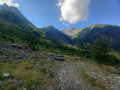
(S/E) Head east and follow the GR®54B (red and white markings) towards the Col de la Muzelle: this is a wide path running alongside the Béranger stream.

(1) At the junction, carry on straight ahead along the stream.

(2) Cross the Béranger torrent.

(3) At the Fork in the road, take the GR®54 on the right towards the Col de Côte Belle. The slope soon becomes steeper and the path winds its way uphill.

(4) Turn right at a hairpin bend and follow a long traverse heading south-west. Then continue up a series of hairpin bends.

(5) As you emerge from a hairpin bend to the right, take a short detour to the left to the Orgues de Valsenestre: a magical spot where you can enjoy various views.

(5) Continue south-west along the GR®54.

(6) At the junction, turn sharply left, still following the GR®, and you’ll soon reach the Col de Côte Belle.

(7) Head back down the same path to the previous junction (located at a hairpin bend).

(6) Leave the GR®54 here and continue straight ahead (west-south-west). Descend through a grassy, steep area where there are several tracks but no single, clearly marked path. At the bottom, look out for the balcony-like path coming from the Combe Oursière: head in that direction (it remains visible at all times). At the bottom of the grassy slope, you’ll reach the base of the Cirque du Pic de Valsenestre and cross some small streams (dry in summer).

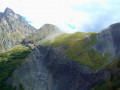
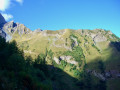
(8) Just before the streams enter a gorge, follow a balcony path heading north-west (do not take the path on the left which climbs towards the Pic de Valsenestre). Continue north-north-west and ignore the offshoots on the right. Go round the Côte Dure on the right, head south-east and cross a forest of ‘crooked’ larch trees.

(9) At the junction, carry on straight ahead towards the Cabane de la Combe Oursière.

(10) Retrace your steps.

(9) At the junction, turn left and start descending into the valley again. The path is clearly marked; ignore a fork to the left and follow several hairpin bends. After rounding a rocky outcrop, descend diagonally (east-north-east) into the Bois du Bot.

(1) Join the GR® again and follow it to the left, alongside the stream. This will take you back to the car park where you started (S/E).


Waypoints

  1. S/E : mi 0 - alt. 4,239 ft - Car park at the entrance to Valsenestre
  2. 1 : mi 0.74 - alt. 4,649 ft - Crossroads of the circular loop
  3. 2 : mi 0.97 - alt. 4,774 ft - Torrent du Béranger
  4. 3 : mi 1.14 - alt. 4,898 ft - Fork in the road
  5. 4 : mi 1.92 - alt. 5,866 ft - Hairpin bend
  6. 5 : mi 3.16 - alt. 7,119 ft - The Orgues de Valsenestre
  7. 6 : mi 3.42 - alt. 7,287 ft - Côte Belle
  8. 7 : mi 3.65 - alt. 7,510 ft - Col de Côte Belle
  9. 8 : mi 4.22 - alt. 6,670 ft - Balcony trail
  10. 9 : mi 5.08 - alt. 6,614 ft - Intersection
  11. 10 : mi 5.26 - alt. 6,706 ft - Cabane de la Combe Oursière
  12. S/E : mi 7.98 - alt. 4,239 ft - Car park at the entrance to Valsenestre

Notes

Please note that part of this walk is off-trail through a grassy and very steep area, near the ‘6
This section should be avoided in wet weather or during the snowmelt.

Extract from the Écrins National Park website:
The Valsenestre Organs
A true geological phenomenon, the ‘grandes orgues’ (Great Organs), also known as ‘la grande bibliothèque’ (the Great Library), were formed during the formation of the Alps. They consist of thin layers of blue-grey limestone and softer, more eroded schistose marl. A network of cracks running perpendicular to the layers cuts the slabs into remarkable columns.

‘Crooked’ larch trees
Beautiful crooked larch trees can be seen from the footpath. In winter, on steep slopes, the snowpack exerts pressure at the base of the trees’ trunks. The curved shape of the larch is evidence of its adaptation to the weight of the snow. On steep slopes, however, this morphological adaptation makes the tree somewhat fragile. Larch trees are ‘pioneer’ species in the mountains. They can colonise hostile environments such as scree slopes and alluvial fans. They pave the way for the future forest.

The ‘Combe des Ours’
The name ‘Combe Oursière’ is thought to refer to the presence of bears in the valley. In 1800, between 26 and 30 bears were still living in the Oisans and the surrounding area. The last known bears around Valsenestre are thought to have taken refuge in the last century near La Morte and Lavaldens, and the last of them is said to have been shot above Livet. In the Alps, the last reliable sighting of a bear is said to date from 1937 and to have taken place in the Vercors.

You are hiking in the heart of the Écrins National Park.

The Écrins massif is an exceptional area, open to all, with a natural, cultural and scenic heritage that is truly unique. To protect these treasures, the heart of the park is marked by blue-white-red flags, and certain regulations must be observed within this area. Please familiarise yourself with these regulations when planning your hike, to help preserve this shared heritage, at https://www.ecrins-parcnational.fr.

Worth a visit

Valsenestre is an ideal starting point for several hikes.

Our thanks to the staff at the Écrins National Park for maintaining the trails, including those less frequently used, such as the Combe Oursière trail

Extract from the Écrins National Park documentation:
“In the 19th century, the hamlet of Valsenestre was home to around a hundred inhabitants. The main industry was livestock farming. In 1851, the opening of a marble quarry at the bottom of the valley, on the way up to the Col de la Muzelle, proved a boon for the village, which welcomed the quarry workers and benefited from improvements to the road. Marble production ceased in 1905. Until 1926, the laughter and shouts of children could still be heard throughout the village: the school had around thirty pupils at that time!

Restored village
Valsenestre is a beautifully restored, flower-filled hamlet now consisting mainly of holiday homes. The road is not cleared of snow in winter. The village, with a population of around a hundred, once had its own school (now converted into a stopover lodge), which remained open until 1936. It was completely buried by an avalanche in the 19th century. Livestock farming remained the main industry, but the opening of a marble quarry in 1840 provided an additional source of income for the workers living in the village. The last permanent resident left Valsenestre in 1959.''

Always be cautious and plan ahead when you're outdoors. Visorando and the author of this route cannot be held responsible for any accidents occurring on this route.

The GR® and PR® markings are the intellectual property of the Fédération Française de Randonnée Pédestre.

Reviews and comments

4.7 / 5
Based on 16 reviews

Reliability of the description
4.7 / 5
Ease of following the route
4.6 / 5
Route interest
4.9 / 5
iffic21
iffic21

Overall rating : 5 / 5

Date of your route : Sep 02, 2026
Reliability of the description : ★★★★★ Very good
Ease of following the route : ★★★★★ Very good
Route interest : ★★★★★ Very good
Very busy route : No

We did this route four or five years ago. It’s always a brilliant walk: a gentle climb, just like the descent, along very well-marked paths. And the rock formations!!
For the off-trail section, we simply followed a lovely track that wasn’t there four or five years ago. It seems quite a few people have been there since!
That said, this section is only suitable for walkers who are used to off-trail walking.

Machine-translated

3617672
3617672
• Edited:

It’s a shame we couldn’t complete the circular route as it wasn’t signposted and was strongly advised against by the walkers there

Machine-translated

User 22523288

Overall rating : 4 / 5

Date of your route : Aug 09, 2025
Reliability of the description : ★★★★☆ Good
Ease of following the route : ★★★★☆ Good
Route interest : ★★★★☆ Good
Very busy route : No

A very pretty route, sometimes high up in the air, towards La Combe. The return via La Combe Oursiere is tricky in places. You really need to be sure-footed and try to avoid the schistose sections as much as possible.
The junction with the balcony path towards the Combe was not easy to find. We had to scramble through the green alders and tall grass, like wild boars.
Be careful before the Côte dure, as the balcony path has partially collapsed... Take care.

Machine-translated

Marie VV
Marie VV
• Edited:

Overall rating : 5 / 5

Date of your route : Aug 06, 2024
Reliability of the description : ★★★★★ Very good
Ease of following the route : ★★★★★ Very good
Route interest : ★★★★★ Very good
Very busy route : Yes

Route only accessible via the GR trail.
The off-trail section is challenging for some people, given the steep gradient.
The Côte Dure trail is damaged in places due to rockfalls, so you need to be very careful in these areas.
Otherwise, it is a very beautiful hike. The weather was perfect. The Valsenestre rock formations are magnificent and surprise hikers as they come around a bend.

Machine-translated

Fredo 38
Fredo 38

Overall rating : 4.7 / 5

Date of your route : Aug 12, 2024
Reliability of the description : ★★★★★ Very good
Ease of following the route : ★★★★☆ Good
Route interest : ★★★★★ Very good
Very busy route : Yes

Frequented on the Valsenestre side. Deserted on Combe Oursiere. Take care when crossing the schist scree to reach the Combe Oursiere balcony trail. Risk of slipping. It is better to descend into the grassy area to cross lower down. Tall grass on the descent.
Be careful not to miss the path below the Combe Oursiere hut when you reach the stream bed.
Do not enter the stream. The path is in the grass on the right. Cairn. No worries if you follow the GPS track.
Superb circular! Thank you

Machine-translated

Louis-Michel Duhen
Louis-Michel Duhen

Overall rating : 4.3 / 5

Date of your route : Aug 03, 2024
Reliability of the description : ★★★★★ Very good
Ease of following the route : ★★★☆☆ Average
Route interest : ★★★★★ Very good
Very busy route : No

A very beautiful hike done in the opposite direction with a bivouac in the cabin (note: no water within 45 minutes). The climb up the pass is not easy this year as there is abundant grass. Check the GPX track frequently. Many thanks for this magnificent circular with the discovery of the Valsenestre organ pipes.

Machine-translated

Francis38isere
Francis38isere

Overall rating : 4.7 / 5

Date of your route : Jul 29, 2024
Reliability of the description : ★★★★☆ Good
Ease of following the route : ★★★★★ Very good
Route interest : ★★★★★ Very good
Very busy route : Yes

Well described and precise; a lovely outing with a magnificent geological destination.
The flock of sheep was safely at the pass with its sheepdog and shepherd, but without any difficulty.
Perfect weather to enjoy the site.

Machine-translated

chabertberruyer
chabertberruyer

Overall rating : 5 / 5

Date of your route : Oct 28, 2023
Reliability of the description : ★★★★★ Very good
Ease of following the route : ★★★★★ Very good
Route interest : ★★★★★ Very good
Very busy route : No

Hiking in snow and ice on a slightly sloping trail towards the Valsenestre rock formations. Be very careful; slipping is prohibited.
White cap to do
Tricky off-trail descent with 5 cm of snow
Balcony trail through Combe Oursière with a still tricky 3/4 m passage following a rockslide and several fairly large torrents to cross following the melting of the first snows
Beautiful autumn colours

Machine-translated

Michel Rando Nature
Michel Rando Nature

Overall rating : 4.3 / 5

Date of your route : Oct 25, 2023
Reliability of the description : ★★★★☆ Good
Ease of following the route : ★★★★★ Very good
Route interest : ★★★★☆ Good
Very busy route : No

A particularly pleasant hike up to Les Orgues. I recommend this site for its uniqueness and geological richness. At the pass, there were a few sheepdogs and a lovely flock of sheep. I had no problems with the sheepdogs, who came over to greet me. On the way back, starting from the pass, I tried to take the marked route that joins the Combe de l'Oursière trail, but I gave up. It was too steep for me. I came back down the same way.

Machine-translated

Charlie 38
Charlie 38

Overall rating : 5 / 5

Date of your route : Sep 03, 2023
Reliability of the description : ★★★★★ Very good
Ease of following the route : ★★★★★ Very good
Route interest : ★★★★★ Very good
Very busy route : Yes

Very beautiful hike.
The organ pipes are truly amazing, well worth the detour.
Nothing special, the path is well marked.

No particular difficulties.

Worth doing again in autumn, the scenery around the Oursière hut must be lovely.

Machine-translated

sempervivum
sempervivum

Overall rating : 5 / 5

Date of your route : Sep 04, 2023
Reliability of the description : ★★★★★ Very good
Ease of following the route : ★★★★★ Very good
Route interest : ★★★★★ Very good
Very busy route : No

A hike with two very different atmospheres. It starts with a well-marked path leading to the impressive rock formations that attract a few hikers (photographers should come in the afternoon for the best light), then a detour to Bonnet Blanc for the view. I didn't have the pleasure of meeting the two sheepdogs named Spirit and Reflex during the alpine grazing season. Crossing off the trail, even in ideal conditions, requires caution. When the torrents are low, you can stray from the GPS track and descend completely down the grassy slope to avoid crossing the scree. And then a wild atmosphere, a beautiful maple forest, deserted except for a flock of ptarmigans. To be done again...

Machine-translated

smashdc
smashdc
• Edited:

Overall rating : 5 / 5

Date of your route : Aug 31, 2023
Reliability of the description : ★★★★★ Very good
Ease of following the route : ★★★★★ Very good
Route interest : ★★★★★ Very good
Very busy route : No

i encountered a maximum of 20 people, the vast majority of whom were backpacking.
In light of the other comments (and also with my planned 300 km walk), I do not recommend going off-trail (I hadn't seen that there was any off-trail walking).
35% slopes. Even zigzagging, it's not great.
No path, so the footing is always unstable (even if it is doable), but it will still be quite physically demanding. Allow for 400 m of zigzags. On top of that, it was very wet. Lots of shrubs. The descent via the same route is more beautiful in my opinion (I left early).
Otherwise, the climb is gradual: 13% at the start and then around 17%.
You can do "the tour of the organ pipes" at the crossed-out cross (hiking symbol). Be careful, though.

Machine-translated

JCParavy
JCParavy

Overall rating : 5 / 5

Date of your route : Sep 04, 2022
Reliability of the description : ★★★★★ Very good
Ease of following the route : ★★★★★ Very good
Route interest : ★★★★★ Very good
Very busy route : No

Climbed Côte Belle on Sunday, choosing the Valsenestre side and therefore following the guidebook fairly closely (for once).
It was a pleasant climb along a well-marked and well-maintained trail, with a visit to the organ pipes (Bibliothèque) along the way.
At the pass, instead of continuing on to Pic de Valsenestre, I visited the surrounding hills: you really must climb to the summit of Bonnet Banc, listed at 2388m on IGN maps, to admire the spiky ridge.
For the descent, the off-trail section is fine when it's dry, and for crossing the torrents of the Combe des Echarennes, a cairn on the left bank of the last one marks the starting point of the connection to the trail that leads to Côte Dure and Combe Oursière. After a short climb, the passage is a little exposed, but fortunately the trail is comfortable.
There is a lot of damage to the trail caused by wild boars in Combe Oursière.
This circular is highly recommended.
I'm adding a few photos.

Machine-translated

Tatiana 73
Tatiana 73

Overall rating : 4.3 / 5

Date of your route : May 17, 2022
Reliability of the description : ★★★★☆ Good
Ease of following the route : ★★★★☆ Good
Route interest : ★★★★★ Very good
Very busy route : No

We did not encounter anyone during this hike.
The way there is uphill but not particularly difficult.
The organ pipes are simply magnificent. Unsettling but breathtaking.
The difficulty lies in the descent straight down the slope. You need to be sure-footed, make sure it's not too muddy (due to rain and snowmelt) and check the height of the two streams you have to cross.
I highly recommend this beautiful hike. It is isolated from the world due to its enclosed valley.

Machine-translated

meego38
meego38

Overall rating : 5 / 5

Date of your route : Sep 06, 2020
Reliability of the description : ★★★★★ Very good
Ease of following the route : ★★★★★ Very good
Route interest : ★★★★★ Very good
Very busy route : No

The hike starts at 8:30 a.m. and arrives at the Col de Côte Belle at 11:00 a.m. The path is pleasant and the slope is steady. You can continue the climb up Bonnet Blanc (100m elevation gain in less than 20 minutes) for an exceptional panorama if, like us, you are lucky enough to have a clear view. The path is good and well marked, and the view is breathtaking.

This is the second time I've climbed the Orgues de Valsenestre, and it's always a wonder to see the beauty of this site. Highly recommended.

Machine-translated

Other walks in the area

For more walks, use our search engine .

The GPS track and description are the property of this route's author. Please do not copy them without permission.