Country:

 City:
City:


Start at the Col de Baerenstall, in front of the impressive German military cemetery.
(S/E) Opposite the cemetery exit, on the right, follow an unmarked path northwards which runs alongside the road and climbs gently towards the memorial. After 600 m, the building housing the museum comes into view; a steep climb of a few metres leads up to the square in front of the entrance.
Note, next to the museum, the fortifications and remains of trenches topped with Black Crosses or White Crosses. Cross the car park and then the D11 road.
(1) Between a monument and a white cross (French soldier), a path begins which climbs steeply up to Schratzmaennele, a key vantage point in the German defences. Take the small path leading to the quarries, where the remains of shelters are still visible. At the junction with the path marked with a Yellow Rectangle (GR®®532), turn right and descend for approximately 200 m.
(2) Do not miss the small, unmarked path on the right after the Petite Carrière. Further down, this path crosses the wide ‘courtine’ path which, for a long time, separated the positions of the warring sides. Cross it to rejoin the small path that emerges from the forest and leads to the monument to the French armies.
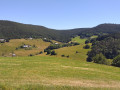
(3) Turn left onto the small tarmac road leading to the Ferme Auberge du Glasborn. Enjoy the panoramic view from the farm’s terrace, then take the ‘Yellow Rectangle’ path climbing to the right of the farm towards the Col de Wettstein. There is a beautiful, unobstructed view of the Vosges ridges, followed by a descent through the forest to the pass.
(4) Cross the D48 and continue uphill through the forest on the Yellow Rectangle path. Near the village of Hautes Huttes (on the right), ignore the Yellow Cross path on the left and follow the Yellow Disc markings towards Lac Forlet (also known as Lac des Truites or Lac Forlen).
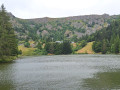
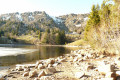
(5) After 200 m, pass the Yellow Triangle trail on your right – this will be the return route – and continue on the Yellow Disc trail. It passes the Altenkraeh farm, which is covered in snow in winter, then leads you easily to Lac Forlet, the highest lake in the Vosges (alt. 1,065 m), surrounded by its magnificent glacial cirque.
(6) Go round the lake to the left via the dam; at the end of the dam, turn right onto the Red Triangle trail. On the right, you can see the Ferme Auberge du Forlet at the foot of the ‘Rochers du cri du pigeon’ (Taubenklangfelsen).
(7) Before reaching the far end of the lake, a path marked with a Yellow Disc climbs to the left near a sign asking visitors to respect the flora. It leads towards Lac Vert. Take this path for a lovely walk through the forest to the Erichson chalet (Munster Club Vosgien), open to all during the season. From there, enjoy a lovely view over a wide meadow sloping down towards the Gaertlesrain farm-inn; behind the trees, you can just make out Lac Vert.
(8) After a break at the Erichson chalet, there are two options:
1) head back up to the ridge via a ‘Red Disc’ trail offering some lovely views of the lake;
2) choose the option shown on the map and in the description and retrace your steps for about 400 m to a lovely stone chalet (at a place called Tiefenbrunnen). Then turn left onto an unmarked path that climbs towards the Altenwasen. This path leads through woodland and along the cliff face to Lac Forlet, passing through the Altenwasen bog.
(9) It is magnificent but very damp, so before you reach another stone chalet at the entrance to the Altenwasen, do not miss the start of a path leading up into the forest on the left. It is marked with a Yellow Arrow on a rock bearing the inscription ‘crêtes’.
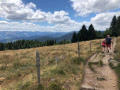
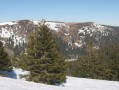
(10) After a short, steep climb, the path quickly reaches the scree slopes, offering views of the lake below the Altenkraehkopf, then of the Gazon du Faîte ridge – the highest point (1,300 m) of the hike – with panoramic views of the Vosges and Alsace sides. You are now on theGR®®5(Red Rectangle), which is dangerous in winter due to the snow cornice.
(11) Leave theGR®®5to the right at the Gazon du Faing to take an alternative route, signposted Red-White-Red Rectangle, then follow the Yellow Triangle path towards the Altenkraehkopf. Ignore the paths branching off to the left or right and continue to the viewpoint, at the far end on the right, which is well worth a brief stop.
(12) Retrace your steps a few metres to rejoin the Yellow Triangle trail, which winds off to the right, amongst the stunted trees typical of the Vosges ridges. The path leads towards the village of Hautes Huttes. As you emerge from the forest, you’ll reach the scree slopes of the Haufenwannkopf, where you’ll cross the Red Disc trail, which leads off to the left towards Lac Noir. The descent through the meadow soon brings you to the junction with the Yellow Disc trail you took on the way out.
(5). Turn left, then cross the Yellow Rectangle trail to head down to the right towards the village.
(13) In the centre of the village, you can see the small Sainte Barbe chapel. Destroyed and rebuilt several times since the 18th century, it is a listed building. Walk past it as you head down the tarmac road towards the village exit. About 150 metres after the exit, turn right to reach a left-hand bend 200 metres further on.
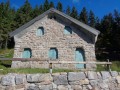
(14) On the right, at the bend, take a path that passes in front of a house and a farm. It descends to the lowest point of the route (alt. 860 m), which is often damp, enters the forest and, after 15 minutes, joins the D48, 200 m from the Col de Wettstein. Follow the road to reach the ‘Cimetière des Chasseurs’ (Hunters’ Cemetery), where more than 3,500 soldiers are buried.
(15) Take the wide path (Yellow Ring) which runs alongside it on the left and passes behind the large granite cross. Continue along this easy, scenic path lined with holly until you reach the Source Madelon, named after a girl’s name like the many springs where the soldiers used to replenish their supplies. Further on, at the three-way junction, take the right-hand branch for about a hundred metres.
(16) Leave the Yellow Ring and take a forest track that climbs to the right. It leads towards the D11. Cross the road to rejoin the Yellow Rectangle a few dozen metres from the road. Follow it to the left and you’ll reach the Ferme du Glasborn. Stay on the Yellow Rectangle to reach the Baerenstall car park.
It first passes through a bumpy meadow where, after more than a century, the traces of the bombardments remain clearly visible, then rejoins the curtain wall path.
(17) Remnants, some of which still litter the ground (bullets, grenades, shell fragments, etc.), are displayed on a stand. Enter the Schratzmaennele forest via the path on the right marked with the Yellow Rectangle and Blue Rectangle, which leads back to the starting point (S/E) after about 15 minutes.



 Visorando Member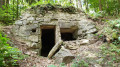
 Easy
Easy 

 Moderate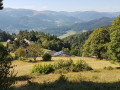
 Tourism professional