Hohrodberg - Linge, World War I battlefield

The Linge region was the scene of bloody clashes in 1914 and 1915. You will discover the remains and traces still very much present on the ground as you follow this route. Between 20 July and 16 October 1915, one of the bloodiest battles of the Great War in the Vosges took place on this section of the Linge-Barrenkopf front, barely 2 km long. It cost the lives of more than
17,000 young French and German soldiers.

Details

108857
Creation:
Last update:
Last review:
  • Walking
    Activity: Walking
  • ↔
    Distance: 14.09 km
  • ◔
    Average duration: 5h 25 
  • ▲
    Difficulty: Moderate

  • ⚐
    Back to start: Yes
  • ↗
    Ascent: + 496 m
  • ↘
    Descent: - 495 m

  • ▲
    Highest point: 1,045 m
  • ▼
    Lowest point: 742 m

Photos

Description of the walk

Park in the car park at the top of Hohrodberg, located along the Linge road, just after the Aqua-Viva hotel.

(S/E) Take the path (welcome sign) going up to the left towards the Glasborn farmhouse inn. The entrance to the path is a German blockhouse (sign no. 1).

The path crosses the western slope of the Kleinkopf and Barrenkopf halfway up, passing through the "No Man's Land", an area between the two front lines. After about 100 metres, you will see the German trench on your right under the edge of the woods (sign no. 2).

When you reach the Glasborn farmhouse and inn, take the access road for about 20 metres to join the path that branches off to the left towards the Col du Wettstein. From here, you will enter the French lines, where the trenches and ground movements caused by the war are still clearly visible. By taking the designated path, you will be able to visit the first French fortifications on the small ridge (elevation 941) overlooking the Glasborn farmhouse and inn.

(1) Leaving the small ridge, turn left and follow the path towards the base of the Hurlin (elevation 939). Turn left.

(2) You will arrive at a second rocky ridge, at elevation 941, parallel to the first, located 300 m behind you.
Leaving this second ridge, turn left and follow the path along the side of the Hurlin slope (sign no. 5). Go around a wooded hillock (elevation 938) to reach the Col du Wettstein and the National Necropolis.

(3) The circuit continues around the cemetery on the left.

(4) Find a forest path that branches off to the right of the road (follow "Centre de vacances le Vallon", Anneau Jaune). Pass the Madelon spring. At the Y-junction that follows, turn right and, after a few dozen metres, take the path that climbs steeply to the right at a right angle. At the top of the hill, leave the forest and return to the D11 road. Turn left towards the Glasborn farmhouse inn.

(5) You will pass the memorial to the Battle of Linge.
Take the road that leads to the Glasborn farmhouse inn. After a few dozen metres, at a Y-junction, take the path that climbs between two barbed wire fences towards Schratzmaennele, later called Schratz by French soldiers. You will reach the infamous glacis of La Courtine. Shortly after entering the Schratz pine forest, take the path on the right to reach the crossroads of the La Courtine paths.

:5:: Now retrace your steps for a few metres and turn right (north) onto the wide path that crosses the western slope of the Schratz halfway up (signpost no. 9).
After 200 metres of climbing straight ahead, you will arrive at the German trenches (signpost no. 10).
At this bend in the path, take the ridge trail on the left that descends towards the Linge Memorial Museum. Before arriving at the museum and crossing the D11, you will reach the monument to Commanders Colardelle and Barberot (sign no. 12).
Cross the road and the car park to reach the Memorial (you can visit the museum and the German trenches) and then the viewpoint.

(7) From the museum, to reach the German cemetery at Baerenstall, take the path that descends to the east of the museum. It joins a forest path below the D11 road. A little further on, on the heights to the right, you will see the shelter of the Bavarian command post from 1916-1917. The forest path leads to the pass and the German cemetery at Baerenstall.

(8) Turn left, cross the rest area and climb the steep path that leads to the top of Schratzmaennele (signpost no. 13). At the top, turn left and head towards the quarries, following the path that roughly follows the line of the first German line.

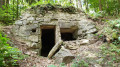
After about 30 metres, a sign (No. 15) indicates the location of the large quarry. Take the small access path that leads you inside the quarry. Then go back up the same path and turn left. A few dozen metres further on, you will arrive at the fort (sign no. 16). A few metres further on to the left, there is another structure (sign no. 17) which is more spacious and can be visited in complete safety.

(9) The latter overlooks the small quarry that you will discover via the path descending to the left. Leaving the small quarry, the path descends to the left towards the French lines, leading to the Courtine crossroads that you already know.

(6) Continue straight ahead (south) towards Barrenkopf. At the entrance to the Barrenkopf woods, you will see sign no. 19.
From the Barrenkopf sign, continue the circuit along the ridge trail towards Kleinkopf and its observatory. After about 30 metres, leave the Barrenkopf trail for a short while to enter the woods and discover a model trench (sign no. 20).

Return to the Barrenkopf trail. All along this ridge, there are numerous concrete remains, trenches and shell holes, which can be seen by stepping 5 or 10 metres off the trail. Shortly after passing the summit, you will come to the first French line at Barrenkopf in 1916. It is less than 20 m from the German trench.

(10) At Barrenkopf, leave the ridge path again on the left to discover the masonry façade of the arrival station of a small German cable car (sign no. 21). Then return to the ridge path. After a steep descent, the path climbs slightly to reach a rocky peak. An observation window is still clearly visible from the path. It is now at knee height, so hikers sometimes pass by without seeing it.

(11) After about 100 metres of rocky trail, you will arrive at a bare peak called Kleinkopf. Begin the descent to the left towards the television relay antenna. When you reach the Linge road, just below the antenna, you will find an orientation table (sign no. 23) located below the road.

(12) Next, take the path that descends to the left of the orientation table, which will lead you to a small pass called Wahlenstall. Take the forest path on the left, which will allow you to discover the relatively well-preserved remains of several shelters.

(13). From the shelters, retrace your steps.

(12) Leaving the crossroads, climb the small hill in front of you, following the edge of the woods, to find the remains of a German artillery observation post (sign no. 26).
You will now descend along the edge of the woods to reach the small pass (elevation 803).

(14). You will arrive at a crossroads of paths, where a wooden refuge hut has been built. Take the path climbing eastwards to reach another small pass called Schneiden on the southern slope.

(15) Here, a sign indicates the presence of an important structure.

Take the forest path on the left (west) to go around the Hoernleskopf on the left and return to the small pass

(14). Take thesecond road on the left and stay below the road to reach the car park (S/E).

Waypoints

  1. S/E : km 0 - alt. 821 m - Parking at the top of Hohrodberg. Blockhouse
  2. 1 : km 1.61 - alt. 921 m - French fortifications at Glasborn (sign no. 3)
  3. 2 : km 2.37 - alt. 939 m - Rocky ridge (sign no. 4)
  4. 3 : km 3.86 - alt. 882 m - Sign no. 6 - Col de Wettstein (882m)
  5. 4 : km 4.05 - alt. 876 m - Nécropole Nationale du Wettstein
  6. 5 : km 5.86 - alt. 947 m - 47 DI memorial (sign no. 7)
  7. 6 : km 6.31 - alt. 970 m - La Courtine (sign no. 8)
  8. 7 : km 7.5 - alt. 972 m - Linge Memorial Museum (sign no. 11) - Le Linge
  9. 8 : km 8.53 - alt. 975 m - Cimetière militaire allemand (Orbey et Hohrod)
  10. 9 : km 9.14 - alt. 1,020 m - Small quarry (sign no. 18)
  11. 10 : km 9.7 - alt. 978 m - Barrenkopf
  12. 11 : km 10.17 - alt. 938 m - Observation window (sign no. 22)
  13. 12 : km 10.67 - alt. 839 m - German field guns (sign no. 24)
  14. 13 : km 10.83 - alt. 852 m - German staff shelters (sign no. 25)
  15. 14 : km 11.33 - alt. 801 m - Small pass at elevation 803
  16. 15 : km 12.17 - alt. 742 m - German command post (sign no. 27)
  17. S/E : km 14.09 - alt. 821 m - Car park at the top of Hohrodberg

Notes

This circuit will allow you to discover the many traces that remain of the Battle of Linge and to better understand the course of this human tragedy.
There are several different routes. The suggested route covers all of them and takes you to all the sites. The main loop takes three hours, and with all the different routes, you should allow five hours, depending on how long you spend at each site and how interested you are in them. Stay on the marked trail, do not enter the tunnels, and do not pick up any ammunition.

Equipment: Walking shoes, torch if you want to go into the bunkers.
Along the route, information panels explain the history of the sites. You can download the commentary and the route at: https://www.cc-vallee-munster.fr/Culture...

Food: Glasborn farmhouse inn Picnic area: Wettstein Pass (shelter), Baerenstall Pass, small pass at 803 metres (shelter)

Worth a visit

Sign 1 The blockhouse in this corner is a remnant of the front line, fortified by the Germans from the summer of 1915. It was intended to house two or three men, responsible for defending this line with their rifles or a machine gun. The French trenches were located here more than 100 metres below, near the village of Soultzeren.

Panel 2: The German trench and its two reinforced concrete blockhouses. This trench linked the summit of the Barrenkopf to the fortified point of the Hohrodberg, near the current "Aqua Viva" hotel, and was an ideal upstream position. It is not uncommon to find rifle bullets or shell fragments on this rain-ravaged path, as this area saw terrible fighting during more than three years of war.

Panel 3: This ridge was heavily fortified with firing and observation positions and crossed by several underground tunnels carved into the rock, all of which have now been filled in by landslides. The panoramic view here is very clear and you can see both the great ridge of the Vosges mountains to your right (towards the west) and the Linge Barrenkopf massif to your left.

Panel 4: This rocky ridge, also occupied and fortified by the French from 1915 to 1918, still has many remains of masonry trenches, tunnels and underground chambers. One of these rooms is still accessible, taking care to observe the usual precautions.

Panel 5 : The Hoernleskopf, with its gentle, wooded slopes, was mainly used as an observation post and fallback position for French Alpine hunters. They called it Hurlin for short, a name that is still used today.

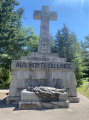
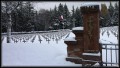
Panel 6 : The Wettstein Pass is a crossroads of many paths and roads, where numerous camps were set up, hidden by the thick pine forest. A French shelter has been reconstructed near the Wettstein car park by the Linge Memorial Association. At the Wettstein Pass is the Wettstein National Necropolis, the cemetery of the French Chasseurs. It contains the bodies of 3,538 French soldiers, including 1,337 in two ossuaries exhumed from the battlefield and surrounding military cemeteries. The site was developed between 1919 and 1926. It also features the monument to the fallen Blue Devils of 1914-1918.

Panel 7: the memorial to the Battle of Linge is dedicated to the three infantry divisions that took part in the operations, the 47th, 66th and 129th Infantry Divisions. It was inaugurated on 13 August 1939 by General d'Armau de Pouydraguin, former commander of the 47th Infantry Division, at this tragic site known as "La Courtine", where successive waves of Alpine hunters were mowed down by German machine guns.

Panel 8: La Courtine is located just in front of the German trenches. The terrain here bears witness to the intensity of the bombardments suffered by the men huddled in their holes. At this point, the French and German trenches are 15 to 20 metres apart. Several accounts from soldiers tell how the close proximity of the enemy made this position the least dangerous, as neither side could use their artillery in such close quarters. A touchscreen display allows you to see examples of the various projectiles and other deadly weapons used by both sides.

Panel 9: The Schratz slope was occupied by the French from July 1915. It had to be climbed under a hail of fire. This immediately gives an idea of the difficulty of these assaults, carried out against an enemy dominating the slope and sheltered in their trenches, equipped with machine guns and grenadiers. The forest, replanted in the 1930s, demonstrates the poor quality of the soil, riddled with scrap metal and other pollutants following heavy bombing. The pine trunks should normally be twice their current diameter at the base.

Panel 10 : As in the rest of this sector, the German trenches were located at the most advantageous geographical point. Dominating the attackers, the German reserve troops, positioned along the ridge line, were protected and out of range of French fire.

Panel 11 : At the Linge Memorial Museum, you can visit the museum (admission fee), the battlefield with its trenches cleared since 1968, and watch a 14-minute film that uses period images to retrace the history of the Battle of the Linge.

Panel 12 : The monument to Commanders Colardelle and Barberot pays tribute to the soldiers of the 5th, 45th and 107th BCP, many of whom fell during the Great War.

Panel 13 : The summit of Schratzmaennele was the first German line to be stabilised here from July 1915 until the armistice in 1918. Here, the trenches were carefully filled in after the war and the forest replanted to restore the mountain to its natural and peaceful appearance and function. However, the general disruption of the ground and the numerous cavities created by underground shelters that collapsed after decades of neglect are still visible. Note that the entire summit was converted into a veritable concrete fortress, criss-crossed by numerous underground tunnels leading to the outposts of the main trench.

Panel 14 : the German cemetery at Baerenstall. At the entrance, a small blockhouse dating from 1917 or 1918 is open to visitors and in perfect condition. The German cemetery was originally located on the other side of the road, on the south-eastern slope of the Schratz, near the mausoleum. It was not until the 1930s that a new cemetery was created to bring together all the German graves in the northern sector of Munster. Several period monuments of great beauty can be seen there. The mausoleum, built by the Bavarians in 1916 and restored in the 1980s, still stands in its original location. Several steles carved from the local pink sandstone can still be seen in the cemetery and next to the cemetery entrance.

Panel 15 : The large quarry was one of the Germans' most effective defensive positions, and the remains of German shelters can still be seen. Long before the war, the sandstone extracted from this quarry was used to build the Protestant church in Munster between 1867 and 1873.

Panel 16 : The fort, a concrete structure at the top of the hill, was the main obstacle to French attacks from 1915 to 1918. This structure illustrates the successive developments and reinforcements made by adding layers of concrete. Taking advantage of their dominant position, the Germans equipped it with a machine gun, making it virtually impregnable.

Panel 17 : This other, more spacious structure was intended to shelter troops or officers during bombardments.

Panel 18 : The small quarry was fiercely contested in 1915 and ultimately remained in German hands until the end of the war. It was stormed by the 15th BCP at dawn on 29 July 1915, after being fired at by a 75 mm gun hoisted by men onto the small ridge overlooking the Glasborn farmhouse and inn, less than 1 kilometre away. Numerous bullet holes and shell fragments dot the pink sandstone walls of this quarry, bearing witness to the extreme violence of the fighting.

Panel 19 : Le Grand Sapin, the German front-line trench, turns west here to join the western salient of the Barrenkopf, dominating the northern and western slopes, the only possible access route for the French attackers, who mainly arrived via the small hollow where the Glasborn farmhouse and inn were located.

Panel 20 : a model trench built by the Germans after 1915 to test concrete assault stairs (previously, soldiers had to climb out of the trench using small wooden ladders).

Panel 21 : a small German cable car used to transport cement and heavy equipment to the top. Two heavily reinforced concrete troop shelters can still be visited near the cable car's arrival point.

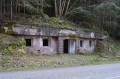
Panel 22 : An observation window. As the trenches were quite far apart (around 100 to 200 metres), this was more of a shelter area for storing equipment and ammunition. The granite summit was pierced through to allow observers to be positioned and ammunition reserves to be stored.

Panel 23 : An orientation table provides information on the names of the many peaks visible on the southern side of the Munster Valley.

Panel 24 : German field guns were installed at the Wahlenstall pass throughout the war to cover the entire Munster and Reichackerkopf area with their fire.

Panel 25: Several shelters for German regimental and battalion commanders.

Panel 26 : German artillery observation post. Upon reaching the summit, several blocks of rock can be seen, facing south and west. Just behind these rocks, sealed in the earth and granite blocks, is a strange metal sentry box in the shape of a snail, which can still be accessed by going around the rock on the left. Before 1914, this type of standard sentry box was used in the many defensive forts along the borders (several examples can be seen at Fort Mutzig). This one was probably dismantled in 1915, in a fort on the Rhine plain that had become obsolete, and reinstalled here to shelter the observers who were essential for adjusting artillery fire.

Panel 27 : an important structure, this was the German command post that housed the senior officers of the entire Linge-Barrenkopf sector. The building, which was of the highest quality, is still in very good condition 100 years later.
White cross, tribute to the crew of Lancaster : On 7 January 1945, the four-engine bomber LANCASTER NN 766(PM-R) took off from Elsham-Wolds airbase in England on a bombing mission over Munich in Germany. The aircraft collided with another Lancaster from 460 Squadron over the Vosges mountains. The latter, although damaged, managed to return to base. The NN 766 crashed near the village of Hohrodberg with its load of explosive and incendiary bombs, setting fire to and destroying several houses and barns in the village.
Of the seven crew members, whose average age was 23, six were Canadian and one was British.

Reviews and comments

4.5 / 5
Based on 51 reviews

Reliability of the description
4.4 / 5
Ease of following the route
4.1 / 5
Route interest
4.8 / 5
francisrcsn
francisrcsn

Overall rating : 4.7 / 5

Date of your route : Mar 09, 2026
Reliability of the description : ★★★★★ Very good
Ease of following the route : ★★★★☆ Good
Route interest : ★★★★★ Very good
Very busy route : No

A big THANK YOU to the contributor of this hike...
There are so many beautiful things to see along the entire route that the completion time could be increased by several hours!
The route in the LINGE Memorial area is entirely feasible, despite the initial impression that you cannot enter the site and walk around it from the inside.

Machine-translated

mimocyr
mimocyr

Overall rating : 4.7 / 5

Date of your route : Jul 14, 2025
Reliability of the description : ★★★★★ Very good
Ease of following the route : ★★★★☆ Good
Route interest : ★★★★★ Very good
Very busy route : Yes

beautiful itinerary and very useful VISORANDO description.

Machine-translated

ghnassia
ghnassia

Yes, absolutely! It was fascinating to discover the trenches, walk inside the labyrinthine passages, and measure their height... because the site is open to the public

Machine-translated

jmfsr
jmfsr

Thank you,
it's important to visit the Places of Remembrance.

Machine-translated

ghnassia
ghnassia

Overall rating : 4.7 / 5

Date of your route : May 19, 2025
Reliability of the description : ★★★★★ Very good
Ease of following the route : ★★★★☆ Good
Route interest : ★★★★★ Very good
Very busy route : Yes

An interesting tour with no difficulties. It's fascinating to walk around the site of this battle, which claimed 17,000 lives in 1915, and to realise how difficult it must have been for the soldiers in these wooded, hilly areas. One comment, however: make sure you take something to read so you can understand the historical points. Don't miss a visit to the Linge Museum!

Machine-translated

Jewa
Jewa

Overall rating : 3.3 / 5

Date of your route : Mar 02, 2025
Reliability of the description : ★★★★☆ Good
Ease of following the route : ★★★☆☆ Average
Route interest : ★★★☆☆ Average
Very busy route : No

Moderate difficulty walk, not too much elevation gain but some sections are steep and rocky (good footwear recommended)
The appeal of this hike lies in the fact that it takes you through World War I battle sites with marked points of interest (cemeteries, observation posts, trenches, bunkers, etc.).
We had some difficulty finding our way at certain points (markings/signs) and there were discrepancies with the route recorded on our watches.

Machine-translated

HANTZH2
HANTZH2

Overall rating : 5 / 5

Date of your route : Nov 10, 2024
Reliability of the description : ★★★★★ Very good
Ease of following the route : ★★★★★ Very good
Route interest : ★★★★★ Very good
Very busy route : Yes

A beautiful hike through the battlefields of 1914-1918 to pay tribute to our ancestors, including a visit to the Linge Memorial Museum. Magnificent scenery with sunshine and a stunning sea of clouds

Machine-translated

Nathalie et Francis
Nathalie et Francis

Overall rating : 4.3 / 5

Date of your route : Jul 14, 2024
Reliability of the description : ★★★★★ Very good
Ease of following the route : ★★★☆☆ Average
Route interest : ★★★★★ Very good
Very busy route : No

A very beautiful hike with some challenging sections, for which walking boots are highly recommended.
The route does not always follow the path, but it is easy to find your way.
A very interesting hike with beautiful views and historical discoveries from the First World War.
Not to be missed

Machine-translated

remi2000
remi2000

Overall rating : 4.3 / 5

Date of your route : Jun 18, 2024
Reliability of the description : ★★★★☆ Good
Ease of following the route : ★★★★☆ Good
Route interest : ★★★★★ Very good
Very busy route : No

very beautiful hike with some difficulty at certain points; GPS poorly marked

Machine-translated

Slayerz974
Slayerz974
• Edited:

Overall rating : 5 / 5

Date of your route : May 01, 2024
Reliability of the description : ★★★★★ Very good
Ease of following the route : ★★★★★ Very good
Route interest : ★★★★★ Very good
Very busy route : No

Superb hike with magnificent landscapes and views. This walk allowed us to discover the remains of theFirst World War. A fairly easy hike

Machine-translated

Joh
Joh

Overall rating : 4.7 / 5

Date of your route : Nov 05, 2023
Reliability of the description : ★★★★★ Very good
Ease of following the route : ★★★★☆ Good
Route interest : ★★★★★ Very good
Very busy route : Yes

A really good hike for nature lovers and history buffs. No difficulty. The trail is well marked, but you can still find your way by looking at the map and the terrain. Lots of ruins and an incredible view at one point: you can even see the Alps if the weather is clear. There is a picnic table at the Linge Memorial. In short, a must-do hike! The only downside for us was that we couldn't visit the memorial (not even the outside) because our dog wasn't allowed in (unlike at Hartmannswillerkopf, which we visited with him last year without any problems).

Machine-translated

billbock
billbock

Overall rating : 5 / 5

Date of your route : Sep 04, 2023
Reliability of the description : ★★★★★ Very good
Ease of following the route : ★★★★★ Very good
Route interest : ★★★★★ Very good
Very busy route : No

in a word: brilliant, historic, challenging but not too much, it was brilliant

Machine-translated

Sandrine68@
Sandrine68@

Overall rating : 3.7 / 5

Date of your route : Jul 29, 2023
Reliability of the description : ★★★★☆ Good
Ease of following the route : ★★★☆☆ Average
Route interest : ★★★★☆ Good
Very busy route : No

GPS often off, but we find our way back.

Machine-translated

moseral1
moseral1

Overall rating : 4.3 / 5

Date of your route : Jun 26, 2023
Reliability of the description : ★★★★★ Very good
Ease of following the route : ★★★☆☆ Average
Route interest : ★★★★★ Very good
Very busy route : No

A beautiful and accessible hike.
The various sites and places we visited, which retraced the battles of the First World War, reminded us that many people fought and even sacrificed their lives for our freedom.
A freedom that we appreciate today thanks to this beautiful and impressive hike. 👍

Machine-translated

WILY68
WILY68
• Edited:

Overall rating : 5 / 5

Date of your route : Oct 09, 2022
Reliability of the description : ★★★★★ Very good
Ease of following the route : ★★★★★ Very good
Route interest : ★★★★★ Very good
Very busy route : Yes

A very beautiful hike, very enriching from a historical point of view and very varied in terms of landscapes. I recommend it for an immersion in the era of the "Great War". A beautiful route without too many difficulties.

Machine-translated

Other walks in the area

For more walks, use our search engine .

The GPS track and description are the property of this route's author. Please do not copy them without permission.