


Refine your search for walks in Léaz
Léaz walks


 Grand Crêt d'Eau via the Crête du Fort l'Écluse
 Visorando Member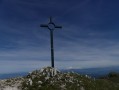
 8.75 mi
 +3,717 ft
 -3,730 ft
 5 hrs
5 hrs
 Very difficult
 Departure from Léaz (Ain)
The aim of the route is to reach the Crêt de la Goutte via the Crête du Fort l'Écluse.
The main difficulty will be encountered during the ascent; the slope is quite steep up to the red and white high-voltage pylon, and at times you will need to use your hands (avoid this when descending and on wet ground).
From Chalet Bizot, the route is straightforward.
On the banks of the Rhône from Fort l'Écluse
 Tourist office
 7.53 mi
+1,854 ft
-1,841 ft
5h 05
7.53 mi
+1,854 ft
-1,841 ft
5h 05
 Moderate
Departure from Léaz (Ain)
Moderate
Departure from Léaz (Ain)
Open from mid-June to mid-October, during the Fort's opening hours.
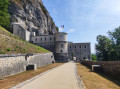
A trail combining history and nature, starting within the fort itself. The final ascent rewards walkers with an exceptional panorama before descending back to the fort.
Starting from Fort l'Écluse when it is open (from June to September), the path enters the forest before reaching the banks of the Rhône. It winds its way between stone steps, medieval ruins and wooded passages to the heights of Léaz, where you can enjoy a breathtaking view of the Rhône valley. The route then continues to the heights of the Upper Fort, offering a panoramic view of the Rhône gorge, the Vuache and the Étournel. The descent to the Lower Fort concludes this circular route rich in history and emotion.
Fort l'écluse loop via the Belvédère de Léaz
 6.46 mi
+1,939 ft
-1,939 ft
4h 40
Moderate
Departure from Léaz (Ain)
6.46 mi
+1,939 ft
-1,939 ft
4h 40
Moderate
Departure from Léaz (Ain)
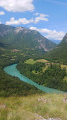
Fort l'Ecluse, a fortified military structure dating from the 16th and 17th centuries.
Léaz viewpoint.
Panoramic view of the Rhône valley.
The Vuache in its entirety from Chevrier
 14.24 mi
+3,550 ft
-3,550 ft
9h 40
14.24 mi
+3,550 ft
-3,550 ft
9h 40
 Difficult
Departure from Chevrier (Haute-Savoie)
Difficult
Departure from Chevrier (Haute-Savoie)
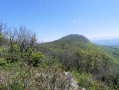
Starting from Chevrier, I suggest you walk the entire length of the Vuache, through a largely wooded landscape, dotted with some lovely viewpoints. The return route follows the foot of the mountain on the eastern side, offering beautiful panoramic views. The main challenge is the distance to be covered.
The water ridges
 8.42 mi
+3,196 ft
-3,163 ft
6h 40
Difficult
Departure from Bellegarde-sur-Valserine (Ain)
8.42 mi
+3,196 ft
-3,163 ft
6h 40
Difficult
Departure from Bellegarde-sur-Valserine (Ain)
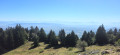
Plateau of the Jura mountain range, overlooking the valleys of Bellegarde sur Valserine and Fort l'écluse. The highest point of the Crêt de la Goutte offers a 360° panorama of the Jura Natural Park and Lake Geneva on the Geneva side, with a horizon dominated by the Alps, including Mont Blanc.
The Tour du Vuache
 Local authority
 16.00 mi
+2,651 ft
-2,648 ft
8 hrs
Very difficult
Departure from Vulbens (Haute-Savoie)
16.00 mi
+2,651 ft
-2,648 ft
8 hrs
Very difficult
Departure from Vulbens (Haute-Savoie)
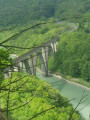
A long journey through the Jura mountain range. Between the Défilé de l’Écluse and the medieval village of Chaumont, Mont Vuache offers a striking contrast, from its eastern forest to its western cliffs!
The Nant en Rhône stream trail
 7.86 mi
+1,519 ft
-1,496 ft
4h 55
Moderate
Departure from Clarafond-Arcine (Haute-Savoie)
7.86 mi
+1,519 ft
-1,496 ft
4h 55
Moderate
Departure from Clarafond-Arcine (Haute-Savoie)
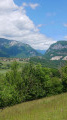
Featuring 16 information panels, this route introduces you to the region’s flora, fauna, geology and history.
At the source of the Parnant
 5.07 mi
+538 ft
-535 ft
2h 50
5.07 mi
+538 ft
-535 ft
2h 50
 Easy
Departure from Clarafond-Arcine (Haute-Savoie)
Easy
Departure from Clarafond-Arcine (Haute-Savoie)
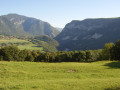
A lovely circular route, skirting the headwaters of the Parnant (a small tributary of the Rhône) and offering varied routes through farmland, woodland or across an ancient glacial moraine where the views are stunning.
Moderator’s note -problem in (2), see reviews 02/08/2022
Les Pertes de la Valserine and much more
11.77 mi
+1,752 ft
-1,755 ft
6h 55
Moderate
Departure from Bellegarde-sur-Valserine (Ain)
This is a long hike that allows you to visit and admire not only the Pertes de la Valserine area, but also to walk along the banks of this river, which has profoundly shaped the landscape over the centuries and enabled industrial activity in the 19th century.
Valserhône - La Ferme du Retord
8.42 mi
+2,999 ft
-36 ft
6h 30
Very difficult
Departure from Bellegarde-sur-Valserine (Ain)
Open from 1 April to 30 November – subject to there being no snow.
First stage of the GRP® de la Valserine.
Starting from Bellegarde station, the route runs past Mussel Castle and the hamlet of Ochiaz before climbing up to the Retord plateau. After a 1½-hour climb through the forest, a splendid panorama of the Jura and the Alps awaits you. The stage ends at La Charnay, with the option of staying overnight at the Ferme de Retord or continuing on to the Refuge de la Conay.
GR® de Pays - Grand Tour de la Valserine
 60.94 mi
+13,058 ft
-13,081 ft
5 days
Very difficult
Departure from Bellegarde-sur-Valserine (Ain)
60.94 mi
+13,058 ft
-13,081 ft
5 days
Very difficult
Departure from Bellegarde-sur-Valserine (Ain)
Open from 1 April to 30 November – subject to there being no snow.
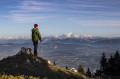
The GR® de Pays Grand Tour de la Valserine covers a vast area in the Ain department. This circular route winds through the Haut-Jura Regional Nature Park, passing through the contrasting landscapes of the Retord plateau, the Valserine valley, the Pays de Gex and the Haute Chaîne du Jura.
Part of the route passes through the Haute Chaîne du Jura National Nature Reserve, which is subject to specific regulations:Dogs are prohibited, even when kept on a lead, as is camping in tents.Please respect these rules to preserve the richness of this exceptional environment.
Lancrans - La Charnay
10.44 mi
+3,133 ft
-610 ft
7h 30
Difficult
Departure from Lancrans (Ain)
Open from 1 April to 30 November ( subject to there being no snow).
Fourth stage of the Grande Traversée du Jura walking route: from La Borne au Lion to Culoz, in 6 days.
The GTJ links Mandeure (Doubs) to Culoz (Ain) in 15 to 20 days, crossing the Jura Mountains and the Haut-Jura Regional Nature Park. The route suggested here covers the second half of the itinerary.
Lancrans - La Charnay
 10.50 mi
+3,182 ft
-640 ft
7h 35
Very difficult
Departure from Lancrans (Ain)
10.50 mi
+3,182 ft
-640 ft
7h 35
Very difficult
Departure from Lancrans (Ain)
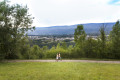
The stage from Lancrans to La Charnay is the fourth stage of the six-day walking tour “La GTJ fromMijoux”.
The GR®9 enters the Ain department via Mijoux, before following the spectacular ridges of the Monts-Jura, passing through the Crêt de la Neige, the highest point of the massif. It then descends towards Bellegarde-sur-Valserine, crosses the Retord plateau and climbs the Grand Colombier. The trail continues its route to Culoz and the Rhône Valley, before leaving the Ain to reach Savoie and continuing southwards.
Circular at Grand Crêt d'Eau
 4.62 mi
+1,345 ft
-1,375 ft
3h 20
Moderate
Departure from Lancrans (Ain)
4.62 mi
+1,345 ft
-1,375 ft
3h 20
Moderate
Departure from Lancrans (Ain)
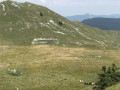
A circular with limited elevation gain, winding through mountain pastures, allowing you to visit three of the ridges that form the Grand Crêt d'Eau (including the highest point) and enjoy breathtaking views of the Genevois and the Alps.
The Gorges and Pertes de la Valserine
 3.89 mi
+846 ft
-869 ft
2h 30
Moderate
Departure from Lancrans (Ain)
3.89 mi
+846 ft
-869 ft
2h 30
Moderate
Departure from Lancrans (Ain)
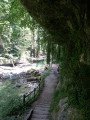
A pleasant walk along the Valserine Gorges, from Les Pertes to Bellegarde. Very popular in hot weather as much of the route is in the woods and always close to the river.
Please note that a municipal by-law dated 11 April 2024 prohibits continuing the hike beyond point 5 along the banks of the Valsorine (footbridges closed)