The tour of the Marmites du Diable from Durbonas

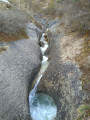
A short but technical hike, offering a chance to discover the Durbonas Torrent (which rises in the mountain of the same name) and the magnificent Monastery of the Dormition of the Mother of God. The climb is steep but offers fine views of the “marmites”, beautiful basins carved into the limestone by the Durbonas Torrent.
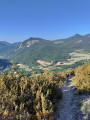
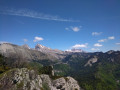
The return journey is more leisurely, along a lovely, open track offering views of the peaks of Buëch and Dévoluy.

Details

89622174
Creation:
Last update:
Last review:
  • Walking
    Activity: Walking
  • ↔
    Distance: 5.77 km
  • ◔
    Average duration: 2h 35 
  • ▲
    Difficulty: Moderate

  • ⚐
    Back to start: Yes
  • ↗
    Ascent: + 318 m
  • ↘
    Descent: - 320 m

  • ▲
    Highest point: 1,163 m
  • ▼
    Lowest point: 835 m

Description of the walk

On the D1075 road, between Aspres-sur-Buëch and La Faurie (coming from the south), pass the hamlet of La Valette. Before entering the village of La Faurie, take the Chemin du Rif on the right, at the “Les Marmites du Diable (P)” tourist sign and the yellow hiking signs.
Follow this track for 1.2 km alongside the Durbonas stream. Park in the Marmites car park (at a hairpin bend).

(S/E) Follow the stony path marked “Marmites du Diable” (yellow markings), heading north. It winds into the gorge alongside the Durbonas torrent, sometimes on the right bank, sometimes on the left, as you have to cross it several times (small wooden bridges).
The slope steepens rapidly and soon becomes technical, but the path is well equipped: handrails, ramps, stairs and metal steps. Below, the torrent flows from pools into waterfalls amidst a rocky landscape.
Gradually, the slope levels out and the path enters the forest.

(1) Leave the stream and climb gently. At the top of the gorge, the path turns left and joins a forest track.

(2) Take the track on the left to head back down towards Notre-Dame and La Faurie, heading south-west.

(3) Continue along the track, heading west, ignoring the path that climbs north-east. Pass a hairpin bend. The track then emerges from the trees and crosses fields to reach the hamlet of Notre-Dame. Pass the ruins and the chapel to reach the Fontaine de Notre-Dame junction (between the Route du Villard and the Route de Notre-Dame) and the GRP® du Tour du Buëch (yellow and red markings). There is a small fountain on the right, which is often dry.

(4) Continue straight on, skirting the Orthodox monastery of the Dormition of the Mother of God, and leave the hamlet. Just after the monastery, leave the small tarmac road and take a grassy path on the left.

(5) Follow the path south then south-east, ignoring the turnings to the right and left, to descend to the D1075 road after two final hairpin bends.

(6) Turn left and walk carefully along the main road for about 150 m to rejoin the track you took on the way out.

(7) Follow the track back up to the left for 1.2 km until you reach the car park where you started (S/E).

Waypoints

  1. S/E : km 0 - alt. 892 m - Marmites car park (signpost)
  2. 1 : km 0.67 - alt. 1,010 m - Entry into the forest
  3. 2 : km 1.55 - alt. 1,163 m - Forest track junction (signpost)
  4. 3 : km 2.39 - alt. 1,081 m - Trail junction
  5. 4 : km 3.37 - alt. 1,001 m - Fontaine de Notre-Dame (signpost)
  6. 5 : km 3.75 - alt. 976 m - Crossroads in the fields
  7. 6 : km 4.62 - alt. 838 m - Junction with the RD 1075 (signpost)
  8. 7 : km 4.75 - alt. 835 m - Chemin du Rif junction
  9. S/E : km 5.77 - alt. 893 m - Marmites car park (signpost)

Notes

This hike is not recommended in wet or snowy weather: the terrain is quite technical, with slippery slabs, steep slopes and steps that are sometimes high. The Marmites du Diable trail features several fords, which can be tricky to cross without getting your feet wet if the water level is high or if you’re not comfortable with this type of crossing.

Although this route is no walk in the park and should only be undertaken by those familiar with walking in low mountain terrain (hiking boots strongly recommended), it is fairly well-maintained. The technical section is relatively short (less than a kilometre). Although the climb is sometimes steep (with steps), it is generally recommended to tackle this trail on the way up rather than on the way down. Finally, the route is never vertiginous despite the often rocky terrain: the path is sound and presents no particular danger.

The section running alongside the Torrent du Durbonas is particularly pleasant when the water flow is high!

Accommodation is available in La Faurie or at the “Les Sabots de Vénus” inn in Agnielles (rooms and restaurant), open in summer.

If you manage to park before the Marmites du Diable car park, without obstructing traffic or agricultural activities, this will allow you to walk along this sun-exposed track earlier in the hike (especially in summer).

Worth a visit

Les Marmites du Diable: the Torrent de Durbonas, which rises on the mountain of the same name, winds its way through the “Marmites du Diable”, a series of beautiful limestone basins carved out by erosion. It is also an accessible canyoning site, where parents can accompany their children from the age of 6.
The Durbonas then joins the Buëch at the heath campsite.

Monastery of the Dormition of the Mother of God: from the 12th century onwards, the monks of Durbon Abbey owned land on an isolated plateau, situated at an altitude of 1,000 metres, between the village of La Faurie and the hamlet of Le Villard.
A hamlet developed there, becoming the parish of ‘Sancta Maria di Biochana’, then ‘Notre-Dame du Villard en Beauchani’, which was attached to that of La Faurie in the 17th century. However, the hamlet declined towards the end of the 19th century and, together with Le Villard, had only around a hundred inhabitants by the start of the 20th century.
In 1970, a young Orthodox man aged 33, a philosophy teacher and the future Father Victor, settled in this place, which was then nothing but ruins, to create a place for gathering, deepening one’s faith and celebration. In 1971, Father Cyril celebrated the first liturgy in what would become the current chapter house. Then came the construction of the large chapel, built from an old ruined sheepfold, which Father Pierre dedicated to the Dormition of the Mother of God in 1972. Added to this are a small oratory dedicated to Saint Nicholas, a chapter house, an iconography workshop, the refectory and its kitchen, around ten cells for the monks (there are currently nine living at the monastery on a permanent basis), a large hall for receiving guests, and the sanitary facilities. Another building houses a further ten cells, toilets, a sewing room and a tea room. The latter is connected by a porch to the carpentry and metalwork workshops. A henhouse and a farm outbuilding complete the complex.
What strikes one upon discovering the site is the architectural harmony that blends perfectly with the surroundings. The exposed stone façades undoubtedly play a part in this. One must walk about a hundred metres to reach the Church of the Holy Wisdom, adjoining the cemetery and built of brick lined with stone. The place of worship reflects the influence of Byzantine art and the distinctive architecture of the Orthodox Church, comprising three sections: the sanctuary enclosed by the holy doors, on which is painted the scene of the Annunciation representing the rite of passage; the nave; and the narthex. The interior paintings were all executed by the monks on a lime base, and the colours are derived from mercury and arsenic sulphides, which offer a wider range of shades than chemical pigments, copper sulphate and semi-precious stones such as lapis lazuli. Egg yolk, vinegar and linseed oil are added to the mixtures.

Other walks in the area

For more walks, use our search engine .

The GPS track and description are the property of this route's author. Please do not copy them without permission.