The Piarards loop via Baumugne, starting from Saint-Julien-en-Beauchêne

A circular route starting from Saint-Julien-en-Beauchêne, mainly on the GRP® Tour du Buëch Variant, around the small summit of Piarards which overlooks the Grand Buëch valley. After a gradual climb through the Durbon forest, the return route passes through the Col de la Bécha to descend to the hamlet of Baumugne, made famous by Jean Giono's novel "Un de Baumugnes".

Details

91570878
Creation:
Last update:
Last review:
  • Walking
    Activity: Walking
  • ↔
    Distance: 5.23 mi
  • ◔
    Average duration: 3h 30 
  • ▲
    Difficulty: Moderate

  • ⚐
    Back to start: Yes
  • ↗
    Ascent: + 1,234 ft
  • ↘
    Descent: - 1,234 ft

  • ▲
    Highest point: 4,239 ft
  • ▼
    Lowest point: 2,979 ft

Photos

Description of the walk

Go to Saint-Julien-en-Beauchêne on the D1075 road (between Lus-la-Croix-Haute and Aspres-sur-Buëch) and park in the large car park in the village, at the side of the road (opposite the Hôtel des Alpins).

(S/E) Cross the road carefully at the pedestrian crossing, then walk back up into the village to reach Rue du Dauphiné.

(1) Turn right, following the signs for "Durbon" to reach the road leading to the former Durbon Charterhouse. Turn left, pass the Ecomuseum, leave the village and walk past the multi-purpose hall. Continue to the large triangular crossroads.

(2) Leave the Durbon road. Turn right and cross a wooden bridge, then take Chemin des Eycharennes heading east. Walk alongside a poultry farm until you reach a three-way junction with a no entry sign.

(3) Continue straight ahead along the farm track that runs alongside a meadow, heading east, leaving the track that turns left. Follow it for about 250 m until you reach another fork.

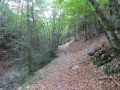
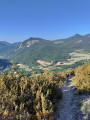
(4) Continue along the track that climbs opposite, heading east, then quickly leave it to follow the GRP® (Yellow and Red) marked trail that turns right towards the south, then south-east into the Commandieu ravine. The path climbs and becomes more limestone, before becoming more wooded as it runs along the bottom of the ravine. Cross to the left bank of the dry stream, then cross back to the right bank, following the forest path. After a bend, join a wide forest track with a directional sign.

(5) Turn right towards La Faurie, heading south, following the markings. The track climbs very slightly until it reaches the Col de la Bécha, which is a wide crossroads of tracks lined with forests.

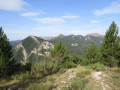
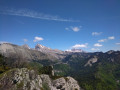
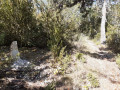
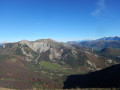
(6) Continue straight ahead on the forest track towards Piarards, heading south-west. Climb gently to reach the summit dome of Piarards, marked by a small IGN marker and a pile of stones around it. The view is unobstructed on all sides: you can see the peak and Roc de Garnesier to the north. A little further on, you can look out over the Grand Buëch valley.

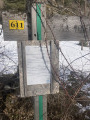
(7) Return via the same track to reach the Col de la Bécha: marker 617.

(6) Take the track on the right towards La Faurie, heading south-east (Chemin des Piarards). Descend eastwards before making a wide turn to head south-west into a grassy area (meadows) where you will join a stony track.

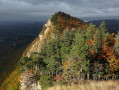
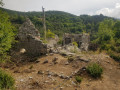
(8) Continue along the track opposite, heading south-west, to descend along the Rif de Baumugne. Pass under a cistern and you will soon arrive at the hamlet of Baumugne, nestled against a rocky outcrop.

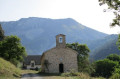
(9) Continue straight ahead to cross the hamlet, leaving the GRP® Tour du Buëch. Behind the few houses, you will see an opening in the rock: this is the Baumugne cave refuge. And on leaving the village, visit the restored chapel (if open). Continue down the small road called Chemin de la Chapelle until you reach an organic cheese dairy (cow) and a crossroads.

(10) Continue straight on Route de Beaumugne, heading west, ignoring Chemin du Rif on the left. The road then turns and heads north until it joins the D1075 at a place called Le Pont Bleu.

(11) Cross the D1075 with extreme caution (no protected crossing) and then cross the Buëch river on a metal bridge, just before the railway line without a barrier. Turn right immediately before the railway line to take Chemin du Poète, which follows the course of the Buëch river northwards: do not take the second path that runs alongside the railway line. Walk between the river (on your right) and fields and gardens (on your left) until you reach a junction between the railway line and the Buëch river.

(12) Turn right to cross the Buëch river on a footbridge that leads to the D1075 and the car park (S/E).

Waypoints

  1. S/E : mi 0 - alt. 3,005 ft - Parking on the edge of the D1705. - Buëch (rivière)
  2. 1 : mi 0.07 - alt. 3,028 ft - Rue du Dauphiné
  3. 2 : mi 0.32 - alt. 3,071 ft - Bouriane forest road junction
  4. 3 : mi 0.45 - alt. 3,104 ft - Chemin des Eycharennes three-way junction
  5. 4 : mi 0.59 - alt. 3,182 ft - GRP® Tour du Buëch Variant three-way junction fork
  6. 5 : mi 1.37 - alt. 3,921 ft - End of forest track - signpost
  7. 6 : mi 1.61 - alt. 4,009 ft - Post 617 - Col de la Bécha
  8. 7 : mi 2.07 - alt. 4,236 ft - Summit of Piarards
  9. 8 : mi 2.98 - alt. 3,734 ft - Crossing the Rif de Baumugne track
  10. 9 : mi 3.42 - alt. 3,412 ft - Baumugne
  11. 10 : mi 3.95 - alt. 3,156 ft - Chemin du Rif - Route de Baumugne junction
  12. 11 : mi 4.89 - alt. 2,992 ft - Le Pont Bleu (junction with the D1075 road) - Buëch (rivière)
  13. 12 : mi 5.16 - alt. 3,009 ft - Chemin des Alpins junction
  14. S/E : mi 5.23 - alt. 3,005 ft - Parking on the edge of the D1705. - Buëch (rivière)

Notes

Fountains at (2) village of Saint-Julien 10 Rue du Dauphiné, 6 Rue de Provence, and at 8 Rue de Durbon (crossroads between Montée de l'Aupet and Route de Durbon). Picnic table on the right on Route de Durbon, just after the community centre.

It is also possible to take a dip in the Buëch at the small bridge next to the D1075 at the bottom of Saint-Julien-en-Beauchêne.

GRP® markings (variant) from Saint-Julien-en-Beauchêne to Baumugne, except for the return trip to the summit of Piarards, which follows a track. Please note: GPS may lose satellite reception in the Commandieu ravine.

This route is suitable for children.

Worth a visit

(9) The Baumugne cave refuge has served as a shelter in the past, and even recently. Three women lived there in a troglodytic manner at the beginning of this millennium, as it was a "white zone", i.e. an area without any electromagnetic radiation.
Be careful! To visit it, you have to cross private property and you need the owners' permission.
Regarding the name "Baumugne", J. Roman indicates: Balmunia (1135), Balma Unia (1162), which can be translated as "united cave". This name seems obvious when you look at the layout of the cave, which has several openings. It should be noted that Tune and Balma are redundant, but this is easily overlooked.

(1) Saint-Julien-en-Beauchêne, and more specifically its "Café du peuple" (which no longer exists), was also the source of inspiration for a well-known author from the region: Jean Giono. He usually stayed at the Hôtel des Alpins at the northern entrance to the village. However, it was one of the hamlets of the village, and not the village itself, that Giono immortalised in his novel "Un de Baumugnes". Although there is a variation in the spelling, Baumugne is indeed the hamlet where Albin, Giono's hero, comes from. The hamlet has changed a lot since then and although there is still a farm there, most of the other houses have become second homes. Baumugne(s) is only alluded to in the story, but it is a fundamental place for the main character in the novel. Giono hesitated a great deal between Montama and Vaunières, two other hamlets in the commune, before settling on Baumugnes.

The Church of Saint-Blaise in Saint-Julien-en-Beauchêne: The painting "L'Assomption" by Philippe de Champaigne (a Flemish painter born in Brussels in 1602 and died in France in 1674) is one of the most important works of art in the Hautes-Alpes and has been classified as a historical monument since 1906. This oil on canvas (1.85 m wide by 2.45 m high) was painted in 1671 on commission from the Carthusians of Durbon for 330 livres. The church also has the painting "The Virgin with the Sleeping Child with Saint Joseph and Saint John the Baptist", a small work by Francesco Trevisani (Cap d'Istria 1656 - Rome 1746), painted around 1700 and classified as a historical monument in 2000.
(To visit the church, please notify the town hall 48 hours in advance).

The former Carthusian monastery of Durbon was founded in 1116 in the Bochaine mountains and flourished there until the French Revolution. The Carthusians lived a life of solitude, silence, prayer and fasting. The architecture of the Durbon monastery (in the commune of Saint-Julien-en-Beauchêne) was typical of Carthusian monasteries, with individual cells for the monks. A 17th-century illustration shows a foundation modelled on the one that can still be seen at the Grande Chartreuse above Grenoble. The Carthusians of Durbon drew their income from the many resources of their territory. They owned a huge forest estate, numerous farms, pastoral mountains where Provençal herds came to graze, and vineyards. They were masters of metallurgy. Although the Chartreuse de Durbon has almost disappeared, evidence of the monastic period can still be seen, such as the painting "The Assumption of the Virgin" by Philippe de Champaigne in the church of Saint-Julien and the altarpiece in the church of Aspres-sur-Buëch.

Reviews and comments

4.3 / 5
Based on 2 reviews

Reliability of the description
4.5 / 5
Ease of following the route
4.5 / 5
Route interest
4 / 5
JulieFJ
JulieFJ

Overall rating : 4.7 / 5

Date of your route : Apr 11, 2026
Reliability of the description : ★★★★★ Very good
Ease of following the route : ★★★★★ Very good
Route interest : ★★★★☆ Good
Very busy route : No

A lovely route around St Julien. Once you reach the top, be curious and venture out of the clearing towards the view; otherwise, you won’t see it straight away, and there’s a surprise waiting for you when you do!
Ends on a small road between Baumugnes and Le Buëch.

Machine-translated

francis1512
francis1512

Overall rating : 4 / 5

Date of your route : Mar 16, 2026
Reliability of the description : ★★★★☆ Good
Ease of following the route : ★★★★☆ Good
Route interest : ★★★★☆ Good
Very busy route : No

A short but pleasant walk with a gentle climb.

Machine-translated

Other walks in the area

For more walks, use our search engine .

The GPS track and description are the property of this route's author. Please do not copy them without permission.