Vaunières from Saint-Julien, returning via Montama (GRP® Tour du Buëch)

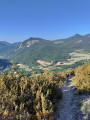
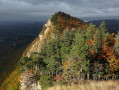
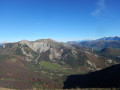
A circular route starting from Saint-Julien-en-Beauchêne, following the GRP® Tour du Buëch and the GR®94 to reach the charming hamlet of Vaunières, passing through peaceful landscapes and offering beautiful mid-mountain panoramas.

Please note! As the path between Fontarasse and the Chemin de Vaunières is closed, you must take the small tarmac road ‘Chemin de Vaunières’ rather than the Fontarasse path.

Details

91116900
Creation:
Last update:
Last review:
  • Walking
    Activity: Walking
  • ↔
    Distance: 16.44 km
  • ◔
    Average duration: 6h 25 
  • ▲
    Difficulty: Moderate

  • ⚐
    Back to start: Yes
  • ↗
    Ascent: + 592 m
  • ↘
    Descent: - 590 m

  • ▲
    Highest point: 1,341 m
  • ▼
    Lowest point: 916 m

Photos

Description of the walk

Head to Saint-Julien-en-Beauchêne on the D1075 road (between Lus-la-Croix-Haute and Aspres-sur-Buëch) and park in the large village car park by the roadside.

(S/E) Take the Chemin des Alpins (dirt track) at the wooden signpost marked GR® de Pays Tour du Buëch, heading south-west. Cross the Buëch via the footbridge. Take the track on the right to go under the railway line and join the Chemin du Buëch, which runs alongside the fields. Continue to the right, following the Buëch river, heading north-west, until you reach the tarmac road D511 which climbs up to Montama.

(1) Continue along the road for about 500 m, heading west, until you reach the first small bend.

(2) Take the Chemin du Buëch on the right, heading north-west, and leave the tarmac road. The path runs alongside the Buëch as far as the bridge over the tarmac D510 road.

(3) Turn left, staying on the small road, heading west and leaving the Buëch on your right. Continue carefully along the road until you reach the junction near a bridge.

Warning! The path between (7) Fontarasse and the (8) Chemin de Vaunièreis closed by a local by-law ( see the ‘Practical Information’ section). You must therefore take the small tarmac road “Chemin de Vaunières” at point (4) with care to reach point (8). It is, however, possible to reach the Fontarrasse resurgence via a return trip.

--- Return trip to La Fontarrasse ---

(4) Take the road on the right towards Les Oches and La Fontarrasse, heading north-west, to cross the Vauniérette stream. Follow the GR® 94 between the fields.

(5) Continue along the D510 road opposite, leaving the GR® 94 which climbs to the right (Chemin de Toussière), until the bend 100 m further on.

(6) Take the Fontarrasse path (wooden signpost: Vaunières) opposite and leave the D510 road, heading west. The path runs alongside meadows, crosses the Torrent du Viavaret and then follows the Vauniérette upstream through the woods.

(7) Continue along the path opposite. Take the opportunity to visit the nearby Fontarrasse resurgence and its cave (caving).
Turn back to avoid the dangerous section of this path. Reach the D510 road.

(6) Continue straight ahead on the tarmac road to join the GR® 94 and then the Vaunières path.

--- End of the detour via La Fontarrasse ---

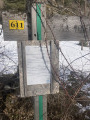
(4) Take the road on the right towards Vaunières, heading west. Ignore the paths leading uphill to the left, cross the bridge over the Vaunièrette and arrive at a hairpin bend. Signpost 611 indicates the La Fontarrasse path and displays the local by-law prohibiting traffic.

(8) Continue up the road towards the hamlet of Vaunières, heading west.
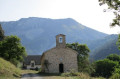
Cross the hamlet via the main road to its western exit. Admire the chapel dedicated to Saint Peter, renovated by the Village des Jeunes association.

(9) Turn back and head down the tarmac road for less than a kilometre, until you reach the hairpin bend.

(8) Continue along the road to the right and cross the bridge over the Vaunièrette. After 150 m, ignore track B247 which climbs to the right.

(10) Follow the path on the right at the bend (GR® 94), which heads into the forest, heading east. Climb up, then cross the dry Tioure stream and its stony bed. Continue to a flat area.

(11) Keep to the left on the GR® 94, heading north-east, ignoring the path that climbs to the right towards Quigouret.

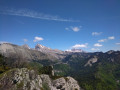
(12) Turn right onto the GRP® Tour du Buëch, heading south-east, leaving the GR® 94. The path through the woodland offers a fine view of the Quigouret summit (on the border with the Drôme), then of the other surrounding peaks: Durbonas, Garnesier and the Grand-Ferrand.

(13) Head down to the left to stay on the GRP®, heading north-east, and walk along the ridge until you reach a junction of paths in the woods.

(14) Continue to the right, walking along the hillside heading south-west, until you reach the Chemin du Berger, at the edge of the fields. Descend to the hamlet of Montama-Haut. Cross the hamlet to join the Chemin de Montama, continuing to the last houses and a hairpin bend.

(15) Turn right at the junction to climb up the Chemin de Montanit, heading south-west, then follow the GRP®. The path runs alongside woods and fields and becomes the Chemin de la Grésière. Follow it to the junction.

(16) Turn left onto the path that descends into the woods, heading north-east. Join the Chemin de France then the banks of the Buëch.

(1) Turn right and follow the route back the way you came, returning to the car park (S/E).

Waypoints

  1. S/E : km 0 - alt. 916 m - Village of Saint-Julien-en-Beauchêne - Buëch (rivière)
  2. 1 : km 0.41 - alt. 925 m - Junction with the D511 road
  3. 2 : km 0.77 - alt. 929 m - Chemin du Buëch junction N
  4. 3 : km 1.76 - alt. 934 m - Crossing at the bridge on the D510 road
  5. 4 : km 2.64 - alt. 956 m - Junction of Chemin des Oches and Chemin de Vaunières
  6. 5 : km 2.92 - alt. 962 m - D510 junction – Chemin de Toussière
  7. 6 : km 3.01 - alt. 965 m - Junction with the Sentier de la Fontarasse (post 618)
  8. 7 : km 3.61 - alt. 1,003 m - La Fontarasse
  9. 8 : km 7.64 - alt. 1,128 m - Chemin de Vaunières junction (post 611)
  10. 9 : km 8.15 - alt. 1,169 m - Vaunières (Village des Jeunes) - Chapelle de Vaunières
  11. 10 : km 8.96 - alt. 1,122 m - Junction: Chemin de Vaunières – GR® 94
  12. 11 : km 9.85 - alt. 1,290 m - GR® 94 junction – Quigouret trail
  13. 12 : km 10.18 - alt. 1,292 m - GR® 94 – GRP® Tour du Buëch junction (elevation 1289 m)
  14. 13 : km 10.88 - alt. 1,341 m - GRP® Les Travers junction
  15. 14 : km 12.31 - alt. 1,124 m - TTR Chaffourane junction
  16. 15 : km 13.42 - alt. 1,063 m - Montama Haut
  17. 16 : km 15.2 - alt. 1,105 m - Chemin de la Grésière junction
  18. S/E : km 16.44 - alt. 916 m - Village of Saint-Julien-en-Beauchêne - Buëch (rivière)

Notes

Please note! Following a municipal decree, the path between (7) Fontarasse and the (8) Vaunière path is closed to the public: "Given the deterioration of the path connecting the hamlet of Les Oches to the hamlet of Vaunières, overlooking the Vauniérette on part of the route.
This trail is strictly prohibited to all traffic, including pedestrians, mountain bikers, horse riders, etc. Violators are liable to prosecution and, in the event of an accident, will be held solely responsible for the consequences."
It appears that the path along the rock face is dangerous despite the handrail installed over a distance of about 15 metres to secure the passage through the marl. There are numerous scree slopes with steep gradients, posing a risk of falling several dozen metres. There is a high probability of rock falls.
It is therefore recommended that you take the small tarmac road "Chemin de Vaunières" between points (4) and (8) with caution until the path has been repaired.

Fountain in the village of Saint-Julien-en-Beauchêne (S/E): 10 Rue du Dauphiné, 6 Rue de Provence, and 8 Rue de Durbon (junction between Montée de l'Aupet and Route de Durbon). Also in the hamlets of Vaunières and Montama Haut.

It is also possible to take a dip in the Buëch at the small bridge next to the D1075 at the bottom of Saint-Julien-en-Beauchêne.

Shorter alternative: you can also start from the D510 (towards Vaunières - Les Oches), just after the Grand Buëch bridge, parking just after it on the right, on the dirt area below the road (3). To return, at the point (12), continue opposite on the GR®94, heading east, leaving the GRP®. Descend the zigzagging forest track until you return to the Vaunières road, which you should take with caution to return to the car park (elevation: 450 m, total time: 4h15).

Worth a visit

(7) La Fontarrasse (or Fountarrasse) is a Vaucluse resurgence that originates at the foot of the cliff and cascades down a height of 20 metres. Best seen in spring. The Fountarrasse cave offers a vertical caving route: abseiling down two beautiful 10-metre shafts, then passing handrails above an underground river with a magnificent terminal siphon. It allows you to learn advanced techniques, while remaining accessible.

(9) The chapel of Vaunières, dedicated to Saint Peter , is located at the western end of the hamlet (6 km from Saint-Julien-en-Beauchêne). The buildings and chapel have been renovated by the Village des Jeunes association. The stained glass windows have been restored by Maurice Noyer. The bell bears the inscription "insignae Fabricae Durbonis", the mark of the Durbon Carthusian monastery foundry. This is the case for most of the bells in each of the surrounding valleys (Beaumugne, Agnielles) as the Carthusians had a very important foundry.

The hamlet of Vaunières was founded during the construction of the Chartreuse de Durbon monastery around 1100. The monks used wood from the Vaunières forest to build their many buildings. This deforestation freed up land that was better exposed than that of Durbon for sowing and harvesting. Gradually, the monks entrusted the land of Vaunières to farmers, thus facilitating the construction of a hamlet. This is how Vaunières came into being around 1590, then built and inhabited around 1620.
This small mountain hamlet at the bottom of the valley has always had a welcoming mission, continued by the few families who remained in Vaunières during the occupation: from 1942 to 1945, the resistance fighters hid in the mountains and used Vaunières as their supply base.
At the end of the war, Vaunières was gradually abandoned by its last inhabitants. The Imbert family was the last to leave, selling their estate to André Court, who subsequently sold the entire village, which he had acquired house by house, to the "Village des jeunes" association in 1964. The association welcomes groups of young people all year round, either on holiday or on international work camps to restore the hamlet.
Most of the houses in the village are built according to the classic principles of rural Alpine architecture. Without a cellar, the first level of the houses consists of a series of rooms with cloistered arches that were reserved for animals. The second level, accessed by a large external stone staircase, is often structured with the same type of vaulted rooms, some of which have retained furniture elements adapted to this particular shape. The most interesting example of these buildings can be seen in the hamlet of Vaunières with the imposing Imbert house, typical of this architecture. It was during work on another of these houses in the same hamlet that a treasure consisting of a batch of ancient gold coins sealed in one of the walls was discovered in 1970. The owner's share of the proceeds from the sale of these coins was used to finance the restoration of many buildings in the hamlet.

Always be cautious and plan ahead when you're outdoors. Visorando and the author of this route cannot be held responsible for any accidents occurring on this route.

The GR® and PR® markings are the intellectual property of the Fédération Française de Randonnée Pédestre.

Reviews and comments

1 / 5
Based on 1 review

Reliability of the description
1 / 5
Ease of following the route
1 / 5
Route interest
1 / 5
User 9109945

Thank you both for your consideration.

Machine-translated

diggi
diggi

Thank you for the confirmation, lemarcheur65.
I hadn't actually seen this decree.
While awaiting a response from the town hall, I have indicated the prohibition and the detour via the road in the hike description.

Machine-translated

diggi
diggi
• Edited:

Hello again, User 9109945,

Thank you for the photo. I also asked the town hall about this.

Machine-translated

User 9109945

Hello Diggi
I have added a photo of the sign posted at the Vaunieres road junction.
However, I do not have the authority to tell people what to do.
Kind regards

Machine-translated

diggi
diggi

Dear User 9109945,

Thank you for your report.
I apologise for not mentioning it in the description, as I was not aware of the issue. I completed this hike quite some time ago and never finalised the guidebook. Taking advantage of the winter period, I finally published it on VisoRando, without realising there was a problem.
On the town hall's website, they still offer the guide to walks around St-Julien-en-Beauchêne (PDF file), which includes this route between Vaunières and Fontarasse, and I haven't found this municipal prohibition order.
Do you have any details about this ban?
Do you think this route is dangerous enough that it should only be recommended to the most experienced walkers, or even avoided by everyone?
Until I receive further information, I will include this in the description of the hike.

Machine-translated

User 9109945

Overall rating : 1 / 5

Date of your route : Feb 23, 2026
Reliability of the description : ★☆☆☆☆ Very disappointing
Ease of following the route : ★☆☆☆☆ Very disappointing
Route interest : ★☆☆☆☆ Very disappointing
Very busy route : No

At point 7, the passage from Fontarasse to the Vaunière path is prohibited by a municipal by-law. And for good reason: the path along the rock face is so dangerous that there is a handrail along a fifteen-metre stretch to secure passage through the marl. There are numerous scree slopes with steep gradients, posing a risk of falling several dozen metres. There is a high probability of rock falls.
It is inconceivable not to mention this in the description of the hike.

Machine-translated

Other walks in the area

For more walks, use our search engine .

The GPS track and description are the property of this route's author. Please do not copy them without permission.