The cliff trail of the Gorges d'Agnielles

Located in the natural site of the Gorges d'Agnielles, the cliff trail winds its way along panoramic ledges accessible by stairs that cross rocky outcrops, offering magnificent views from two lookout points. Equipped with interpretive panels, this trail is accessible by a staircase suspended from the cliff and crosses the cave with five entrances. The trail is easy except for those who are apprehensive about steep paths.

Details

89616657
Creation:
Last update:
Last review:
  • Walking
    Activity: Walking
  • ↔
    Distance: 1.82 km
  • ◔
    Average duration: 0h 55 
  • ▲
    Difficulty: Easy

  • ⚐
    Back to start: Yes
  • ↗
    Ascent: + 145 m
  • ↘
    Descent: - 142 m

  • ▲
    Highest point: 913 m
  • ▼
    Lowest point: 817 m

Description of the walk

From the D1075 road between Aspres-sur-Buëch and La Faurie, about one kilometre after the junction with the D994A coming from Veynes, turn right onto the small road signposted "Gorges d'Agnielles" (at a roadside car park). Follow it to pass under the railway line and continue on a carriage road for about 500 metres. Pass the first car park on the right to reach the smaller and often full car park at the climbing cliffs (on the left side of the road).

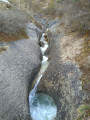
(S/E) Take the road towards the village of Agnielles, heading east. Walk for about ten minutes, following the Rif d'Agnielles river, which rushes along on your right at the bottom of the gorge. Pass the access path to the "difficult via ferrata" and reach the purple totem marking the start of the Sentier des Falaises trail. Coloured markers are placed at the start of each activity area: blue for climbing, pink for via ferrata, purple for hiking trails.

(1) Leave the track and climb up to the left via a dry stone staircase. This winding climb takes less than five minutes to reach the foot of the cliff and the first metal staircase (start of the easy via ferrata).

(2) Take the staircase to reach the first platform carved into the rock. Continue up thesecond staircase, which has four sections, to find yourself 25 metres higher on the balcony trail. The ledge offers panoramic views without being vertiginous, revealing the complexity and diversity of the stacked strata.
Follow the path as it winds around, then make a long traverse to reach the steps.

(3) Climb the few steps that lead to the cave with five entrances. With its vertical opening and flat floor, the unexpected fault curves inside the rocky ridge, barely bathed in a shaft of light halfway across. A headlamp or the light from a mobile phone makes it easier to cross to the other side, as the ground can be damp and slippery (do not take the branch that goes to the left as it is a protected area for bats).

Exit the cave and descend a few steps to continue along the Sentier des Falaises, which quickly leads to another, shorter staircase to climb up to the ledge above. Caution for those prone to vertigo: the path continues along a cornice to a ledge with a metal handrail on the wall side.

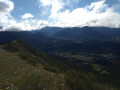
(4) Climb a final metal ladder to enjoy the first viewpoint, which is well secured by a metal railing. Enjoy the bird's-eye view of the gorges.
Climb back up, then continue along the path on the hillside to reach the second viewpoint, slightly lower down, and the end of the path. Enjoy the view of the gorges and catch a glimpse of a waterfall opposite.

(5) Turn around, as the return to the car park (S/E) is via the same route in the opposite direction.

Waypoints

  1. S/E : km 0 - alt. 819 m - Car park for the Via Ferrata in the Agnielles Gorges
  2. 1 : km 0.45 - alt. 842 m - Purple totem pole - Start of the Falaises trail
  3. 2 : km 0.5 - alt. 865 m - Start of the easy Via Ferrata
  4. 3 : km 0.66 - alt. 903 m - Cave with 5 entrances
  5. 4 : km 0.78 - alt. 898 m - 1st viewpoint
  6. 5 : km 0.91 - alt. 898 m - 2nd viewpoint
  7. S/E : km 1.82 - alt. 819 m - Car park for the Via Ferrata in the Agnielles Gorges

Notes

There is a picnic area below the car park near the stream.

With its highly visible purple markings, this short hike is fairly easy, despite a few steep sections, high steps and stairs suspended from the cliff. Caution: not recommended for people who suffer from vertigo.
Take care in winter and when the steps are wet (rain) or in stormy weather.
Tip: wear good shoes and bring a torch for the cave!
This trail is also used as a return route from the Via Ferrata.

The road leading to the car park is in poor condition. Traffic is prohibited in snowy weather and parking is prohibited along the track outside the car parks.

Located at the top of the gorges, the former hamlet of Agnielles (which had nearly 283 inhabitants in 1806) has two lodges open to the public: the Maison forestière Retrouvance® d'Agnielles and the Auberge "Les Sabots de Vénus".

Worth a visit

Inaugurated in July 2023, theGorges d'Agnielles cliff trail allows walkers to experience the same visual thrills as climbers and other rock-climbing enthusiasts, thanks to its route through the rocky outcrops, right on the cliffs, connecting the balcony trails with solid metal equipment, similar to the Eiffel Tower!

The unspoilt natural site of the Gorges d'Agnielles, with its remarkable landscapes, is classified as a Natura 2000 site. It is very popular for outdoor activities : a climbing site suitable for beginners and families, two via ferratas, a cave for caving, a themed trail, mountain bike and electric mountain bike routes and circular horse riding loops.

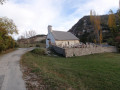
In the village of Agnielles, only a few houses remain, some of which have been restored and converted into group lodges by the ONF. All that remains of the small church is the bell tower, which watches over the cemetery. In 1933, the Agnielles municipal council voted to merge the commune with that of Aspres-sur-Buëch. The last priest had left in 1907. In 1934, when the commune was dissolved, only four children were still attending the school. Since then, there have been several attempts to revive the village, including in 1943 when the Eaux-et-Forêts established an agricultural cooperative, some of whose members joined the Resistance, followed in the 1960s by a project led by young people from Île-de-France. In vain, the isolation of the place got the better of the best intentions. In the end, it is tourism (through lodges) that is reviving the village today, even though no one lives there year-round.

Other walks in the area

For more walks, use our search engine .

The GPS track and description are the property of this route's author. Please do not copy them without permission.