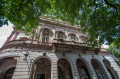
(S) The Hôtel de la Société Industrielle (SIM): Built between 1827 and 1829, this hotel was originally the headquarters of the Cotton Exchange and the Chamber of Commerce and Industry. It houses the Société Industrielle de Mulhouse, created in 1826 by young philanthropic industrialists from the Mulhouse Masonic Lodge. Still in operation today, the SIM is a think tank made up of specialised committees (chemistry, mechanics, fine arts, publicutility , etc.) that has been responsible for numerous economic, social and technical advances. The Arcades of the Nouveau Quartier surround the Square de la Bourse. Originally called the Charles X district, this first urban complex outside the medieval walls was built according to plans by young Strasbourg architects Jean-Godefroi Stotz and Félix Fries. They drew inspiration for their project from the Rue de Rivoli in Paris.
(1) Bourgeois house: Dating from 1850, this mansion marks the transition between the Nouveau Quartier and the rapidly developing Sinne district.
(2) Villa Mantz bears the name of the family for whom it was built around 1840. Its Palladian style is reminiscent of colonial houses in the southern United States. It was originally located in a garden area.
Villa Risler: Built around 1840, it is home to the Risler family. It was also the Mulhouse studio of world-renowned architect François Spoerry, who designed the Tour de l'Europe in Mulhouse, among other buildings.
The trading house with its red shutters. Dating from 1850, it was the first headquarters of the Edouard Vancher & Cie company after its move from the Porte du Miroir, then a cotton trading house.
(3)The Villa Vaucher-Lacroix and the former Grosheintz and Hartmann weaving mill. The Villa Vaucher-Lacroix was owned by Edouard Vaucher, a Mulhouse merchant and banker. This villa, built of cut stone and exposed brick, was constructed in 1867 by the architect De Rutté. Upon Edouard Vaucher's death, it was occupied by his son-in-law, Camille de Lacroix, until 1924. The City has owned the property since 1951, and it now houses the Municipal Health and Hygiene Department. Just after the Villa isthe former Grosheintz and Hartmann weaving mill. This building, in operation since 1806, was the city's first large cotton weaving factory. It ceased operations in 1836.
Villa Schoff was built in 1903 for the industrialist Schoff, co-manager of Schaeffer & Cie, based on plans by Charles Schulé. This mansion is typical of the late19th century. Today, it serves as the residence of the Sub-Prefect.
The Maison Thierry-Mieg was acquired in 1818 by Mathieu Thierry-Mieg. This renowned chemist and manufacturer of painted fabrics created the Andrinople red that made Mulhouse's Indian fabrics so successful. Passionate about agronomy, he set up a model farm behind his home, renowned for its cattle breeding. Gaspard Ziegler and then Frédéric Lamey, both directors of the Société Alsacienne de Construction Mécanique (SACM), became successive owners.
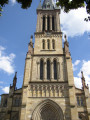
Saint-Etienne Church: The influx of workers, mostly Catholic, made it necessary to build a second church, as Sainte-Marie Church (converted to Catholicism in 1803) was too small to accommodate all the faithful. The first stone was laid in 1855 in a neighbourhood undergoing urban redevelopment, where orchards and vegetable gardens still dominated. The building, in a neo-Gothic style inspired by the great cathedrals and with high-quality interior decoration, was completed in 1860. Its radiating chapels and perfect layering of masses make it an undeniable architectural success.
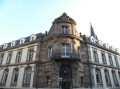
(4) Bourgeois building: Located near the old market halls, this building from 1870 had a ground floor for commercial use. The painter Jean-Jacques Henner (1829-1905) had a studio there.
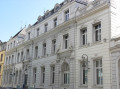
The former Mulhouse Bank: Founded in 1872, the Mulhouse Bank moved to Rue de la Sinne in 1882-1883. It was one of the leading banking institutions of the late19th century.
Steinbach Park: The park is located on land between the city's former moats. In 1798, the manufacturer Blech, owner of the Maison Vetter, now the Museum of Fine Arts, acquired the land and filled in part of the moats to create a garden that stretched to Rue du Sauvage. Its size gradually decreased due to the construction of various buildings, such as the theatre, and the filling in of the Sinne moat. Georges Steinbach bought the house and garden, which were bequeathed to the city upon his death in 1893. The garden, which included production greenhouses, became public.
(5) The Théâtre de la Sinne in Mulhouse, with its prestigious19th-century red and gold Italianate décor, hosts a very eclectic programme: boulevard theatre, performances by the Opéra du Rhin, concerts by the Ecole Nationale de Musique, dance and drama, Alsatian theatre and the Tréteaux de Haute-Alsace for performances aimed at young audiences.
The Bourgeois House. Dating from 1847, this mansion was built in a cul-de-sac overlooking the Sinne River before it was covered and transformed into a street between 1859 and 1866.
The Gangloff building, constructed in 1905-1906 for Henri Gangloff, based on plans by Louis Schwartz, has a façade decorated with an allegory recalling its original function as an art gallery, bookshop and antique shop, attributed to the sculptor Bartholdi (a native of Colmar and creator of the Statue of Liberty). Acquired by the Schlumpf brothers, famous Mulhouse industrialists who founded the car collection of the same name, it was converted into a hotel in 1920.
The Banque d'Alsace et de Lorraine was built in 1891 on one level based on plans by Ernest Duvillard. Its first floor (1926-1927) is attributed to architect Charles Schulé.
(E) The former Hôtel de Paris: Owned by Daniel Roth, this hotel, built in 1838, is the largest in the city along with the former Hôtel Central (now demolished). Closed in 1859, its garden stretched as far as Square Steinbach. Designed to accommodate industrialists and sales representatives, this luxury hotel was also the departure and arrival point for the Paris courier services.



 Country:
 City:
City:


 Tourist office

 Visorando Member

 Moderate
