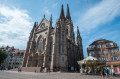
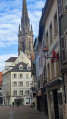
(S) Saint-Étienne Temple: This temple was built between 1858 and 1868 on the site of a12th-century church . It was designed by Jean-Baptiste Schacre in the neo-Gothic style that was very popular at the time. It still houses the magnificent stained-glass windows that were in the old church. These are among the most beautiful in the Upper Rhine region. Located on Place de la Réunion, Saint-Etienne Temple is also a cultural hotspot in the heart of the city, hosting concerts, exhibitions and events, particularly during the Christmas period.
The birthplace of Jean-Henri Lambert: Born in Mulhouse in 1725, Jean-Henri Lambert was one of the most famous scholars of his time, the Age of Enlightenment. An astronomer, physicist, philosopher and mathematician, he is credited with the cartographic projection and theorem in astronomy that both bear his name. Thanks to his work, you can now discover the city using geolocation!
Former Presbytery: Built in the16th century, this building was the presbytery of the former Saint-Etienne Church until the Reformation in 1528. A Latin school from 1550 to the end ofthe 18th century, it became a college and then a school. It now houses the Centre d'Interprétation de l'Architecture et du Patrimoine (Centre for the Interpretation of Architecture and Heritage) as part of the Ville d'Art et d'Histoire (City of Art and History) label, better known as the Maison du Patrimoine Edouard Boeglin (Edouard Boeglin Heritage Centre).
The Pharmacie au Lys. Built in the late Renaissance style, the house has been listed since 1464 and was completely renovated in 1634. It is the oldest pharmacy in France still in operation (since 1649). Its painted ceilings date from the second half ofthe 17th century and the pharmacy's furniture, from the Charles X period, is very well preserved.
Maison Mieg: Built in 1560 by Valentin Fries, it was the Mieg family, who owned the property from 1675 to 1840, who gave it its name. It owes its current appearance to Mathieu Mieg, who, in 1799, decorated the façade with murals of his own design depicting the Swiss hero Arnold von Winkelried. The Maison Mieg is the largest of the houses surrounding the Place de la Réunion.
Former headquarters of the tailors' guild: The building dates from 1564 and underwent considerable alterations inthe 19th and20th centuries. The tailors' guild was the largest in Mulhouse before the 1798 merger. The guild's emblems (tailor's scissors) can be seen in the murals on the building.
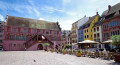
Town Hall: Destroyed by fire in 1551 and rebuilt the following year, Mulhouse Town Hall was described by Montaigne as a "magnificent, gilded palace". Since 1698, it has been decorated with trompe l'oeil paintings by Jean Gabriel. This beautiful building, a testament to the Rhineland Renaissance, now houses the Historical Museum.
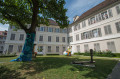
(1) Maison Steinbach: Built by the manufacturer Vetter in 1788, this mansion takes its name from the Steinbachs, its owners inthe 19th century. Upon the death of George Steinbach in 1893, the house was donated to the city and its grounds became the public garden of the same name. Today, the house houses the Museum of Fine Arts.
Hofer-Mieg House: In 1776, Dr. Hofer bought part of the Teutonic Knights' courtyard and had this house built on the corner of Place Guillaume Tell.
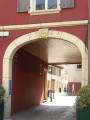
Passage des Augustins: This passage takes its name from the former Augustinian cloister that stood there. Built in 1268, it was decommissioned following the introduction of the Reformation in 1523. A hospital was established there from 1529 to 1624. The passage was built between 1761 and 1763 after the monastery was demolished.
18th-century manufacturing complex: Dating from the last quarter ofthe 18th century, it was built on the site of the noble courtyard of the Fritschmann family of Illzach. From 1764 onwards, for a century, it housed a painted canvas factory that changed hands several times. In themid-19th century, the Schlumberger family, then owners, demolished the buildings. The new construction housed the Mulhouse bank between 1872 and 1883.
18th-century house: Built in the 1770s-1780s on the site of the Knights of Saint John's enclosure, it housed commercial premises before being converted into a mansion in 1824 with a sober façade and wrought iron railings. In 1790, it housed the Nicolas Dollfus wallpaper factory, the predecessor of Jean Zuber et Cie in Rixheim.
Paul Curie's house: Built around 1800, this house has a very sober façade and a double staircase, reminiscent of the decorative elements of the Age of Enlightenment. From 1825 to 1833, it was inhabited by Paul Curie, grandfather of the famous physicist Pierre Curie.
Saint-Jean Chapel: Built in 1269 by the Knights Hospitaller of Saint John of Jerusalem, the chapel was enlarged in 1351. Around 1500, a side chapel was added, while 20 years later, murals (unfinished) of great stylistic quality were painted, depicting the life of Saint John the Baptist and the Passion of Christ. With the Reformation, the Knights of Saint John left the city and in 1798 their property was finally seized and sold. The chapel then became a brewery and then a blacksmith's workshop, before being classified as a historic monument in 1893.
Central Library: This library, the oldest in the city, has occupied its current premises since 1905. It offers: around 45,000 adult books, self-service computer stations, a documentation room and three rooms for group work, an exhibition room, an events room, a heritage room reserved for consulting documents stored in the library's archives that cannot be borrowed, a youth room, and a patio where visitors can read in the sun.
(4) 18th-century mansion: House built around 1760. The first known example in Mulhouse of a house belonging to Indian cloth manufacturers, which housed a factory producing Indian cloth, printed with oriental-inspired designs.
(5) Cour de Lorraine: Pierre Thierry, originally from Lorraine, acquired the former noble courtyard of the Wunnenbergs in 1725, which he restored and embellished. In 1765, it housed a painted fabric factory owned by Jean-Henri Dollfus, then, from 1820, a spinning mill owned by Nicolas Koechlin. These factories burned down in 1870 and were replaced by a primary school. This building was exceptional in the18th century as it was the only one to have pink sandstone foundation stones, chaining and window frames.
Schloessle: This house, built around 1796 for Jean-Jacques Ziegler, an industrialist, housed a fabric printing factory from 1800 to 1810, then a roller engraving factory. This second factory belonged to Daniel Koechlin Ziegler, co-founder of the drawing school, now the School of Fine Arts, from 1827 to 1862. The building was then used for the Brinckmann Printing Works from 1892 onwards.
Sainte-Marie Church: Originally a Franciscan convent founded during the second half ofthe 13th century, the rise of the future Sainte-Marie Church was cut short by the establishment of the Reformation in Mulhouse inthe 16th century. The former convent was used as an artillery depot before Catholic worship was re-established in Sainte-Marie Church in the early19th century. Since then, various restoration works have been carried out and the church frequently hosts choirs.
Maison Loewenfels: Around 1764, Jean-Jacques Feer built what is undoubtedly the most beautiful18th-century residence in Mulhouse, constructed from cut stone. Named "Zum Loewenfels" (the lion's rock) because of the coat of arms painted on two shields on the pediment, the mansion was sold to Jacques Degermann in 1847, who set up a brewery there. The Cercle Sainte-Marie bought the property in 1949 and turned it into the presbytery and parish hall.
(E) Maison Vogel: In 1778, Simon Vogel, a merchant from Mulhouse, acquired this building, located on the site of the city's first hospital, to build his mansion. From 1866 to 1870, the building housed the Sous-Préfecture (sub-prefecture) and then the Kreisdirektion, its German equivalent, until 1882. Since then, it has been home to shops.



 Country:
 City:
City:


 Tourist office
 Visorando Member
 Moderate