(S) The voice of the tram: French composer Pierre Henry was commissioned to create the audio announcements broadcast inside the 34 trams and tram-trains . These sounds add a sensory dimension to the station name announcements broadcast on board. The principle is to precede or accompany the voice announcement with an audio signal in the form of a few bars of music characteristic of the composer's previous creations (electro-acoustic music) or recorded sounds. Two series of announcements are broadcast according to the season: the first features small , highly synchronised individual musical entities , harmonised and mixed with the voice announcements. The second features sequences composed around the name of each station, often repeated, evoking the pictorial and popular world of cartoons. Two musical worlds have been composed: one energetic and optimistic, the other based on humour and cheerfulness. In total, there are 23 mini-musical pieces lasting between 6 and 11 seconds.
The ray of sunshine: born in Barcelona in 1945, Peret is a multi-talented artist: graphic design, illustration, photography, sculpture... In the early 1980s, he founded a studio bringing together international collaborators and led projects all over the world. The Spanish graphic designer was chosen by the residents following a competition to decorate the tram and design the interior harmonies. His proposal combines a warm, vibrant yellow with red and black graphic motifs, specific to each of the 27 trams and available in three different styles. The interior is clad in grey, accented with touches of red and yellow, and the seats are upholstered in fabric featuring the same graphic motifs as the exterior. Peret's design has also been adapted for the buses in the Solea network.
(1) "The welder, Dr Schweisser": also known as the "Schweissdissi", he is a powerful symbol of the city. He was undoubtedly the easiest choice for artist Yves Carrey, as he is so rich in symbolism relating to the industrial past of the Cité du Bollwerk. The man's seated position is linked to unemployment (the disappearance of Mulhouse's large manufacturing plants). The pieces are mainly automotive mechanical parts sourced from a materials recycling company and old tools taken from Yves Carrey's personal bric-a-brac collection.
(2) The three exclamation marks: Renato Montanaro is an artist from Mulhouse of Italian origin. He has created three monumental resin cows. Inspired by pop art, they are three times larger than life. Here, Renato Montanaro mixes genres, images and references.
Avenue du Président Kennedy: "Tram Trame". Daniel Buren's project is based on the regular installation of two arches at each stop on the West-East line, line 1 (except at Porte Jeune), which signal the stations and create a sense of continuity along the tram route. The arches symbolise an entrance and an exit, spaced at intervals similar to the length of the tram cars; they span the platform. The arches have a rectangular cross-section. Different colours have been used on three of the four sides of the arches. Each station has different colours, creating a new universe at each stop. On the outer curve, five black and white stripes of equal width extend in a straight line on the ground on either side of the arch, giving the appearance of stripes. Daniel Buren is known for having created the columns in the courtyard of the Palais Royal and the Salves bridge arch in Bilbao.
(3) Rue des Franciscains: without the small wheels: despite the lack of detail, these characters, created by Jean-Louis Toutain, convey a certain joie de vivre, a joyfulness that combines humour, satire and tenderness. The figures created by the artist oscillate between massive bodies, imposing curves and elegance, and refined, airy forms. There is a perfect balance of volumes, and Jean-Louis Toutain has succeeded in combining lightness with mass, as if these silhouettes were flying or floating gently.
Two black landmarks: Anne-Marie Schoen's work, installed here in the Cour des Chaînes, was acquired by the City of Mulhouse in 1991. It consists of two sculptures, themselves made up of pieces of wood pressed together and tied together. Anne-Marie Schoen considers these sculptures to be landmarks, hence the title, which could be placed around the city to represent or map out a route.
(4) "Les Moutons" ( The Sheep ): the idea of producing sheep came suddenly to Yves Carrey when he simply looked at oil drums, which offer one of the most attractive raw materials due to their lightness and volume. When you look at one of these animals, you can't help but see a kind of barrel on legs.
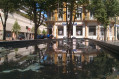
(5) Place de la Paix: "Water table". The work of artist Quentin Garel revolves around sculpture in bronze, iron, wood or porcelain. Most of his works represent animals, sometimes realistic, sometimes in skeletal form. He created the work "Water table" for the Place de la Paix. It consists of 120 bronze frogs of different sizes, which sit on a steel "table". The basin is partially filled with water, which spouts from some of the frogs. Some are crafted with astonishing detail. The sober work fits perfectly into the renovated square.
In front of the Museum of Fine Arts: "La Licorne du Fayé" (The Fayé Unicorn). A work exhibited in the museum garden. For the artist, Livia de Poli, the desire to create monumental works came naturally. While remaining in a world of rounded shapes and colours, she wanted to give volume to her creations. La Licorne du Fayé stands proudly in the middle of the garden of the Museum of Fine Arts. This colourful work has its origins in the "racontâtes" of yesteryear. These stories, told during evening gatherings, reveal the concerns, fears and hopes of the people of the Vosges region over the centuries. In contrast, the "Licorne du Fayé" is a positive and sunny figure that wards off bad luck. The front is made up of colourful and joyful curves. The back shows four animals corresponding to the four elements: Earth (horse or cow figure), Air (bird), Water (fish) and Fire (salamander).
(6) "The Golden Potato": Tobias Rehberger installed a very special potato field (in 2009) which, according to the legend he created around this work, contains a golden potato. The actual potato field measures 185m². Initially, the potatoes were harvested and the first crops were donated to the Restos du Coeur charity. This work is part of a larger ensemble that the artist created for the entire tram line 1. Other works by the same artist can be seen in front of the fire station, on the facades of the PAX, at the Musée de l'Auto tram stop, etc.
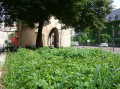
The work "La clé" ( The Key ) by Louis Perrin, an artist from Mulhouse, was installed in 1989 as part of the pedestrianisation of the area. It was for this gateway to the past that he created this 4-metre-long bronze key, planted in the ground "like King Arthur's sword". Louis Perrin said: "I see the Bollwerk Tower as a unique object. I know full well that it wasn't a gateway to Mulhouse, but as it's the only visible part of the old ramparts... For me, it's the key to the city, so it has to be a big key, and it's as if it had been thrown there." Over time, the work has been well received by the locals and is now a very lively object, with children climbing on it and the first tags appearing. For the artist, this proves that the work is now "part of the walls".
(7) Along the Nouveau Bassin:
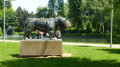
Hector: Renato Montanaro's work, entitled Hector, but often nicknamed the bulldog, was installed at the Nouveau Bassin in 2010. The work, weighing over a tonne, is a bronze created by the Strassacker Foundry and has been patinated. It is a replica of an English bulldog that the artist has been producing since 2004. The work commissioned by the City is thefourth monumental version of Hector. The artist has therefore reworked an image he has already used, but has integrated it and designed it in accordance with a new exhibition environment. Renato Montanaro's work finds its place in this natural environment, echoing the dogs of passers-by and walkers in the alley.
Cristaux: this work is entitled Cristaux and was commissioned from the artist Pierre Watzky in 2013. It is special because the artist died prematurely just after the City of Mulhouse agreed to purchase it. Pierre Watzky had already prepared the models and drawings, but it was Roland Vonarzx who finally created the work based on the notes and sketches. It represents a mineral mined in the mines, in this case rock salt in its crystalline form, i.e. an interlocking of different volumes of simple geometric shapes. Many people said at the time that Cubism had been incorporated into the works at the Nouveau Bassin. Indeed, this work features shapes, geometry and volumes. It echoes the life and career of the artist, who himself worked deep in the potash mines in the region.
The Tree: Yves Carrey's work located at the Nouveau Bassin is called The Tree. It was installed in 2003 and is thesecond piece installed on the promenade. Yves Carrey is a Mulhouse artist who is well known in the region's artistic circles. A welder by trade, he quickly put his skills and expertise to use in his art. His creative inspiration comes from his first profession, and he transposes his manual work into artistic and plastic art. L'Arbre was made with concrete reinforcing bars, long scrap metal rods that were recovered from the wastelands of former potash mine buildings. At the top of his work are flowers that are in fact old parts of agricultural vehicles. This work fits in very well, on the one hand because it refers to the environment (a tree among trees) but also because its colour blends into the surroundings.
Maternity: Georges Hanskens' work was installed in 2009 at the Nouveau Bassin. The sculpture is made of bronze covered with brown patina and stands on an imposing white monolithic granite base. From a distance, this work appears smaller than the others, less imposing, but it is certainly also its theme that invites the viewer to come closer and contemplate it more closely. At first glance, we discover a set of interlocking geometric shapes, playing with each other. Without knowing the title of this work, it is difficult to discern the artist's intention. Once we know the name, the shapes immediately come to life. One can see a mother embracing her child. One can also see a single figure, the silhouette of a pregnant woman. The artist himself has stated that he created this sculpture as a hymn to women, to gestation, to birth. This idea of birth is reflected in the environment in which the work is placed: nature, where flowers and trees are born, live, wither, etc.
Réserve (for all luggage): in 2004, the City of Mulhouse commissioned Anne-Marie Schoen to create a work for the Nouveau Bassin. The work Réserve features a bright red metal cage, half-buried in the ground in the middle of the grass. It is as if we wanted to create a reserve of our various baggage here, whether in the literal sense (real objects) or in the figurative sense (memories, recollections, etc.). Ultimately, another interpretation seems possible. This red cube is a powerful symbol, perhaps of danger, which seeks to delimit and protect an area. Indeed, if we approach the work, we see that the part of the ground beneath the cage is no longer accessible and that vegetation, ivy, is growing there without human control. Here we find a link with the title of the work. This small plot of land would be reserved. However, we quickly understand the irony and paradox of this idea, since ultimately, although humans can no longer access or influence this plot, the cage delimits it and acts as a prison for this vegetation, which is free without actually being so. The idea behind the title "Réserve" (Reserve) can therefore also refer to ecological concerns.
La Jonque: Vincente Blanchard is originally from Rouen and currently lives in Mulhouse. The work installed here at the Nouveau Bassin is not her first monumental work, nor her first public commission. Several of her works can be found in Alsace, such as at the Zoological and Botanical Park or in Altkirch. La Jonque is a combination of patinated bronze to which the artist adds a special mixture of sand and cement to create a mortar-like material that flows between the metal. The material gradually overflows, almost obscuring the metal. The stone gradually emerges from the metal structure. The work is closely linked to nature and responds to the environment in which it is placed. Vincente Blanchard's work is closely linked to the idea of nature, as can be seen in the title she gives to her series, 'Invertebrates', which are animals found in nature (insects, crustaceans, etc.). The title of the work refers to nature and especially to water, since a junk is also the name of a traditional Asian boat.
La Girafe: Françoise Matt-Halm's work, installed in 2005, consists of an electro-galvanised sheet metal structure measuring 2.70 metres and weighing 30 kg. The artist first designed her work on a model, which was then used to laser cut the necessary pieces of sheet metal, which were then welded together. Finally, she applied a powder-coated paint, which gives the sculpture its vivid appearance. Françoise Matt-Halm's artistic work is based on three major criteria that dominate this project: stylisation of form: the artist starts with a figurative image, hinted at in the title, in this case a giraffe. The artist stylises, refines and clarifies the features of this image as much as possible to arrive at a set of simple, geometric shapes which, when assembled together, recreate the original image in the viewer's mind. There are no longer any details in the final work; it is up to the viewer to redraw the missing features or details in their imagination. Lightness of structure: the artist works with electro-galvanised sheet metal, which is a very flexible material that is easy to work with but also very light. Indeed, the giraffe in the Nouveau Bassin appears light, thanks to its fine, refined features and the delicacy of its material. Cheerfulness in colour: Françoise Matt-Halm generally uses bright colours in her artistic work, sometimes contrary to reality (here the giraffe is composed of orange and blue). This gives the sculpture an additional cheerfulness and enchantment.
Julia: Yves Lemarque's work was commissioned by the City of Mulhouse in 2011. The sculpture is a scaled-down replica of the chimneys that made Mulhouse famous, formerly known as the city of a hundred chimneys. The work should also be seen in the context of the industrial past of the Nouveau Bassin district. The artist named his creation Julia. Through this first name, so common nowadays, he wants to create a link with passers-by walking along the Nouveau Bassin. However, it is not the artist who has a friend called Julia, but the viewer who may know someone with this first name and thus, through the sculpture, remember memories and a story involving a person named Julia. Giving the sculpture a name also humanises the work, giving it an identity. Yves Lemarque has also pierced the sculpture with small holes all around it. At eye level, these holes allow the viewer to look inside, giving them a different perspective and a new relationship with the work.
Nos ombres en attendant la nuit (Our shadows waiting for night): Christian Lapie has created imposing figures by erecting these tree trunks. Presented in groups or pairs, these figures suddenly impose themselves on the viewer in places that the artist takes into careful consideration. In Mulhouse, these colossal figures can be found on either side of the street, with five figures in total facing each other in dialogue. These sculptures are positioned there like monumental totemic figures. A human figure appears thanks to the small head at the top. However, when you get closer, you see that it is a sculpture without age, without a face, without limbs, of all nations, all cultures, without race. Here we find the desire to construct a universal dialogue, addressing everyone. The souls created by the artist can evoke something different in each person, while keeping in mind the metaphorical figure of the being. Some speak of obvious brutality when faced with these silent, distant colossi, like ghosts; others see them more as guardians, protective figures who guard and watch over the place. The link with nature is very present in this work, not only through the use of wood, but also through the idea of the trunk being rooted in the earth and rising towards the sky, like the surrounding trees.
Ouroboros: Kristian Ingold, a local artist, attached great importance to the location where his work would be installed. His wish was to create a sculpture that was both dynamic and connected to the surrounding space, but without creating a focal point that would catch the visitor's eye. As the artist himself says, he conceived his work as a sculpture "to be discovered rather than imposed". He therefore sought to preserve the open perspective offered by the tree-lined avenue. The shape of the work gives rise to an object that can have several uses in its space: a bench or table, a place for socialising, exchange, play or meditation.
The work is made of strong materials such as metal for the upper part and rock for the four bases, which also represent feet. The shape sculpted by the artist is in fact the mathematical symbol for infinity, also known as the lemniscate. This creates a continuous line, like the infinity sign. This shape can also be referred to as an Ouroboros, a term the artist used for the title of his work. It refers first and foremost to the symbol of infinity, but also to this sculpture, which will continue to live on over the years with the multitude of passers-by who will look at it, use it and infinitely update the work.
La Grande Ourse: this work was installed at the Nouveau Bassin in 2011. It is the result of an art competition launched among Mulhouse high school students on the theme of "The planet is warming up, let's not be afraid!". Two high schools won the competition: Lycée Général Lambert and Lycée Professionnel Stoessel. Julie Wittich and Marie Kebs are the two designers of the work, who studied art at Lycée Lambert. The work was then produced by students studying for a CAP in metalwork at Lycée Stoessel. Its construction required 148 stainless steel pipes and several recycled metal barrels. The work weighs approximately 700 kg. The image of the bear was chosen as a strong link to global warming. Choosing perforated and half-open pipes also gives the bear a fragile appearance, signifying that it is an endangered animal, already affected by the damage caused to nature and its environment. The link can also be made with the polar bears at Mulhouse Zoological and Botanical Park. Finally, the title of the work refers to the celestial constellation, which is like a guide to follow in order to find solutions to the damage being done to nature and the planet.
Pégase: this work was created in 2017 by Pascal Gangloff, a sculptor and ceramist from Mulhouse. He took part in the summer sculpture programme in 2011, during which he presented four sculptures of characters with animal heads, depicting themes from everyday life. It is one of the last works Pascal Gangloff created in Mulhouse before leaving the region. His sculpture also reflects the artist's unique dreamlike universe, which blends the worlds of humans and animals while mixing a variety of materials, as can also be seen in another work by Pascal Gangloff installed in front of the school of coopers in Mulhouse.
(E) Space: Jean-Pierre Raynaud is an internationally renowned French artist born in 1939 and originally from Courbevoie. He is well known for his works, particularly his flower pots, but also for his works created using white tiles with black joints, which have become his trademark. The work Space was commissioned by the City of Mulhouse with financial assistance from the State. It is part of a political desire to establish a genuine programme of public commissions for works of art. For Deputy Mayor Michel Samuel-Weis, Mulhouse was one of the last cities not to have placed public commissions and was lacking in works of art in public spaces. The sculpture is a circular, ascending ensemble of eight white columns. The work is quite minimalist, rising from the ground in a mathematical progression that draws the eight columns or steles towards the sky. The whiteness of the sculpture contrasts with the brutality of the noise from the nearby motorway route, and even at night it is highlighted by the lights of passing cars. For the artist, it is at once a "work of art, a piece of architecture, a signal, an enigma", but one that creates a new space in the city, a public space with free thought.



 Country:
 City:
City:



 Tourist office
 Visorando Member
 Moderate