The Baroness’s Trail

The scree from the summer of 2024 makes this route extremely difficult and demanding.
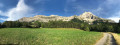
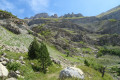
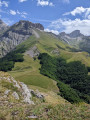
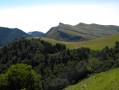
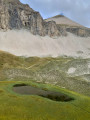
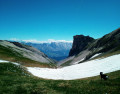
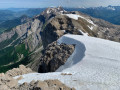
Brought back into the spotlight by Pascal Sombardier’s publications, the Sentier de la Baronne crosses the Petites Charances, a suspended balcony at the foot of the western face of the Dévoluy (stretching from the Grand Ferrand to the Obiou), above Tréminis.
It is a long and demanding route, not necessarily very technical, but one where you must take great care with every step.
The view stretches westwards, from the Chartreuse to Mont Ventoux, via the eastern face of the Vercors.

Details

2436580
Creation:
Last update:
Last review:
  • Walking
    Activity: Walking
  • ↔
    Distance: 15.90 km
  • ◔
    Duration according to the author: 10 hrs 
  • ▲
    Difficulty: Extremely difficult

  • ⚐
    Back to start: Yes
  • ↗
    Ascent: + 1,438 m
  • ↘
    Descent: - 1,438 m

  • ▲
    Highest point: 2,432 m
  • ▼
    Lowest point: 1,057 m

Photos

Description of the walk

Start 500m past the hamlet of Le Serre in Terminis, reached from Clelles (Route du Col de La Croix-Haute) or from Mens via the Col de Mens.
(You can also start from the Boutari car park in the Ebron valley, then join the ascent path as described at the end of the guide to return to Le Serre).

(S/E) Leave the track that heads right towards the Grotte de la Fétoure and take the forest path opposite, which climbs up to Champ la Selle.

(1) Head straight up, veering right twice, following the yellow aeroplane-shaped markings.
The path eventually emerges from the forest to climb a ridge where the memorial stone and the wreckage of the plane that crashed here are located.

(2) From the memorial, at the foot of the Grande Casse, cross the scree to the left and follow a path up through the steep woods of Poët de Plantin. On leaving the forest, at the edge of the ravine, the path reaches a clearing where a chalet once stood.
N.B. It is also possible to head straight up the ridge from the memorial until you reach the flat patrol path: then turn left.

(3) From this platform, head right through the grass to rejoin the ascending path as it enters the forest once more. It joins the old patrol path, which you should follow to the left on level ground.
Before reaching the scree, a path branches off to the right and back, climbing in wide switchbacks up to the Seia mountain pasture.

(4) From here, the long, north-bound ascent begins; after crossing an initial ravine with unstable scree, it climbs the often grassy slopes of the first section of the Petites Charances (the easiest part).
The path in this section comes to a halt at the cliffs carved out by the upper Ebron basin: the route continues higher up.

(5) A switchback allows you to climb up to the pass leading to the upper part of the Petites Charances.
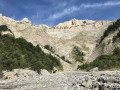
The path gradually becomes less steep but much more exposed, crossing grassy, rocky or scree-covered slopes—all of which remain steep—and crossing ravines that are often rockier (use your hands for support).

The ridge is not far away near the Cols du Courtet, du Nid and Col de la Cavale. But it is closest at the foot of the Col du Portail.

(6) From the path, climb for 10 minutes to this pass via a corridor of “devoluard steps”

(7) For a view of the east face: Combe de la Prison and Tête de la Cavale.

(6) Descend back down the Sentier de la Baronne, which crosses a first ridge at the same level, then, at the start of the descent, a second ridge, 20m above a narrow, jagged ridge.

(8) Descend through the scree to reach a grassier ridge descending from Tête de la Cavale. Then follow a series of cairns, and at the last one, don’t miss the descent into the valley to the north.

(9) Join the main hiking path coming from Rochassac.

(10) From the junction with this path, head south-west towards the Courtet mountain pastures.

(11) The path descends via wide switchbacks (alternative route in practical information).

Caution: do not descend too far towards the Saint Baudrille-et-Pipet side, but veer left at the end of the switchbacks (south-west direction) to switch properly to the Tréminis side.
The path is marked in yellow as you approach the 1717m altitude.

(12) Turn left towards the south-east to cross over to the Sous-Courtet slope (forest house) and, via switchbacks through the Pravert forest, quickly lose altitude to reach the Pravert torrent and its RTM structures.

(13) A track for machinery access exists from here, but its dusty hairpin bends are conveniently bypassed by the yellow-marked trail of the “Ebron route”.

(14) Cross the Ebron and, after two bends, head straight down the old track, which cuts across the hairpin bends of the new track.

At an altitude of 1190m, turn left to descend a marked forest track, which takes you through the Combe Amare, to a junction by a stream (1140m).

(15) Continuing straight on would lead to the Boutari car park. To return to the top of the Serre, turn left to climb an old path, destroyed by flooding: you will now be climbing a path that is heavily eroded and littered with rocks and pebbles carried down by a flood of the Torrent des Chaberts.

Climb up to the old ford, now unrecognisable, to cross the torrent and rejoin the forest track on the left bank, which remains in good condition and descends straight down to meet the ascent route.

(1) Turn right onto this path to return to the car park where you started (S/E).

Waypoints

  1. S/E : km 0 - alt. 1,057 m - Above the Serre
  2. 1 : km 0.33 - alt. 1,098 m - Common junction for outward and return journeys
  3. 2 : km 1.83 - alt. 1,423 m - Cap Brooks aircraft memorial
  4. 3 : km 2.51 - alt. 1,621 m - Platform at the old chalet (La Seia)
  5. 4 : km 3.94 - alt. 1,925 m - Start of the challenging Petites Charances route
  6. 5 : km 5.19 - alt. 2,166 m - Cliffs of the Ebron basin: end of part 1
  7. 6 : km 6.87 - alt. 2,408 m - Foot of the Col du Portail
  8. 7 : km 6.92 - alt. 2,420 m - Col du Portail (2476m)
  9. 8 : km 7.35 - alt. 2,372 m - Last ridge to cross before the descent
  10. 9 : km 7.7 - alt. 2,222 m - Grassy ridge leading down to the Rochassac path
  11. 10 : km 8.15 - alt. 2,111 m - Hiking trail from Rochassac
  12. 11 : km 8.61 - alt. 2,041 m - Summit: Courtet mountain pasture
  13. 12 : km 10.65 - alt. 1,707 m - Crossroads turning towards Pravert
  14. 13 : km 12.06 - alt. 1,411 m - Pravert Torrent
  15. 14 : km 13.01 - alt. 1,294 m - Ébron (torrent)
  16. 15 : km 14.54 - alt. 1,097 m - Crossroads leading up to Torrent des Chaberts
  17. S/E : km 15.9 - alt. 1,057 m - Above the Serre

Notes

Alternative route: Once you reach the mountain pastures, you can follow the grassy ridge and then through the forest from (11) and rejoin the path further down after (12).

Warning: the route is exposed over long stretches and is therefore only suitable for hikers with sure-footedness. Not suitable for those prone to vertigo or for children.

Avoid in wet weather and on slippery ground; in spring, wait until the snow has melted.

Otherwise, in good conditions, no special equipment is required, though you will need to use your hands a little in certain sections. Walking poles are useful, and an ice axe may be advisable for added security.

Worth a visit

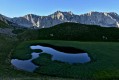
The trail is cited as one of the most spectacular; this is no myth but a reality. It is impressive to behold, but once you set off, you’ll be surprised at how easily it goes.

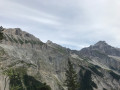
The view is unobstructed from north to south, but to the east: Chartreuse, Vercors, Diois, as far as Mont Ventoux, and of course the western side of the Dévoluy: Grand and Petit Ferrand, Tête de l’Auget, Le Rougnou, Le Nid and Tête de la Cavale, then the Bonnet de Calvin.

Legend has it that a Baroness of Tréminis had this path cut into the slopes overlooking the cliffs to allow shepherds and their sheep access to the grasslands of the Petites Charances, which she owned.

Reviews and comments

4.6 / 5
Based on 5 reviews

Reliability of the description
4.6 / 5
Ease of following the route
4.4 / 5
Route interest
4.8 / 5
Dibona38
Dibona38

Overall rating : 5 / 5

Date of your route : Aug 26, 2025
Reliability of the description : ★★★★★ Very good
Ease of following the route : ★★★★★ Very good
Route interest : ★★★★★ Very good
Very busy route : No

Hello,
I did this hike a year after the last comment, and the two scree slopes are still the most difficult part of this route. With the passage, a path has formed, and the fact that you have to descend makes it difficult but possible to avoid.
Of course, I must emphasise the difficulty of this hike. Falling is prohibited as it would be fatal on more than half of the crossing.
This route is extremely easy to follow, as there is a clearly visible path and nothing else.

Machine-translated

fruit23
fruit23

Overall rating : 4.3 / 5

Date of your route : Aug 20, 2024
Reliability of the description : ★★★★☆ Good
Ease of following the route : ★★★★☆ Good
Route interest : ★★★★★ Very good
Very busy route : No

Hello,
The path is impassable as two rockfalls have recently occurred between points 4 and 5. The first can be avoided by descending into an extremely unstable scree slope, quickly crossing the scree and climbing up a wet and slippery grassy slope. The second is impassable unless you are prepared to take extreme risks!
Given the scale of the rockfalls, restoration seems highly problematic.
Note that all the cairns have been destroyed, particularly at the changes of direction.
I think potential users should be warned of the extreme difficulty they will encounter and that the use of a rope may prove beneficial.
Kind regards
Jean-Pierre ORANGE

Machine-translated

GIELLY Bruno
GIELLY Bruno

Overall rating : 4.3 / 5

Date of your route : Aug 14, 2024
Reliability of the description : ★★★★★ Very good
Ease of following the route : ★★★★☆ Good
Route interest : ★★★★☆ Good
Very busy route : No

A challenging route with some technical sections. Ropes aren't strictly necessary, but you'll need to stay focused for half the route.

Machine-translated

Delphine2519
Delphine2519

Overall rating : 5 / 5

Date of your route : Aug 12, 2024
Reliability of the description : ★★★★★ Very good
Ease of following the route : ★★★★★ Very good
Route interest : ★★★★★ Very good
Very busy route : No

A very challenging hike,

Very well signposted, with cairns (not sure of the spelling), breathtaking scenery (!!!)

Bring walking poles and possibly a helmet (chamois can knock stones loose...).

Good physical fitness is required.

In my opinion, between points 5-6 and 7, avoid looking down if you’re prone to vertigo!
Rated 10 hours, I did it in a leisurely 7 hours (yes... I couldn’t believe my eyes ^^)
You’re going to love it!
Enjoy the hike, friends

Machine-translated

grandin
grandin ★

JCParavy

Thank you for that explanation. There are indeed no intellectual property issues.

Machine-translated

JCParavy
JCParavy

I don’t have the book by Pascal Sombardier mentioned here, so I’m not familiar with the text.
However, I did mention in the introduction that this route had been updated by Pascal Sombardier, who discusses it in his blog, which is always worth a read.
The guide published on Visorando was written solely on the basis of my solo hike on 16 August 2019.
The track is the one I recorded, manually corrected: it is obvious that, given the terrain, it must be more or less identical to those published elsewhere, except perhaps for the start and finish points, the locations of which may vary.
I do not believe that this publication infringes any intellectual property rights in any way.
Kind regards.

Machine-translated

grandin
grandin ★

vire

Thanks for that information. Does the book only contain the route, or is the text of the hike guide identical too?

Machine-translated

vire
vire
• Edited:

Overall rating : 4.3 / 5

Date of your route : Jun 04, 2010
Reliability of the description : ★★★★☆ Good
Ease of following the route : ★★★★☆ Good
Route interest : ★★★★★ Very good
Very busy route : No

I did this hike on my own in the spring, with snowdrifts in the small valleys; you can cross them easily with an ice axe by cutting a few steps.
It’s a beautiful but very challenging hike.
BUT I am surprised that Visorando has published this route, which appears in Pascal Sombardier’s book *Du Mont Aiguille à l’Obiou* on page 44, when it is stated that published routes must not be taken from books!!!???
As a great fan of the ‘Vertige’ hikes published by Sombardier, one should follow his publications with GLENAT.

Machine-translated

Other walks in the area

For more walks, use our search engine .

The GPS track and description are the property of this route's author. Please do not copy them without permission.