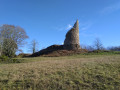
Le Puy du Sapt from Fournols

A hike in the tall forests of Haut-Livradois, the ideal habitat for Tengmalm's owls and black woodpeckers. The paths marked with crosses around the priory of Fournols offer views of the Forestier ponds, the Croix des Knolls and the Colombière.

Details

25122813
Creation:
Last update:
Last review:
  • Walking
    Activity: Walking
  • ↔
    Distance: 5.79 mi
  • ◔
    Average duration: 3h 10 
  • ▲
    Difficulty: Easy

  • ⚐
    Back to start: Yes
  • ↗
    Ascent: + 538 ft
  • ↘
    Descent: - 541 ft

  • ▲
    Highest point: 3,465 ft
  • ▼
    Lowest point: 3,182 ft

Description of the walk

(S/E) Leave the car park by taking Rue des Résistants (D105) opposite the Town Hall for about 60 metres before turning right onto the D264 towards Aix-la-Fayette and Echandelys in front of the school entrance.

Follow it carefully for about 100 metres. When you see a drinking fountain on the left, turn left onto Chemin des Rapans. Follow it until it meets Route de la Cripoche (D264).

(1) Turn left and follow the road for about fifty metres before turning left onto the old road for a circular route. Returning to the D264, head left for about forty metres, then turn left again onto the first road leading to the hamlet of Les Andes.

At the entrance to the locality, there is a beautiful view of the Sancy and the Chaîne des Puys. At the crossroads in the hamlet, take the road opposite which goes around it and continues along a path that descends gently towards the south.
Continue straight ahead for about 700 metres to reach the third path on the left. Take this path to the Croix des Knolls located at the side of the road.

(2) Turn right and follow the road carefully. Cross the bridge over the streams coming from the two ponds to the north. Immediately afterwards, take the forest path on the right, which passes slightly west of the ponds, and follow it to a T-junction. Take the path on the left.

(3) At the next crossroads, continue straight ahead on a path that curves sharply to the left, passing through a place called La Colombière before reaching the hamlet of Le Viallard.

(4) At the first crossroads in the hamlet, take the left-hand road, then straight ahead at the next crossroads and follow the road downhill to a triangular crossroads a little over four hundred metres away: there is a picnic table here.

(5) Carefully cross the road to the left of the crossroads and take the path downhill opposite, which joins the Ruisseau de la Grive stream. Cross the stream via a footbridge and at the three-way junction take the path on the right uphill.

Three hundred metres further on, turn left onto the path that climbs straight up to Puy du Sapt. Cross the hamlet and continue straight ahead downhill.

(6) At the junction with a good forest path, turn left between an isolated house and a ruin.
Two to three hundred metres further on, turn right onto a path at a detached house and its annex. The path is now flat and leads to the hamlet of La Genestière. Cross the hamlet and leave it by turning left to join the D37.

(7) Cross carefully and continue straight ahead on the path downhill towards Le Forestier. Just before you reach it, pass a pond on your left, located south of the hamlet. Take the road leading to Le Forestier heading north, which runs alongside a small pond on your right a little further on. When you reach the hamlet of Grapille, turn right onto the path leading to the D37.

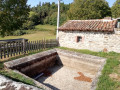
(8) Turn right and carefully follow this road, which soon runs alongside a pond on the left, where there is a stone bench and three picnic tables. Just before the first house in Fournols on the left, you will see a small calvary on the corner of some low walls. After the house, there is a small drinking fountain on the left at the side of the road. At the crossroads between the D37, which goes to the right, and the D105 opposite, you will see a beautiful circular fountain on the right. Continue straight ahead.

(9) At the next crossroads, just after the Hôtel des Voyageurs, leave the marked route and turn right onto the D264 to see the Greek cross near the crossroads with Rue de la Crouvette. Continue along Petite Rue (D264), which turns north, and return to the car park at Place de la Mairie (S/E).


Waypoints

  1. S/E : mi 0 - alt. 3,323 ft - Town Hall Square
  2. 1 : mi 0.57 - alt. 3,373 ft - Path x road D264
  3. 2 : mi 1.57 - alt. 3,304 ft - Path x road at the Croix des Knolls
  4. 3 : mi 2.62 - alt. 3,425 ft - Crossroads
  5. 4 : mi 3.16 - alt. 3,438 ft - Crossroads north-west of Viallard
  6. 5 : mi 3.52 - alt. 3,327 ft - Triangular crossroads
  7. 6 : mi 4.29 - alt. 3,363 ft - Crossroads after Le Puy du Sapt
  8. 7 : mi 4.67 - alt. 3,278 ft - La Genestière x road D37
  9. 8 : mi 5.3 - alt. 3,238 ft - Path x road D37
  10. 9 : mi 5.63 - alt. 3,274 ft - Grande Rue (D105) x Petite Rue (D264)
  11. S/E : mi 5.79 - alt. 3,323 ft - Town Hall Square

Notes

The car park is located at Place de la Mairie.
Access: from the village of Saint-Germain-l'Herm, take the D37 for 9 km towards Fournols.

This hike covers varied terrain and requires suitable footwear.

This hike does not present any real difficulty in terms of orientation as it is marked in yellow (PR®) and follows the "Le Puy du Sapt" route, updated and published by the Puy de Dôme Departmental Council and the Livradois-Forez Tourist Office. In addition, it is advisable to follow the directions in the description and on the map, combined with a good reading of the landscape. The waypoints (with their GPS coordinates and distance from the starting point) are helpful for hikers who are discovering the route for the first time.

Worth a visit

Fourniols
Places and monuments
Saint-Côme Church or Notre Dame de la Nativité (13th-15th centuries), Romanesque in style.
The church was built with an oriented layout. It has an elongated plan consisting of a single nave ending in a flat-ended choir. An annex was added to the north of the building.
The 10th-century church was built on the ruins of the feudal castle of Fournols.
Exterior elevation: The façade, consisting of a bell tower, has a pointed arch doorway on the lower level, surmounted by a niche housing a 16th-century Pietà. There are no other architectural features until the top of the bell tower, where there are four geminated arched windows with sound baffles. The two corners of the tower, on the façade, are supported by buttresses. The bell tower is covered with a hipped roof topped by a campanile crowned with a cross.
The entire building is covered with a double-sloped roof. The north side walls have no windows, apparently to protect against the cold; the south side walls, on the other hand, have arched windows. The chevet has a single window.
Interior elevation: The nave of the building is constructed on a single level, with windows on one side. It is covered with ribbed vaults and punctuated by transverse arches. This elevation and roofing have been used throughout the interior of the building, from the entrance to the flat-ended choir.

Greek cross (listed in the Supplementary Inventory of Historic Monuments on 22 July 1963).
An old cemetery cross with two equal cylindrical arms. On one side is a crucified Christ. On the other, a Virgin and Child. The openwork ornamentation features garlands of ribbed cords forming a frame around the arms. A metal collar secures it to the top of a tall octagonal shaft, the square base of which rests on a massive trapezoidal pedestal, square at its base. It dates from the 13th century.

Les Pierres Folles, a pile of rocks considered by some to be a megalithic site, healing stone, menhir, cup mark.
North of Fournols, a megalithic complex is hidden near the Boisgrand forest house. The arrangement of these stone giants has given rise to many legends. There is no shortage of "pierres folles" or "roches folles" (wild stones or wild rocks) in the Livradois region. But in Fournols, travellers can see "one of the most enigmatic sites in the Livradois mountains" (1).
The famous 18th-century map by geographer Cassini already mentions a "Boisgrand rock" near "la Foresterie". Today, its location on IGN maps allows curious visitors to easily find the site between Fournols and Échandelys. Leaving their cars in front of the forest house, travellers venture into the woods towards the well-marked site.

A Druidic monument
The stones can be seen at a fork in the path on a hillock to the left of the small trail. The multitude of stones and their almost circular arrangement led Dr Coste, a convinced Celtic scholar of the 19th century, to believe that these megaliths were a Druidic monument. These writings are reported in Jean Olléon's book (2). Altars of oblation, kromlechs (druidic enclosures), dolmens, sacrificial stones... Dr Coste gives a specific function to almost all the rocks on the site.
"At the centre of the Druidic monument, in the highest part, stands a rough monolith formed by an enormous stone six metres high and four metres wide at its base, split by lightning" (3). He believes that this monument was originally formed by another column and a flat stone connecting the two, thus forming a trilithon that served as an altar.
The circular arrangement of the rocks gave rise to the hypothesis that a series of three enclosures (kromlechs) were drawn around this central element. "Six metres from the main altar, there is a row of large, long stones forming a circular enclosure," then another eight metres away and finally a last one even further away, explains Dr Coste. He believes that, in addition to their religious use, these enclosures were also used for large gatherings, elections and even justice. Travellers can try to find these various enclosures, most of which are covered by vegetation in this wild area.
At the heart of this complex is a stone with a surprising basin at its summit. This distinctive feature has earned it the name Pierre du Bénitier (Holy Water Stone).
Source: Wikipedia and Religious Heritage (excerpts)

The Pierre du Lit and the Pierre du Bénitier
Dr Coste is categorical about its origin: this cavity was made by human hands. ... Left to its own devices, it could never have been carved out in this way by nature. He is equally certain about its actual use, since "this basin was used to contain the blood of victims during various religious ceremonies".
Finally, a little further along the path, stands an enormous rock in the middle of a clearing that the locals call the Bed Stone, a fairly common name given its somewhat elongated shape, reminiscent of a bed. Legend attributes such fertile powers to it that, in the past, "women would go there in the hope of becoming pregnant". Dr Coste, however, dismisses these beneficial virtues and attributes a much less happy function to what he calls a dolmen, explaining that "the Druids made human victims lie down on it to sacrifice them".
So is it a Druidic monument or simply a pile of granite? The loose stones of Fournols hold many secrets that are sure to pique the curiosity of visitors.
(1) J.-L. Boithias and C. Gay, Le patrimoine naturel et légendaire de l'arrondissement d'Ambert (The Natural and Legendary Heritage of the District of Ambert), Éd. Montmarie, 2005.
(2) Megaliths and religious and popular traditions in Livradois and Forez, Créer, 1992.
(3) "Découvertes d'un monument druidique et de deux camps romains à Fournols d'Auvergne" (Discoveries of a Druidic monument and two Roman camps in Fournols d'Auvergne), Clermont, 1876.
Text and photos: Rémi Pironin
Source: La Montagne article dated 16/11/2014: The strange Pierres Folles of Fournols (Puy-de-Dôme)

The Tengmalm's owl
The Tengmalm's owl, sometimes called Tengmalm's scops owl, is a small strigid with a large head. Its dark brown cap is marked with a multitude of small spots of varying intensity and highlighted by a white V between the eyes. The facial discs are white. The yellow irises ringed with black give it a very characteristic surprised expression. The upperparts are a deeper brown than those of the Little Owl and are covered with white spots aligned on the upper wing coverts. The reddish-beige underside, which is more or less barred, is lighter on the belly than on the breast. When it leaves the nest, the juvenile's plumage is entirely chocolate brown, gradually developing the adult's markings. Like many nocturnal birds of prey, it is difficult to observe.
Source: oiseaux.net website

Always be cautious and plan ahead when you're outdoors. Visorando and the author of this route cannot be held responsible for any accidents occurring on this route.

The GR® and PR® markings are the intellectual property of the Fédération Française de Randonnée Pédestre.

Reviews and comments

4.7 / 5
Based on 9 reviews

Reliability of the description
5 / 5
Ease of following the route
4.7 / 5
Route interest
4.4 / 5
User 8871496

Overall rating : 4.7 / 5

Date of your route : Mar 16, 2026
Reliability of the description : ★★★★★ Very good
Ease of following the route : ★★★★★ Very good
Route interest : ★★★★☆ Good
Very busy route : No

A lovely walk

Machine-translated

User 4382868

Overall rating : 4 / 5

Date of your route : Sep 15, 2025
Reliability of the description : ★★★★★ Very good
Ease of following the route : ★★★☆☆ Average
Route interest : ★★★★☆ Good
Very busy route : No

Pleasant route, needs updating as the path has been closed, probably by the owners

Machine-translated

VB01
VB01

Overall rating : 5 / 5

Date of your route : May 05, 2025
Reliability of the description : ★★★★★ Very good
Ease of following the route : ★★★★★ Very good
Route interest : ★★★★★ Very good
Very busy route : No

A very beautiful, easy hike. The route is very rural, with magnificent wildflowers at this time of year.

Machine-translated

Pit
Pit

Overall rating : 4.7 / 5

Date of your route : Oct 14, 2024
Reliability of the description : ★★★★★ Very good
Ease of following the route : ★★★★★ Very good
Route interest : ★★★★☆ Good
Very busy route : No

Lovely little hike. Waterlogged trails.

Machine-translated

Nicolas VERDES
Nicolas VERDES

Overall rating : 5 / 5

Date of your route : Dec 30, 2023
Reliability of the description : ★★★★★ Very good
Ease of following the route : ★★★★★ Very good
Route interest : ★★★★★ Very good
Very busy route : No

We enjoyed a lovely hike as a family. Beautiful parish-specific to Brittany colours, the sun rising through the tall trees. Pretty little hamlets along the way, we didn't meet a soul. A wonderful hike in our beautiful region.

Machine-translated

bouvreuils71
bouvreuils71

Overall rating : 4.7 / 5

Date of your route : Jun 24, 2023
Reliability of the description : ★★★★★ Very good
Ease of following the route : ★★★★★ Very good
Route interest : ★★★★☆ Good
Very busy route : No

A very beautiful hike. We enjoyed the beautiful meadows full of flowers.
No difficulty.
I recommend it.

Machine-translated

Damuse
Damuse

Overall rating : 4.7 / 5

Date of your route : Apr 17, 2023
Reliability of the description : ★★★★★ Very good
Ease of following the route : ★★★★★ Very good
Route interest : ★★★★☆ Good
Very busy route : No

A lovely hike to do with the family! A variety of landscapes, beautiful little hamlets and fresh mountain air that does you good! There are some lovely points of interest just 5 minutes from Fournols that are a must-see after your hike, such as the druidic stones and the Belvedere des Deux Frères viewpoint!

Machine-translated

BEQUILLOUX
BEQUILLOUX

Overall rating : 5 / 5

Date of your route : Oct 31, 2022
Reliability of the description : ★★★★★ Very good
Ease of following the route : ★★★★★ Very good
Route interest : ★★★★★ Very good
Very busy route : No

The route has been slightly modified from the map, but it is still a very beautiful route.

Machine-translated

REDONDIE ARLETTE
REDONDIE ARLETTE

Thank you for the correction. Have a nice day.

Machine-translated

pgetrochon
pgetrochon

Hello,
Thank you for your message. I have corrected the Visorando listing to suggest a detour to the Croix des Knolls and a return along the route, going around the ponds to the south instead of the north.
Enjoy your hikes.

Machine-translated

REDONDIE ARLETTE
REDONDIE ARLETTE

Overall rating : 4.7 / 5

Date of your route : Aug 28, 2022
Reliability of the description : ★★★★★ Very good
Ease of following the route : ★★★★☆ Good
Route interest : ★★★★★ Very good
Very busy route : No

Very nice hike, encountered a difficulty at point 2, couldn't find the path leading to La Colombière, went as far as the two ponds, barbed wire everywhere, impossible to know where to go, so we went back up to the road that led us to Le Viallard, and continued on our way.

Machine-translated

Other walks in the area

For more walks, use our search engine .

The GPS track and description are the property of this route's author. Please do not copy them without permission.