Country:

 City:
City:


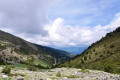
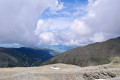
Coming from Perpignan or Mont-Louis, follow the N116 towards Bourg-Madame. Leave Err on your left and before Sainte-Léocadie, turn left onto the D89 towards Station Err-Puigmal until you reach a barrier. There is a large car park before a new barrier (2022). The old car park is now closed. A cycle path (closed to all motor vehicles) has been tarmacked as far as Jassa del Prat de Tossa.
Yellow markings are fairly consistent and should be followed in bad weather.
(S/E) Go through the barrier and continue along the tarmac road. Head south-east. After the old car park, the road becomes a tarmac cycle path. Follow it until the sharp right-hand bend.
(1) At this bend, continue straight ahead, leaving the drinking water building on your right. Follow the Ribera d'Err along a steep, unpaved track. Continue to the end of the track, which heads north-east.
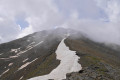
(2) After the water intake (captured spring), you will have to follow a very steep path. At around 2,550 metres, the path levels out and becomes very steep before reaching the ridge.
A large snowfield was still present on 6 June 2021. I passed through the rocks without any problems.
(3) Follow it to the right, due east, along a good path that is still marked in yellow. This will take you to the France-Spain border ridge. The Puigmal Petit de Segre is on the left, in a round trip.
(4) Now head south, still on a good ridge path marked in yellow. The path will generally descend to a barely visible fork.
At around 2790 m, there are two options for climbing Puigmal d'Err:
- either follow the yellow markings to the right.
- or follow the unmarked trail on the left, which was noted on the day of the reconnaissance.
I chose the route on the Spanish side, off the marked trail but with numerous cairns.
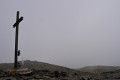
(5) A vast area dominated by two steel crosses. There are four paths leading to this summit.
Pay attention to the rest of the route
Turn south-west and descend the border ridge, following the path marked in yellow.
(6) At around 2,850 m, there are two options:
- either follow the yellow trail to the right, which crosses into France.
- or follow the trail marked on the day of the survey.
Continue along the border ridge, looking for cairns and old multicoloured markings.
(7) When the path descends steeply, at around 2,750 m, turn right, crossing into France. This will take you to the path marked with thick yellow lines. Turn left to reach a fork at an elevation of 2,637 m, where there are numerous markers. On the left, look for a large grassy depression.
(8) Turn right towards the north-west. This is followed by a 420 m descent, which is steep, rugged and difficult, heading generally west. Finally, this path joins a good grassy track at an altitude of 2217 m.
(9) Turn right onto this track for about 50 metres and turn left at a cairn to rejoin the path you climbed up. Turn left onto this path to return to the (S/E).




 Visorando Member

 Moderate
 Easy
Easy