The Fox’s Cave

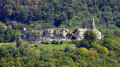
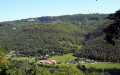
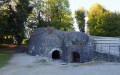
Lime production in Chalezeule is a long-standing tradition, dating back to the 12th century; it was the village’s main economic activity, and its name, Calisola, was derived from the word for lime. After exploring the lime kilns, this walk offers superb views of the feudal castle of Montfaucon, the Doubs valley and, following a short detour to the Grand Désert – a vast expanse of scree – our Citadel and the old town nestled within its circular shape. Then, after a fascinating stroll through the fort’s moats, you’ll venture, just a stone’s throw from the bustling town, onto quiet paths, accompanied by the scent of budding boxwood, for a visit to the Grotte du Renard.

Details

38940951
Creation:
Last update:
Last review:
  • Walking
    Activity: Walking
  • ↔
    Distance: 4.80 mi
  • ◔
    Average duration: 3h 00 
  • ▲
    Difficulty: Moderate

  • ⚐
    Back to start: Yes
  • ↗
    Ascent: + 892 ft
  • ↘
    Descent: - 902 ft

  • ▲
    Highest point: 1,447 ft
  • ▼
    Lowest point: 804 ft
  • ⚐ Country: France
  • ⚐ City: Chalezeule (25220)
  • ⚑
    Start/End: N 47.250651° / E 6.063677°
  • ❏
    IGN map(s): Ref. 3323ET
  • Hour-by-hour weather

Photos

Description of the walk

Car park in front of the old lime kilns on Rue des Fours à Chaux in Chalezeule. The route is marked by signposts at junctions. Yellow markings for mountain biking and trail running, with large sections unmarked. Bus stop: Four à Chaux.

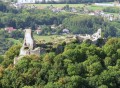
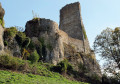
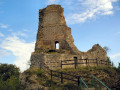
(S/E) Walk around the lime kilns, return to Rue des Fours à Chaux and turn right. At the end of the street, continue straight on along Rue des Vareilles du Milieu, then turn left up Chemin des Buis to reach the viewpoint overlooking the Doubs valley and the ruins of the feudal castle of Montfaucon.

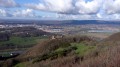
(1) Set off again along the path at the far end, passing between two large stones. After 200 metres, at the first fork, continue straight down (left-hand path). At the second fork, continue down to the left. A little further down, at an X-shaped junction, continue down to the right. Join and follow the Rebondaine cul-de-sac, with views of Montfaucon Castle and the Doubs Valley. Join the Chemin des Prés de Vaux.

(2) Follow the river on your right until just past the dog training club. Carefully pass behind the wooden barriers on the left-hand side of the road. As you come out of the bend, opposite the gap between the barriers, a signpost marked 113d indicates the start of a path on the other side of the road.

(3) Climb steeply up the winding log steps and pass in front of an old hut.

(4) At signpost 113b, join the small tarmac road to Échenoz Saint-Paul; turn right onto this road and follow it to the dead end. Head up the first path on the left, passing close to a small cave and above some old ruins – perhaps former ‘cabordes’, those winegrowers’ huts so common in our Besançon hills. Cross at right angles onto a path, which you follow to the right for about fifty metres. Take the path that climbs steeply to the left. At the top, you’ll come to a wide forest track; turn left onto this for a few dozen metres to reach the ‘dry grasslands’ of the Grand Désert.

(5) Head straight ahead across the open space, following the forest track, guided by a signpost (121) at the edge of a small tarmac road. Cross the road and continue straight on along the gravelly path that winds through the grasslands, keeping the edge of the woodland on your left.

(6) Enter the woods on the left (post 129e), heading towards Fort de Brégille, to reach the cliff-top path (129d). Then turn right and continue straight on, following the top of the ditches, and descending a few steps on the left. Do not take the dangerous path that runs along the top of the walls. Pass by a superb view of the Citadel and the Besançon mountains.

(7) Descend into the moats and turn right (post 129c) for a 800-metre circular loop through the fort’s moats. Then head back up to the left to the fort’s entrance for another view of the Citadel and the old town of Besançon.

(8) Head down the stony path opposite the entrance (signpost 129). Soon, ignore a path on your left and continue straight down to reach a fork (signpost 127b). Turn right towards the Grand Désert. You’ll reach a tarmac road at a hairpin bend. Head up to the right until you come out of the next bend.

(9) Head up the path on the left to reach an X-shaped junction. At the first fork, turn left and then right at the second. You’ll reach a tarmac road, which you follow down to the left for about a hundred metres.

(10) Turn right onto a lovely, straight forest lane: the Grande Sommière. Continue straight on for about 800 m (passing signpost 138 and its fork), heading towards Vareilles Dessus, until you reach the end of this straight lane (signpost 130).

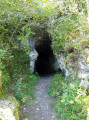
(11) Stay on this path, which curves slightly to the left (towards Chalezeule), until you reach a crossroads (signpost 132, Trail 3). Turn right towards Prés de Vaux for a few metres until you reach another fork (signpost 131). Head down to the right (Prés de Vaux) then, immediately to the left, to visit the Grotte du Renard.

(12) Head back up the path that passes in front of the cave, then turn right onto this ridge path which overlooks the valley in places. Carry on straight ahead at the next fork. Then ignore a path leading down to your right, staying on this ledge. You’ll reach a wider, stony path which you take to the right, then come to another X-junction. Take the right-hand route (mountain bike route 88) to reach the viewpoint.

(1) Turn left and follow the route back to the car park. (S/E)

Waypoints

  1. S/E : mi 0 - alt. 1,175 ft - Lime Kiln
  2. 1 : mi 0.3 - alt. 1,227 ft - Clamentigney viewpoint. Junction of the circular route
  3. 2 : mi 1.11 - alt. 807 ft - Rebondaine Path - Doubs (rivière)
  4. 3 : mi 1.51 - alt. 807 ft - Signpost 113d
  5. 4 : mi 1.64 - alt. 1,024 ft - Caborde
  6. 5 : mi 2.14 - alt. 1,398 ft - The Grand Désert
  7. 6 : mi 2.36 - alt. 1,440 ft - The dry grasslands
  8. 7 : mi 2.48 - alt. 1,404 ft - View of the Citadel and the Bregille moats
  9. 8 : mi 2.88 - alt. 1,401 ft - The old town - Fort de Brégille
  10. 9 : mi 3.37 - alt. 1,217 ft - The Bregille Fort Trail
  11. 10 : mi 3.58 - alt. 1,368 ft - La Grande Sommière
  12. 11 : mi 4.11 - alt. 1,348 ft - Mont de Bregille
  13. 12 : mi 4.2 - alt. 1,306 ft - The Fox’s Cave
  14. S/E : mi 4.8 - alt. 1,175 ft - Lime Kiln

Notes

The route includes ledge paths and unsecured viewpoints. The paths are rocky and slippery in places. Sturdy footwear is essential and the use of walking poles is recommended.

It’s close to the town, certainly, but make no mistake – this isn’t just a leisurely stroll: the climb up Mont de Bregille, between points (3) and (5), will really leave you out of breath!

Worth a visit

(S) The lime kilns: lime production in Chalezeule is a long-standing tradition, dating back to the 12th century; it was the village’s main economic activity, and its name, Calisola, was derived from the word for lime. The lime kiln, or ‘chaufour’ – a calcination kiln (a vertical, fixed structure open at the top with a wide inner wall, usually lined with bricks) – transformed limestone into quicklime. This was then slaked in an adjacent pit using a large quantity of water, before being placed in barrels for use in masonry. During the 19th century, lime was also used in agriculture to liming the soil, restoring a neutral pH to soil that tends to become acidic.

(5) The Grand Désert: dry grasslands occur on shallow limestone soils, which are generally poor in nutrients available to plant species, well-drained and exposed to harsh conditions of drought and heat. Often regarded as wasteland, they are in fact home to a rich variety of flora and fauna, with Mediterranean affinities, and play an important role in the landscape.

(7) The Citadel: overlooking the old capital of the Comté region from a height of around a hundred metres, it is one of the masterpieces of Sébastien Le Prestre de Vauban (1633–1707), military engineer to King Louis XIV. The site was listed in 1924 and has been inscribed on the UNESCO World Heritage List since 2008. The foundation stone of the Citadel was laid on Mont Saint-Étienne (whose strategic importance was noted as early as 58 BC by Julius Caesar) in 1668, whilst the town was still a possession of the Spanish Crown.

(8) Bregille Fort – also known as Fort Morand – perched at an altitude of 446 metres, was built from 1820 onwards. Like most of Besançon’s fortifications (and fortunately so), it was never used in times of conflict. You can walk around it via the moats, making for an intriguing and enjoyable stroll.

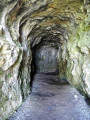
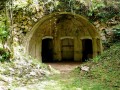
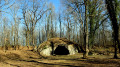
(12) The Grotte du Renard: remember to bring a torch. The cave’s main interest lies in its geology, but in 1805, there was mention of a small cave on Mont Bregille where a small treasure was discovered: two axes, a copper vase, a bronze handle and 250 coins, some of which were from the time of Nero.

Reviews and comments

4.7 / 5
Based on 3 reviews

Reliability of the description
4.7 / 5
Ease of following the route
5 / 5
Route interest
4.3 / 5
User 27492512
• Edited:

Overall rating : 4.7 / 5

Date of your route : Nov 10, 2025
Reliability of the description : ★★★★★ Very good
Ease of following the route : ★★★★★ Very good
Route interest : ★★★★☆ Good
Very busy route : Yes

This route covers a small section of the "trail des forts" route, giving us an idea of the effort required by participants in this race.
This walk also offers magnificent views of the Doubs river on the "Malate" side and Vauban's citadel.

Machine-translated

marielle.combe
marielle.combe

Overall rating : 4.3 / 5

Date of your route : Apr 08, 2024
Reliability of the description : ★★★★☆ Good
Ease of following the route : ★★★★★ Very good
Route interest : ★★★★☆ Good
Very busy route : No

Very close to the town, a lovely climb up the hillside, with a metal rope to help you at one point; a section that has been refurbished with a fitness route (recently installed)
A lovely walk to do in warm weather, as part of it is through the woods

Machine-translated

GMR25
GMR25

Overall rating : 5 / 5

Date of your route : Sep 14, 2023
Reliability of the description : ★★★★★ Very good
Ease of following the route : ★★★★★ Very good
Route interest : ★★★★★ Very good
Very busy route : No

A walk without any major difficulties, except perhaps the climb after point 3, which is very steep but well signposted; best done in dry weather. The same goes for the descent to the cave – don’t forget to take a torch as it’s quite deep. An interesting way to visit or revisit Bregille and its fort. We found it fairly quiet, even though we’re… in town, or at least very close by!

Machine-translated

Other walks in the area

For more walks, use our search engine .

The GPS track and description are the property of this route's author. Please do not copy them without permission.