Country:
 City:
City:


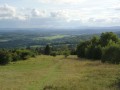
(S) Car park at the viewpoint at the top of the village of Montfaucon, Rue des Alpes. Walk down the road for about 200 metres, following the yellow and red markings, until you reach the first bend. On the left is the memorial to the explosion at Fort Woirol. Turn left towards the Le Château-Les-Rattes route, passing through a barrier. After 300 m, at the sign indicating Terrain militaire (Military Zone), do not follow the yellow-red markings that invite you to turn right, but continue straight ahead on this small road until it ends, opposite the fort's entrance gate. In front of you is the Fort Woirol antenna. You will quickly find yellow-blue markings.
(1) About 15 metres from the entrance to Fort de Montfaucon, take a hairpin turn to the left onto the path that descends along the cliffs for 400 metres to discover rock shelters and powder magazines. Of course, entry is prohibited, as it is for all the other old military buildings you will encounter. Always be careful, as there is a risk of rockfalls. At the last shelter, dated 1889, turn back and go back up to the entrance to the fort.
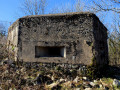
Turn right at the entrance onto the path that runs alongside the fort (MTB route 113). After about 100 metres, just before the second "Domaine Militaire" sign, leave the path that runs alongside the fort's moats and turn right onto a small unmarked path that climbs into the grove. You will arrive at the Observation Post. With your back to the post, facing a red Attention Danger sign, you will see a path that quickly splits. One path leads to a small clearing, which you ignore, taking the one on the left that winds for about thirty metres through the grove to reach the two anti-aircraft batteries. To the left of the first one, climb over a low dry stone wall. The path winds its way to the second battery to the left of the previous one. From here, you should easily spot the small tarmac road you came along.
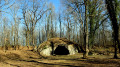
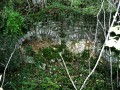
(2) Head back towards the village for about a hundred steps and a few metres before the Terrain Militaire sign you passed on the way here. This time, turn left onto the stony path (yellow-red markings). Along the way, on the right, you will come across what are probably the remains of a military structure in two semicircles, in the middle of which a tree has grown. Continue peacefully along this pleasant path until the woods disappear on the right, giving you a view of the village of Saône and the Jura mountains. On the left, there are two new observation posts. Once again, be extremely careful when visiting the site, as there are a few protected pits, but it never hurts to be overly cautious.
(3) Return to the marked path and turn back for about 400 metres. At the VTT.113 mountain bike route marker, turn right onto a small path that climbs perpendicularly for about 20 metres. You will see another Military Terrain sign. You are now on the path that runs along the fort's ditches.
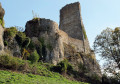
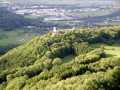
Turn right (VTT113, yellow-blue markings), go around the fort to the climbing site, a superb (unprotected) viewpoint over the Montfaucon valley and another castle, this one medieval, which belonged to the powerful family of feudal lords of Montfaucon.
(4) Continue down the path running alongside the cliffs (take care!) and crossing two pastures. After a short descent through a grove, which can be slippery, you will come to a much wider forest path at a post and sign indicating the Route des Falaises du Château (yellow-blue markings). When I passed by, the sign had fallen and was lying at the foot of the post.
Turn right. After about 500 metres, this path turns into a small tarmac road, which you follow to the end. Along the way, you will see the old Fontaine du Champ des Creux fountain on your right. After crossing a small copse, the road reaches a crossroads with another clear view of the Jura mountains.
(5) Turn left towards Chalèze-Arcier (yellow-blue markings). Pass a bench that invites you to take a short break, while a sign for Chemin de Épesses 300m above encourages you to continue in that direction. The road crosses a small open space topped by high-voltage power lines before re-entering the woods. After about 100 metres, leave the road and take a forest path sloping down to the left to reach a clearing. Ten metres before this, on the left-hand side, slightly hidden by the vegetation, you will see a small line of mossy stones arranged in a semicircle. Follow this line downhill. It will lead you to a powder magazine dug into the rock. Retrace your steps to find the path. Opposite you, a small path about twenty metres long will take you back to the small tarmac road.
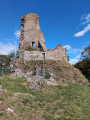
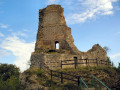
You will arrive in front of a sign indicating the direction to the right of Fort des Épesses (yellow-blue markings). Ignore the dead-end road on the left. The road gradually loses its surface and leads to the entrance to the fort. Here you will find the remains of an old bridge and its moat and, a little further on, some ruins. If you are curious, don't let your curiosity get the better of your caution. Keep your distance for fear of rockfalls.
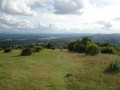
(6) Turn right at the entrance onto the yellow-blue marked trail and follow the ditches for about 100 metres. This trail joins another trail at a right angle. The markers will invite you to turn left, but ignore them and turn right, leaving the marked path and continuing straight ahead. Look for the mountain bike route signs (but facing the other way). You will come to a crossroads with five paths; choose the one that will take you to the clearing. The path runs straight ahead through a pasture. Opposite you, in line of sight, are the Montfaucon antennas and a clear view to the left of the Jura mountains, the small peak of Mont Mahoux and, further on, the massive silhouette of Mont Poupet. Join a small tarmac road.
(7) Turn left. After 300 metres, the road splits. Take the well-paved right-hand fork which, at the edge of the woods and a barrier marked Bois de la Ratte, turns into an unmarked gravel forest road. It crosses a fir forest, then a deciduous forest, and descends the hillside.
(8) You will come to a wider gravel path at a signpost. Turn left towards the Batterie des Rattes, 850 m away. After 400 m, you will come to another barrier. A yellow and blue marker on a small France Télécom post suggests you turn right to climb up to the Fort des Rattes. Ignore the paths that branch off to the right and continue along the same track. You will arrive at Fort des Rattes. Same advice: be careful! In front of the first ruin, a more or less well-marked path continues to the right and passes in front of other ruined buildings. After the second one, a small climb and a marker indicate that you should continue to the left, again along the ditches. The descent is a little slippery!
(9) You will reach a wider forest path which you take on the left, still descending, and you will come out onto a better-marked stone path. Despite the cross inviting you to go in the opposite direction, turn left and continue straight ahead. You will pass a new small blue France Télécom post (No. 4/5), then the previous barrier. You have now gone around the old fortification.
(8) Continue along this well-graveled path for 1 km until it ends at a small car park on Rue de la Pérousse.
(10) Go up Rue des Jonquilles on the right (yellow-blue markings). At the street name sign, continue right onto Rue de la Sablonnière and pass in front of a La Sablonnière electrical transformer. This street joins Rue des Ravières, where you turn right.
(1) Just before another transformer, turn left onto a cattle track that climbs straight up the hillside, keeping the large antenna in your sights. Two-thirds of the way up the slope, look for a wide opening in the thorny hedge bordering the field, which will take you back to a small tarmac road.
Head left to a small gravel car park on the right-hand side of the road and, only if you are sure-footed, take the stone mule track that climbs up the hillside.
(12) Otherwise, continue straight ahead. You will pass under a rocky outcrop shaped like a small cliff and go around it on the left. The path seems to end, but on the far left you will see a small, poorly marked gravel path climbing behind the rock for 4 or 5 metres. When I passed by, the path was marked by a small red ribbon tied to a tree. Be careful when climbing, as the stones roll underfoot! You will arrive at a final observation post. Carefully retrace your steps to return to the road.
At the car park, turn right to reach Rue du Belvédère at a bend in the road, then turn right up Rue de la Vue des Alpes. Ignore the signs inviting you to descend via the A Regardot path and, at the end of the second bend, in a space between the wooden safety barriers (yellow-red markings), a path climbs up through the pasture, taking you back to the viewpoint and the car park (S/E).




 Visorando Member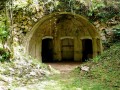
 Easy
Easy