Country:
 City:
City:


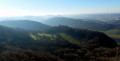
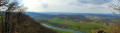
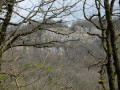

Park in the car park opposite the stadium, at the top of the village of Montfaucon. Yellow-blue markings. A significant section is unmarked.
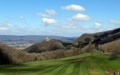
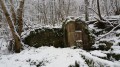
(S/E) Walk up Rue de la Comtesse Henriette, the path along the banks of the Château. On the right, there is an old fountain with a pump. When the road bends at a 90° angle, turn left onto the small tarmac road. Take a look at the valley and the castle ruins, then head straight left onto the stony path (Sentier de Nacra). There’s a lovely view to the left over the Besançon mountains. The path becomes a trail running alongside an old pile of stone gathered from fields on the right.
At a fork where the path begins to descend, take the left-hand path. The path becomes very steep (and sometimes slippery), winding its way between the rocks and the daffodils in early spring. There’s a view of the Doubs valley through the trees, which are still bare. You’ll join another path.
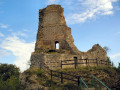
(1) Ignore the signposting and head off to the right, despite the Yellow Cross and Blue Cross which might try to dissuade you. Directly ahead of you lie the ruins of the feudal castle of Montfaucon; to your right, you’ll walk alongside some beautiful rocks, where you might, like me, spot a squirrel darting from branch to branch. You’ll soon reach the wild, secluded valley of Nacra.
At the end of the rocky outcrops, head down to the left to wade across the stream, continuing along the path on the other side, then crossing a second stream. You’ll walk along the hillside beneath the ruins of the old fortified castle, keeping to the right until you reach a more open area with dry-stone walls – no doubt remnants of terraced farming. You’ll be accompanied by the scent of boxwood, so characteristic of our Besançon limestone hills.
(2) You’ll come to a wider, signposted path which you’ll follow uphill to the right. Opposite you lies the Roche de la Côte d’Arbois, which we’re going to climb. To your left, you’ll look down on a charming little valley and its stream. When the path stops climbing, and when the stream’s narrow gorge ends and its bed merges with the walking path, you’ll turn sharply left.
(3) To help you find your way, immediately after crossing the stream, on a tree to your left, there is a yellow-and-blue Cross which you should, of course, ignore. You are once again leaving the marked trail. Immediately after the Cross, at the fork, ignore the path on the left which descends alongside the stream and continue straight on uphill. At the foot of the hill, you’ll come across another path at right angles; head up to the left, passing beneath dry stone walls. You’ll climb along the cliffs via a narrow, steep path. If you’re having trouble spotting it, simply stick close to the rock face as you climb, at least until you reach halfway up the slope. Climb carefully and with caution, as stones may come loose. At the corner of a large rock (marked with painted blue arrows), the path heads straight on, but carry on climbing, keeping close to the rock face. Halfway up the slope, you’ll start to move away from the rocks and will need to carefully cross a scree slope for a few metres. Remember to look back to catch a glimpse, through the branches, of the ruins of the old keep, with its romantic Germanic charm.
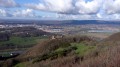
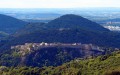
A little further on, the path becomes somewhat obscured by the stones and you will have moved about thirty metres away from the rocks to reach a more open area with, on your right, a very steep wooded hillside. Turn right at a 90° angle, climbing this hillside – which is very slippery in wet weather – with the rocks in your sights and your back to the valley. Climb carefully, making sure to plant your feet firmly. You’ll soon realise that the two walking sticks are no luxury. Once you reach the rocks – which aren’t very high at this point – walk alongside them for a few metres, veering to the right to find a narrow path that leads you to a gap between the rocks. Cross to the other side of the ridge line and  carefully head right towards a small, unprotected outcrop about twenty metres away: an unprotected viewpoint, of course, overlooking the castle, the Doubs valley and Besançon. Enjoy the view safely and carefully, keeping well back from the edge.
(4) Retrace your steps, passing beyond the gap between the rocks, whilst staying on this side of the ridge. This is the trickiest part of the route, as the path is barely visible: climb up, parallel to the ridge, skirting the rocks at a distance of about ten metres, keeping them on your left. You should come across a slightly more visible path. About fifty metres from the gap, the path veers left, climbing back up towards the ridge. You are now on the ridge and will climb the next hill in front of you via a path running down the middle of it, which is more or less visible and overgrown with scrub.
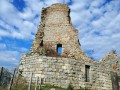
At the summit, you’ll come across an old ruin which the path passes through. Immediately after the ruin, head slightly to the left, skirting the rocks on your right, and you’ll soon reach a bend in the wider Yellow-Blue marked path, which you’ll continue to follow straight up for about a hundred metres. A Yellow-Blue sign directs you to climb up to the right onto the ‘Sentier des Falaises du Château’. You’ll enter a pasture, skirting the cliffs on your right. Take care! You’ll reach an unprotected viewpoint with a lovely view of the ruins and the valley. Continue along the path, which winds round the old Fort Woirol and leads you to its entrance.
(5) Walk a few metres along the small tarmac road, ignoring the first stony path that descends to the right, and a few steps further on take the path leading (still to the right) into the woods. At the start of a section of moss-covered stone wall, look out for the signpost and the track that climbs to the left, running alongside the ditches of the Redoute de Montfaucon.
You’ll pass under the TV transmission pylon. At the fork in the path, continue to the right. At the small patch of meadow, carry on to the viewpoint along the track that crosses it.
(6) Leave the viewpoint on the left (facing the valley) via a few stone steps, walking along the ledges 2m from the edge, with lovely views over the valley and the Citadel. You’ll enter a copse and come to another viewpoint overlooking the valley, the Citadel and the Montfaucon valley. Set off again along the path that leads away from the ledges.
You’ll reach Rue des Pâturages, which you follow downhill. At the bottom of the street, turn right onto the ‘no entry’ road (except for residents), which you’ll follow downhill to the church. Then take Rue des Fontaines opposite the porch and, just before the town hall, Rue de la Fruitière, which will take you back to the car park (S/E).


 Visorando Member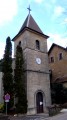

 Average