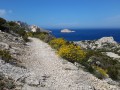
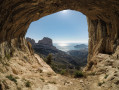
You are in the Calanques National Park, which is subject to


 Country:

 City:
City:


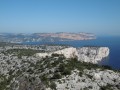
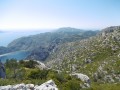
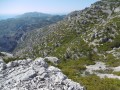
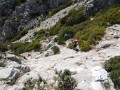
Start from Calanque de Callelongue.
(S) Immediately follow the red and white markings ofthe GR®51-GR®98and stay on this route until you reach the Col des Escourtines.
Follow the coastline, passing in turn the Calanque de la Mounine, an old battery, the Calanque de Marseilleveyre with its beach and bar, the Calanque des Queyrons and the Calanque de Podestat.
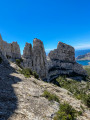
(1) Continue left on theGR®, do not take the green-marked path which branches off to the right. TheGR® climbs steeply up to the tops of the calanques, the first significant ascent, towards the Cirque des Walkyries. The scenery is spectacular.
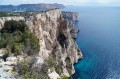
Continue along theGR® along the heights of the calanques, overlooking the Îlot de la Mélette.
(2) Reach the Col de Cortiou then head back down towards the road (be careful, the descent is tricky).
(3) Cross the road at the Col de Sormiou, which leads down to the Calanque de Sormiou, and take the track opposite. Keep following theGR® markings, which overlook the Calanque de Sormiou.
(4) Pass the Col des Baumettes and continue along theGR® to the Baou Rond junction.
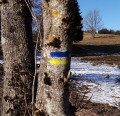
(5) Leave theGR® and turn right towards the Crêtes de Morgiou, following the blue markings. Please note that the descent towards Cap Morgiou is very technical and dangerous.
(6) Once at the bottom, turn left and continue down towards the Calanque de Morgiou. To the right, you’ll head towards Cap Morgiou and the cove where the Cosquer Cave is located.
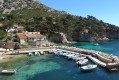
We stopped for a snack at the Port de la Calanque de Morgiou.
Resume the hike by following the coastline, marked with red signs. A difficult climb followed by a technical section involving some scrambling (the chain that used to assist with this tricky section has been removed). Take care, as the rock is slippery. Descend the metal ladder to reach Calanque de Sugiton.
(7) At the cove, take the path on the left which climbs steeply, then left again at the next junction. Climb straight up to the track.
(8) Turn left onto this track. The surface is concrete. The climb is long, tiring and uninteresting.
(9) At a hairpin bend, leave the track to take a shortcut and rejoin it. Turn right and continue to the next junction, which rejoins theGR®51-GR®98.
(10) Turn right onto it and stay on it until you reach the finish. Cross the valley and head for the next junction.
(11) Take the path on the left and leave the track. From this point, you begin the ascent of the Col de la Candelle. Never stray from the red and whiteGR® markings, despite the numerous junctions with other paths.
The scenery is breathtaking. This section is difficult, long and involves a significant climb. At the pass, you will be at the highest point of the hike. The view to the west overlooks the calanques you have already crossed and the Îles de Riou. To the east, Cap Canaille, the Pas du Diable and the cliffs of Denvenson. You will also be able to see the route you still have to cover.
(12) At the pass, continue along theGR® which heads left and then descends into the valley floor. Pass above the Pas du Diable, also known as the Pas de l’Œil de Verre, and continue to the Col de l'Oule.
(13) Follow theGR® straight ahead (ground markings “En Vau”), which descends steeply into the Vallon d’En Vau. To the right, the path leads to the Belvédère d’En Vau.
(14) Turn right towards the Calanque d'En Vau and descend to a junction where theGR® branches off to the left.
(15) Take theGR® to the left. The climb is steep and very difficult over scree (120m elevation gain over 300m). Once at the top, cross the track and continue along theGR® which descends steeply towards the Calanque de Port Pin. At the bottom of the calanque, climb up the other side and follow theGR® along the Calanque de Port Miou.
At the end of the calanque, you’ll find the car park and the end of this journey (E).




 Visorando Member
 Difficult