You are in the Calanques National Park, which is subject to


 Country:

 City:
City:


Coming from Marseille, cross Les Goudes towards Callelongue, negotiate the hairpin bend and park in the first car park on the right.
No markings
(S/E) Turn back along the road towards Les Goudes. Before reaching the first houses (wooden post with a 30 km/h speed limit sign), climb the embankment on the right. The trail, which is not very distinct at first, becomes clearer at the houses, which it runs behind.
You will soon reach the start of a north-east facing valley. Climb up this valley, keeping to the right. As you progress, the stony trail becomes less distinct: simply follow the winding valley floor, which ends in a scree slope. Climb this slope to reach a marked cross-country path.
Markings:GR® White and Red + Black
(1) Turn right and you will come to a crossroads marked by a large cairn preceded by a small rock bearing numerous markings. Continue straight ahead. A few metres further on, leave the red marking no. 1 on your left and reach a small pass where you must turn left (elevation 65).
The descending path leads to a flat area. Continue on the right, keeping to the right at the next fork (elevation 14). Pass a house on your left.
Green markings
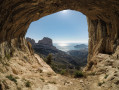
(2) Before reaching the next building, turn left onto a wide stony path which narrows after the first steep section. Climb the steep path which winds along the northern flank of the Rocher des Goudes. The well-marked signs help you navigate the numerous rocky sections and lead to the narrow entrance to the Grotte de l'Ermite.
Green dotted markings no. 2A
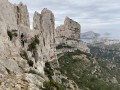
(3) Just before this, turn right onto a path on the side of the Rocher de Saint-Michel. A few rocky passages where you need to use your hands lead to the most challenging part of the route: a very narrow ledge about 40 metres long that you need to cross very carefully to reach the Pas de la Demi-Lune.
(4) Cross this gap, which offers an exceptional view: Les Goudes and Île Maire on one side, Île de Jarre, Île Plane and Île du Riou on the other.
Green dotted markings no. 2A
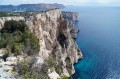
Turn left onto a narrow path along the cliff edge on the southern slope of Rocher Saint-Michel. After a steep descent, you will reach a fork marked by green dotted markings on the ground indicating the path you have just taken andyellow PR®markings with the indication "Callelongue" on the right.
YellowPR® markings
(5) Turn left. Descend to the point marking the end of the Vallon de la Mounine, then climb back up to the Col de la Galinette (elevation 149). Continue to the left as indicated by the markings.
(6) At a yellow marker on the ground, look for a large rock on the right with the very old inscription "Calanque Marseilleveyre" and a dotted yellow trail marker. Turn right and go around this rock on the left: the trail marker no longer exists on the ground. The descent is steep and includes several sections where you will need to use your hands to climb down. You will also need to watch out for the many loose stones underfoot. Continue down to the bottom of the valley and continue on flat ground until you reach the junction with the path coming from Grand Malvallon.
Green markings
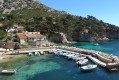
Continue to the right. Pass Plan des Cailles and head for the buildings at Calanque de Marseilleveyre. Once you reach theGR® signpost, squeeze through the narrow rocky passage that leads to the cove and the beach. Swimming is possible in the summer.
(7) Retrace your steps to theGR® signpost.
GR® trail markers: white and red + black
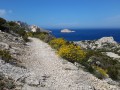
Turn left towards Callelongue. The wide, stony path climbs higher, offering beautiful views of the islands. You will reach a crossroads at the tiny Calanque de la Mounine.
(8) Continue left, following the double markings. The path passes at the foot of the old semaphore and, after a few rocky passages that can be difficult to navigate, leads to a high point offering breathtaking views of Île Maire and Callelongue, which you reach after a quick descent.
Once on the tarmac, turn left towards the roundabout and walk back up the road, keeping to the left-hand side to enjoy the view all the way. Pass the viewpoint on your left, then the first bend, and return to the car park (S/E).

 Visorando Member
 Very difficult
 Association / Club / Walk leader