The circular route of the Col de Cuberselle, Combe Noire and Abarjavan passes

A magnificent circular route passing through three passes with Mediterranean vegetation. Sheltered from the wind and well exposed to the sun, this hike allows you to discover the heights of Veynes with beautiful views of the Buëch valley, even if some aerial passages can be impressive at the edge of ravines. It gives a good overview of the Veynois National Forest and the complex relief of the Buëch mountains.

Starting from the small town of Veynes, this hike is easily accessible without a car!

Details

89450961
Creation:
Last update:
Last review:
  • Walking
    Activity: Walking
  • ↔
    Distance: 9.73 km
  • ◔
    Average duration: 4h 20 
  • ▲
    Difficulty: Moderate

  • ⚐
    Back to start: Yes
  • ↗
    Ascent: + 555 m
  • ↘
    Descent: - 549 m

  • ▲
    Highest point: 1,293 m
  • ▼
    Lowest point: 850 m

Description of the walk

Take the D994 road or the train from Veynes-Dévoluy station to the centre of Veynes. Take Rue de la Chapelle then Boulevard Stendhal towards the municipal swimming pool. Park in the swimming pool car park.

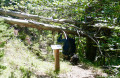
(S/E) From the car park, walk down Boulevard Stendhal towards the boules court, heading east (pedestrian path protected by red barriers) for about 100 m until you reach the wooden hiking sign.

(1) Turn left onto the GR®94D trail (marked red and white) towards the Col de Cuberselle. The trail climbs steeply into the ravines overlooking Veynes, hiding the drop below. These are grey marl formations, characteristic of the Buëch region.
Ignore the paths on the right and then on the left. Enter the wooded area of the Égarets plateau where the trail becomes a flat forest path.

(2) Continue straight ahead on the GR® trail, heading north, and leave the path on the left.

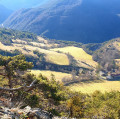
(3) Continue straight ahead towards the Col de Cuberselle, following the GR®. The path becomes flat, heading north, then begins to climb with ravines on the right and forest on the left. The slope becomes steeper at the edge of the ravine, but the path is fine, apart from the feeling of emptiness. Magnificent view of Veynes.
The path becomes flat again, with a balcony profile that is less physically demanding. You enter a wooded area and the vegetation reappears: the trail is lined with Montpellier aphyllantes (a Mediterranean flower typical of poor, dry environments).
As you approach the pass, climb the steeper slope via a few switchbacks.

(4) Continue opposite on the GR®94, which climbs towards the Col de Combe Noire and the Col de Berthaud. The path climbs gently along the hillside. A slightly open section offers a view before you reach the Col de Combe Noire.

(5) Leave the GR®94 (which heads right towards Col de Berthaud). Take the path opposite, "Veynes par Serre et La Grange", heading west. The route continues through the forest , which is quite pleasant. Admire the landscape between the trees, particularly the Tête de Garnessier to the north. Walk along a ridge to reach Col de l'Abarjavon.

(6) Turn left to descend, heading east. The slope is steep at first, but then levels out as you pass along the left bank of the Torrent de Serre ravine. Finish on a fairly flat path to reach the signpost near the ruins of the Ferme de Serre.

(7) Take the path on the right to descend to the bottom of the valley. Cross the Torrent de Claüs and continue downhill, passing a few steps. After the rocky area, the forest path joins a forest track. Continue downhill on this track and pass a building (Ferme de Claüs). The track continues southwards and arrives at a group of houses.

(8) Cross the ford near the wooden footbridge and arrive at the junction between Chemin de Claüs and Clavus. Descend the path on the right for 100 m towards the south, following the Rif de Saint-Marcellin, until you reach the crossroads at the tarmac road and a farm shed.

(9) Take the path that climbs furthest to the left, leaving the two roads behind. Pass a telephone pole and climb behind the La Grange farm before entering the forest.
The track winds three times, then, in a large upward curve, reaches the Égarets plateau.
Walk along the fields, then enter the forest again, staying on the main path, which climbs then levels out, heading east. Continue along a trail until you reach the outward route. Enjoy the views of Veynes on the way down.

(3) Take the opposite route, turning right and heading back to the swimming pool car park (S/E).

Waypoints

  1. S/E : km 0 - alt. 850 m - Veynes swimming pool car park
  2. 1 : km 0.08 - alt. 852 m - Start of the hiking trails (wooden sign)
  3. 2 : km 0.61 - alt. 973 m - Forest crossroads
  4. 3 : km 0.7 - alt. 977 m - Crossroads of the circular loop
  5. 4 : km 2.69 - alt. 1,254 m - Col de Cuberselle
  6. 5 : km 3.71 - alt. 1,291 m - Col de Combe Noire
  7. 6 : km 4.33 - alt. 1,270 m - Col d'Abarjavon
  8. 7 : km 5.28 - alt. 1,118 m - Post 503 - Serre farm
  9. 8 : km 7.22 - alt. 860 m - Clavus ford
  10. 9 : km 7.32 - alt. 858 m - Croisement de la Grange
  11. S/E : km 9.73 - alt. 850 m - Veynes swimming pool car park

Notes

Free parking, fountain and all amenities in Veynes, including Veynes-Dévoluy station (train and bus).

Some aerial passages can be impressive at the edge of ravines, especially on the slopes ofthe first part : remain cautious because even if the path is stable, it can upset those who are afraid of heights.
The start of the trail is in full sun, so it is best to avoid it when it is hot, or else set off early in the morning and take plenty of water with you.
The rest of the route is pleasant and straightforward.

Shorter alternative:
At Col de Cuberselle (4), leave the GR® which climbs to Col de Combe Noire and take the path downhill on the left to reach the ruins of the Serre farm (7). Elevation gain 500 m, total time 3h30.

Worth a visit

The start of the route is undoubtedly the most difficult: it climbs steeply and the Mediterranean vegetation on this south-facing slope offers little shade for hikers. After that, it turns into a walk in the forest, as the three passes are wooded and offer no visibility. However, there are many views to the west, with magnificent panoramas of the Drôme mountains.

Veynes, the capital of the Hauts-pays du Büech, is nestled in the middle valley of the Petit Buëch. This former stop on the Roman road between Briançon and Die was a prosperous site in the Middle Ages, attracting Jewish bankers and Lombard merchants. This small town of 3,400 inhabitants is full of architectural treasures: churches, chapels, old houses, castles and manor houses.

  • Saint Sauveur Church: one of the oldest buildings in the town, dating back to the 11th century. It features Romanesque architecture. In 1692, the building was set on fire by the army of the Duke of Savoy. It was not rebuilt until 1778. Nearly ten years after its reconstruction, the cemetery, which until then had been adjacent to the church, was moved to its current location. The church tower was rebuilt at the end of the 19th century and the entire building was completely renovated in 1962 with the addition of the porch.
  • The town hall: the Château de la Villette was built in the 15th century by the family whose name it bears. Of particular note are the town gate and the old tower.
  • Place Adrien-Ruelle is one of the most important squares in the town. It was formerly known as Place Grenette or Place aux Grains. It was named Adrien Ruelle in honour of the engineer who left his mark on the town's history. A beautiful fountain dating from 1687 stands proudly in the middle of the square.
  • Market every Thursday from 8 a.m. to 1 p.m.
  • The Cheminot Veynois Ecomuseum invites you to relive the railway history that opened up the Hautes-Alpes in the 19th century. Immerse yourself in the amazing world of railways, from 1850 to the present day. Many period tools and equipment are on display. You can also discover reconstructions of a 1900 ticket office, a 19th-century waiting room, a model of the old roundhouse and a model train with the La Rochette level crossing and Montmaur station. In the garden, you will find a level crossing gate, an above-ground/underground junction gate that was used as a tunnel, a brake gate, a hydraulic crane and more.
  • The museum of traditional costumes and crafts helps visitors discover part of the history of the Hautes-Alpes. Several rooms have been set up. A treasure hunt for accompanied children will enhance their visit. Many of the headdresses that characterised each costume are also on display. The museum strives to preserve and showcase this precious testimony to an activity that has now disappeared. Free admission.

Always be cautious and plan ahead when you're outdoors. Visorando and the author of this route cannot be held responsible for any accidents occurring on this route.

The GR® and PR® markings are the intellectual property of the Fédération Française de Randonnée Pédestre.

Reviews and comments

4.3 / 5
Based on 1 review

Reliability of the description
5 / 5
Ease of following the route
3 / 5
Route interest
5 / 5
User 3671348

Overall rating : 4.3 / 5

Date of your route : Apr 16, 2026
Reliability of the description : ★★★★★ Very good
Ease of following the route : ★★★☆☆ Average
Route interest : ★★★★★ Very good
Very busy route : No

On the way down, the markings are scarce; a forest track prevents us from spotting the poorly marked path, but we manage to find our way back onto the right route.

Machine-translated

Other walks in the area

For more walks, use our search engine .

The GPS track and description are the property of this route's author. Please do not copy them without permission.