The water cycle and natural environments of the Saône marshlands

This easy loop takes hikers on a journey of discovery through forests, pastures and preserved wetlands. You will pass through the typical hamlet of La Couvre, peaceful woods and pretty wooden pontoons will lead you to the ponds of Prés Neufs, La Vaivre, and Creux sous Roche, which drains water from the Bisontins to the source of Arcier. The route offers a variety of settings: old farms, romantic ruins, streams and clearings. Between the reflections on the water, the croaking of frogs and the rural landscapes, the walk charms visitors with its diversity and tranquillity. Accessible to all, it is an ideal nature walk for families.

Details

83902769
Creation:
Last update:
Last review:
  • Walking
    Activity: Walking
  • ↔
    Distance: 6.57 km
  • ◔
    Average duration: 2h 00 
  • ▲
    Difficulty: Easy

  • ⚐
    Back to start: Yes
  • ↗
    Ascent: + 35 m
  • ↘
    Descent: - 35 m

  • ▲
    Highest point: 409 m
  • ▼
    Lowest point: 374 m

Photos

Description of the walk

Parking at the Saône roundabout (Route de Maiche), third exit (Rue de la Pérouse) on the left. White-red markings.

(S/E) Head towards the roundabout, using the pedestrian crossing. Cross carefully, follow the pedestrian crossing on the other side to reach the start of the hike. Take the gravel path on the right, which quickly leads to a signpost (Boucle des milieux naturels).

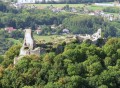
(1) Head straight ahead along this path, below the main road, which enters the woods. This is a beautiful forest path, a little noisy at first, but it quickly moves away from the road and the noise. Along the way, on your left, you will have a view of the Gratteris cliffs. You will reach the hamlet of La Couvre with its beautiful old farms.

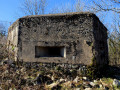
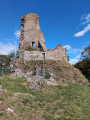
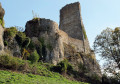
(2) At the crossroads (last farm), turn left down into the pastures. Enter the woods to discover the romantic ruins of an old property with its gate and a long, shady driveway that stretches on without becoming boring. Pass by a first small pond, accompanied by the song of the "grebeuces", our Franche-Comté frogs.

(3) Turn left at marker post no. 11 for a return trip of about fifty steps to discover the Prés Neufs ponds. Return to the path and continue to the next marker post, noting a path on the right.

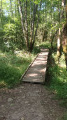
(4) Cross the Ruisseau des Marais via the footbridge. At the nearby fork (marker no. 10), continue to the right along the long wooden pontoon to cross a wetland and arrive at the beautiful Vaivre pond and a fork in the path.

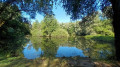
(5) Turn left to go around the pond. There is a bench where you can take a break and admire the pond, which acts as a mirror. Between sky and water, the boundary disappears. Turn left after the bench onto another very long pontoon. You will return to dry land by walking along a pasture on your left until you reach Creux sous Roche.

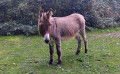
(6) Continue along the path to reach the "Pâture" and its curious donkeys. Cross the stream again via a small bridge and rejoin the stone path, turning left and crossing a footbridge until you reach the next fork.

(7) Turn right, overlooking the Ruisseau des Grands Terreaux stream, 3 metres below. The path becomes grassy, and you will come to a new signpost and a hunter's observation post.

(8) Enter the field on the left, through the chicane, and continue straight ahead, following a drainage ditch for a while, until you reach the opposite edge. Continue along the beautiful forest path, then walk up the field to the first signpost.

(1) Turn right to return to the car park (S/E).

Waypoints

  1. S/E : km 0 - alt. 409 m - Rond-point de Saône, Rue de la Pérouse
  2. 1 : km 0.2 - alt. 400 m - Natural environment loop
  3. 2 : km 1.59 - alt. 392 m - La Couvre
  4. 3 : km 2.66 - alt. 382 m - The Champs Neufs ponds - Marais de Saône
  5. 4 : km 3.06 - alt. 381 m - The water loop
  6. 5 : km 3.22 - alt. 381 m - La Vaivre Pond
  7. 6 : km 3.92 - alt. 374 m - Rock hollows
  8. 7 : km 4.61 - alt. 383 m - Les Grands Terreaux
  9. 8 : km 5.25 - alt. 383 m - Bois de la Verne
  10. S/E : km 6.57 - alt. 409 m - Rond-point de Saône, Rue de la Pérouse

Notes

Throughout the route, certain sections pass through fragile environments linked to the presence of protected species or remarkable habitats. In these areas, it is essential to behave respectfully: stay on the marked paths, keep noise to a minimum and avoid picking plants or disturbing wildlife. The tranquillity of these areas contributes directly to their preservation. Depending on the time of year, specific rules may apply; please pay attention to the signs on site in order to preserve this natural heritage for the long term.

This route passes through multiple protected areas, which may be subject to special regulations:

Worth a visit

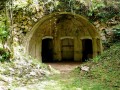
The ice house: on the edge of the marsh, traces of an old estate remain. A collapsed surrounding wall and a wrought iron gate are reminders of past activity. According to Cassini's map, the site was once home to a tile factory. Today, this mysterious site is known as "La Glacière " (the ice house).

(3) The Prés Neufs ponds: at the heart of the marsh, there are no fewer than 55 bodies of water, including the Prés Neufs ponds, which were created in 2001. Unlike those of La Vaivre, their configuration is ideal: gently sloping banks and well-defined shores promote biodiversity. The natural maintenance of the surrounding area is ensured by extensive grazing by Konik Polski horses, thus preserving the ecological balance of the site.

(4) The Marais stream: after passing through pleasant undergrowth, a footbridge allows you to cross the stream. Its deeply carved bed is a reminder of the old dredging work carried out to drain the wetland. Further upstream, its course has been rectified and completely reshaped: it now follows the path of the old Marais stream bed, which was once more winding and natural.

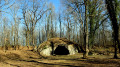
(6) Le Creux sous Roche: at the viewpoint, the natural site of Le Creux sous Roche stretches out. This karstic funnel, located at an altitude of 367 metres, is a special feature of the landscape: the waters of two streams disappear into the ground here to join the Arcier spring, located 267 metres below. In the event of excess water, the surplus flows to the Bergeret spring. This water, naturally filtered by limestone formations, is then collected and treated at the Malate drinking water production plant to supply the city of Besançon. The site perfectly illustrates the importance of karst areas in the management and protection of drinking water, justifying the strict regulation of the surrounding catchment areas in order to preserve this precious resource.

(8) Les Grands Terreaux: the path overlooks the small stream of the same name, three metres below. Under the canopy of oak trees, traces of ancient meanders, now filled in, can still be seen. Their disappearance has altered the natural balance of the watercourse: the flow is now more linear and the diversity of habitats has been reduced, leading to a decline in wildlife. This area thus illustrates how valuable the natural dynamics of rivers are for biodiversity.

(8) Drainage ditch: these structures, common in the 19th and early 20th centuries, were built to meet agricultural needs, to gain pasture land and to limit flood zones. Marshes were considered unhealthy and unproductive areas that needed to be drained. Today , however, the importance of these wetlands for biodiversity and natural water regulation is recognised. The stream and its marsh now form a valuable ecosystem, home to amphibians, birds and numerous plant species adapted to waterlogged soils.

(8) La Verne: an old term used in Franche-Comté to refer to alder trees. Here lies a rare marshy alder forest, a wet forest environment dominated by black alder. These forests play an essential role: they naturally filter water, limit bank erosion and are home to a wide variety of biodiversity, including amphibians and numerous birds. In Franche-Comté, this type of environment is still relatively uncommon, which gives La Verne major ecological significance.

Reviews and comments

4.3 / 5
Based on 1 review

Reliability of the description
4 / 5
Ease of following the route
4 / 5
Route interest
5 / 5
User 2753782

Overall rating : 4.3 / 5

Date of your route : Oct 18, 2025
Reliability of the description : ★★★★☆ Good
Ease of following the route : ★★★★☆ Good
Route interest : ★★★★★ Very good
Very busy route : Yes

It is a beautiful route for exploring the Saône marshes. The route is well laid out (with wooden walkways and small bridges to cross the streams).

Machine-translated

Other walks in the area

For more walks, use our search engine .

The GPS track and description are the property of this route's author. Please do not copy them without permission.