The feudal castle of Montfaucon, Fort Woirol and the Fontaine de la Dhuit

Between forest paths and old walls covered in ivy, this hike immerses you in nature and heritage: from the Vue des Alpes viewpoint to the cliffs overlooking the Doubs valley, the route offers panoramic views of the Citadel, the Jura Mountains and the Saône plain. Along the way, history unfolds: Fort Woirol, marked by a tragic explosion, the optical post and its anti-aircraft batteries, as well as the imposing remains of the feudal castle, testimony to a rich medieval past.

Details

83783258
Creation:
Last update:
Last review:
  • Walking
    Activity: Walking
  • ↔
    Distance: 7.90 km
  • ◔
    Average duration: 3h 05 
  • ▲
    Difficulty: Easy

  • ⚐
    Back to start: Yes
  • ↗
    Ascent: + 285 m
  • ↘
    Descent: - 277 m

  • ▲
    Highest point: 606 m
  • ▼
    Lowest point: 405 m

Photos

Description of the walk

Parking at Montfaucon, at the top of Rue du Belvédère, at the start of Chemin du Mont. If there are no spaces, drive down a few metres to find another car park on the left. Yellow-blue markings, some sections without markings.

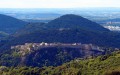
(S/E) Climb up Rue de la Vue des Alpes to the first bend nearby. Turn left into Rue À Regardot, then turn right at the nearby fork and enjoy the beautiful views of the Jura mountains. At no. 10, climb up the grassy slope on the right to find the zigzag path around the corner of a low wall. Follow the edge of the pasture, passing the first path on your left and taking the second to get closer to the cliffs and a beautiful viewpoint over the Citadel, the ruins of the feudal castle and the distant silhouette of Mont Poupet. Continue along the path to return to the pasture and reach the Belvédère des Alpes, which you may be lucky enough to see on a clear day.

(1) Turn your back on the viewpoint and descend the path through the grass that runs alongside the road. Take the forest path, following the yellow-blue markings. Soon, at a fork, climb left up the scree. Just before a corner in the ditch, at the fork, continue left, still following the ditch to reach the entrance to Fort Woirol.

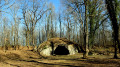
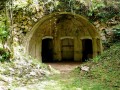
(2) At the entrance to the fort, take the path on the left that descends and forms a hairpin bend with the road. Be careful, as rockfalls are possible. You will pass the rock shelter of five casemates, built between 1890 and 1893, which could be used as barracks in times of war, most of which have collapsed. Do not be imprudent enough to visit them.

This stony path becomes the Chemin des Poudrières at the first houses at the top of the village of Montfaucon. You will pass a pretty eco-friendly house and a beautiful panorama. Continue to the "Give Way" sign at the junction with Rue du Château. Go down to the right until you reach the bend.

(3) Turn right down Chemin du Donjon. There is a beautiful view of the valley topped by the ruins of the old castle. This path leads you to the foot of the castle, which has been renovated by a volunteer association. On the right is an old spring.

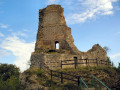
(4) Climb up to the castle, passing under the old reconstructed gate. Take the stone path on the left, which first leads you to the old parish church built in 1311, then along the entrance tower and ramparts to the old keep, inhabited by crows. There is a table set up for picnics. Climb to the foot of the keep via a small footbridge to admire the view of the Doubs valley and the valley.

(5) Cross the footbridge again and walk past the flagpole flying the colours of Montaucon to discover a stone staircase, which leads down to the path that skirts the ruins. Continue to the right, passing below the church as the path begins to curve towards the entrance to the castle (picnic tables, rustic toilet). At the foot of the staircase, enjoy a beautiful, unspoilt view of the Monts Bisontins, as they were before urbanisation.

(6) Continue straight ahead along the path. You will walk past old ruins covered in ivy from the old village. Do not be foolhardy enough to approach them (risk of collapse). Continue to the very tip of the promontory. Go around it on the right, walk along the other side of the ruins, then return to the tables.

(6) Go down to the left, along the path that runs alongside the dry toilets, then immediately turn left again, walking along the walls and joining a stone staircase. Go down to the right, continuing along the path that winds through an orchard and joins the marked hiking trail below. Go down to the left along this stony path for about a hundred metres, arriving at the top of a small valley cluttered with fallen trees.

(7) Head to the far right. At the foot of the mountain, you will reach another path running perpendicular to this one. Climb up to the right. Soon, at a fork, continue to the right. You will arrive at a crossroads of paths forming an X. Continue straight ahead (blue arrow). The path turns to the right and, immediately at the new fork, continue straight ahead. Shortly after a small cairn, you will arrive at a fork.

(8) Turn right onto a parallel path and descend to the right towards the Fontaine de la Dhuit. Retrace your steps and climb to the right, returning to a beautiful stone path with signposts. Climb to the left. After the bend, continue for about a hundred metres.

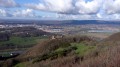
(9) Climb to the right onto the Falaises du Château path. You will enter a pasture, walking along the cliffs on your right. Be careful! You will reach an unprotected viewpoint with a beautiful view of the ruins and the valley.

(10) Continue along the path around the old Fort Woirol. When you reach the entrance, shortly after the third "Terrain Militaire" sign, look for a path on the left (or the second one, a little further on).

(11) Climb into the woods via the path that leads to the observation post. Turn your back on the post and head towards the open area, veering left towards the aircraft battery bases. After the third one, enter the woods via a path on the left that quickly joins a wider trail. Turn left and walk about 20 metres, then at the next fork, take the path on the right downhill. Pass under a power line, then climb back up to the right. You will come out behind some houses, near a tree that splits into four trunks.

(12) Descend at a 90° angle, following the edge on your left, for about twenty steps. Be careful, do not let your children run ahead! Turn left onto a small, unassuming stony path. Cross a mound of rubble, with a beautiful view of the Saône plain. Continue along this path. Four metres before another mound, carefully take seven small steps to the right, onto the path (barely visible) that leads you to the top of nearby rocks, hidden by vegetation. On the left, the path becomes clearer and takes you down into a scree slope. Further down, the path splits. Take the right-hand path, skirting a rock face, and descend towards Chemin du Mont and the car park (S/E).

Waypoints

  1. S/E : km 0 - alt. 551 m - Chemin du Mont
  2. 1 : km 0.81 - alt. 596 m - Belvédère de la Vue des Alpes
  3. 2 : km 1.45 - alt. 596 m - Fort Woirol - Fort Woirol (ou de Montfaucon)
  4. 3 : km 2.78 - alt. 503 m - The Montfaucon valley
  5. 4 : km 3.84 - alt. 457 m - The feudal castle - Château de Montfaucon
  6. 5 : km 4.25 - alt. 484 m - The keep of Montfaucon
  7. 6 : km 4.68 - alt. 464 m - The old village
  8. 7 : km 5.24 - alt. 405 m - Top of a small recess
  9. 8 : km 5.56 - alt. 462 m - Fontaine de la Dhuit - Fontaine de la Dhuit (Montfaucon)
  10. 9 : km 6.03 - alt. 514 m - The climbing cliffs
  11. 10 : km 6.44 - alt. 562 m - Viewpoint over the feudal castle
  12. 11 : km 7.04 - alt. 601 m - Optical station and batteries for aircraft - Fort Woirol (ou de Montfaucon)
  13. 12 : km 7.64 - alt. 579 m - The invisible blockhouse!
  14. S/E : km 7.9 - alt. 551 m - Chemin du Mont

Notes

(!) The route includes cliff-edge paths and unsecured viewpoints. The paths are rocky and slippery in places. Sturdy footwear is essential and walking sticks are recommended. Keep your distance from the ruins. " Dear walkers, these buildings are in ruins. For your safety, please stay on the path. Montfaucon Castle and its village are communal property and are not secured," the local council advises.

(12) The invisible blockhouse: rest assured , there are no ghosts haunting the area, but an uncompromising owner has now prohibited access to the blockhouse via a path that was previously marked. This is undoubtedly the result of the success of Visorando, which has attracted too many walkers to these once more secluded paths. No regrets, it is now lost in the vegetation. The return to the car park was therefore via discreet, sometimes barely visible paths, on which you will need to tread carefully, but which pose no difficulty if you follow the description.

Worth a visit

(2) The Fort de Woirol, built between 1874 and 1878 as part of the Besançon entrenched camp, dominates the Thise valley and the Saône plateau, and was one of the few "Séré de Rivières" forts: built of masonry covered with earth to withstand the artillery of the time. On 16 September 1906, in the early afternoon, several witnesses observed lightning striking the fort while the lightning rod was not yet operational; a huge explosion followed, blowing up the main powder magazine, shattering windows within a 1,200-metre radius and transforming part of the new fort into a pile of rubble where eight bodies were discovered, including six civilians (walkers, as it was a Sunday) and several wounded, including five soldiers. Armed with a dozen artillery pieces and firing casemates, it illustrates the desire to strengthen French defences after the 1870 war. Quickly overtaken by military advances, it lost its strategic role at the beginning of the 20th century and was used occasionally as a depot or training ground. Now abandoned and partially overgrown, it remains a testament to the military architecture of the Third Republic and a discreet but historically significant site.

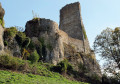
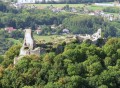
(4) The feudal castle of Montfaucon dates back to the 11th century, when Conon de Montfaucon built the first wooden fortress. Rebuilt in stone at the end of the 13th century by Amédée III, it became the centre of a castle town with a church and a bailey. A fiefdom of one of the most influential families in the county of Burgundy, it then passed to the Chalon-Arlay family, princes of Orange, before being abandoned after the Ten Years' War in the 17th century. Acquired by the municipality in 1984, the site has since undergone restoration and offers visitors the imposing remains of its walls, towers and keep, perched on a rocky spur overlooking the valley.

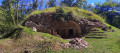
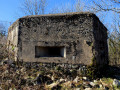
(10) The optical post at Fort Montfaucon is a small vaulted masonry casemate, partially buried under a thick layer of earth to provide solid protection against pre-1885 shells. Light was provided by a petrol lamp, then an electric lamp. During the day, a heliostat captured the sun's rays through a chimney. The fort communicated with three other fortresses: the Grelimbach redoubt in Salins, the Larmont in Pontarlier and the Lomont defensive pier. The system used a variable light source: in broad daylight, a heliostat (a mechanical device consisting of mirrors automatically tracked by a clockwork mechanism) captured the sun's rays, directed them through a chimney pierced in the vault, and focused them into transmission ducts (horizontal conduits) precisely oriented towards the distant forts. In the absence of sunlight or at night, light was provided either by a petroleum lamp or, from the early 20th century onwards, by an electrical installation. The forts of the Séré de Rivières system were equipped with alternative means of communication to mitigate the risk of power cuts or interception of electrical cables. Optical telegraphy remained a robust and discreet means of communication, resistant to enemy attacks or espionage.

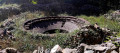
(10) The anti-aircraft batteries, built from 1929 onwards, consisted of six circular masonry tanks dug between the access road and the optical post. Completed in 1930, the firing posts were designed to house 75 mm anti-aircraft guns. Each tank was equipped with a circular platform mounted on a rail and fixed to a central axis, allowing the weapon to be aimed at high elevation and rotated through 360°. This device provided complete coverage of the sky and illustrates how the fort was adapted to the new threats of the interwar period, marked by the rise of military aviation.

Reviews and comments

4 / 5
Based on 2 reviews

Reliability of the description
4 / 5
Ease of following the route
3 / 5
Route interest
5 / 5
Good vibes
Good vibes

Overall rating : 4 / 5

Date of your route : Sep 07, 2025
Reliability of the description : ★★★★☆ Good
Ease of following the route : ★★★☆☆ Average
Route interest : ★★★★★ Very good
Very busy route : Yes

A very beautiful hike that gave us a hard time on the way back... due to difficulties in finding our way and a GPS that was a bit temperamental in that area, of course!
Otherwise, it was a superb hike with some wonderful discoveries and beautiful views!
Thank you for this circular!

Machine-translated

annecornut
annecornut

Overall rating : 4 / 5

Date of your route : Sep 07, 2025
Reliability of the description : ★★★★☆ Good
Ease of following the route : ★★★☆☆ Average
Route interest : ★★★★★ Very good
Very busy route : No

A pleasant hike with beautiful views. However, there are difficulties at levels (7) and (8) in identifying the various paths and junctions indicated. The Dhuit fountain was not found.
At point (11), hesitation at the first aircraft battery, the other two being invisible. Perhaps it should be specified that you should not go as far as the road and that you should turn left at the first battery.
Thanks to Tonnoguh for his always very interesting itineraries

Machine-translated

Other walks in the area

For more walks, use our search engine .

The GPS track and description are the property of this route's author. Please do not copy them without permission.