Country:
 City:
City:


(S) From the campsite, return to the path and turn left heading south-west. Continue to the junction with the BU-P-4041.
(1) Cross the road carefully. A concrete marker with a shell and an information sign indicate that you are on the right track. Continue in this direction, across vast arid fields, until you reach the crossroads.
(2) Continue straight on towards the south-west until you reach the access road to the Fuente Sidres reservoir.
(3) Continue westwards and keep in this direction until you reach a picnic area several hundred metres before the village of Hontanas.
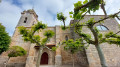
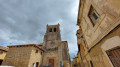
(4) Continue towards the village, passing the Albergue Santa Brígida and then the Church of Nuestra de la Concepción. Stay on this narrow street until you reach the Stop sign. You can stock up on supplies here at a small supermarket.
(5) Carry on straight ahead to leave this small village and pass a lorry weighbridge before reaching the Stop sign.
(6) Cross carefully and head left for about a hundred metres, then take the small road on the right, which slopes gently downwards and is marked by a milestone engraved with a scallop shell. Continue along this path, lined with a few trees, until you reach the fork.
(7) Turn left onto the path heading south-west. Continue to the ruins of Una Torre , consisting of an approximately eight-metre-high pillar built of cut stone, which appears to have been part of a tower.
(8) Continue south-west, ignoring the crossroads, until you reach the junction with the BU-P-4013.
(9) Turn right and continue along this tree-lined road to the ruins of the Convento de San Anton.
(10) Go under the arch to pass through a small hamlet consisting of a few houses and a refreshment bar, before reaching the junction leading to the village of Villaquiran de la Puebla.
(11) Continue straight on until you reach the fork at the entrance to the town of Castrojeriz, marked by a concrete cross.
(12) Turn right. At the first houses, turn right towards El Mazano, pass the church and turn left just after it, then continue to the crossroads.
(13) Continue to the right along narrow streets lined with stone houses until you reach the foot of Mount Tracastillo, dominated at its summit by Castrojeriz Castle.
(14) Turn left (south-west) and continue along Calle de Ote, passing several lodges or hostels before arriving at the Church of Santo Domingo, which is next to a pilgrim information point.
(15) Continue through this long, narrow town, staying on this narrow street. Pass a memorial stone and continue to the Plaza Mayor, where the Town Hall is located. You can stock up on supplies at a grocery shop.
(16) Cross the square and continue until you reach the Church of San Juan.
(17) Carry on straight ahead before turning left and reaching a Stop sign at the junction with the BU-404.
(18) Cross carefully and continue straight ahead along a stony path to reach another stop sign at the junction with the BU-400.
(19) Cross this road just as carefully and head west across the fields until you reach a fork.
(20) Continue straight on (west) to reach the Bárcena Bridge, a wooden footbridge spanning the River Odra.
(21) Continue north-west to begin a steep climb and carry on to the crossroads.
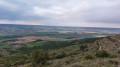
(22) Turn left, stay on the right-hand path (west) at the fork and climb up to reach the Mirador del Alto de Mostelares, the highest point of this stage. You are on the Mostelares plateau. The climb to the summit is difficult but is rewarded by the breathtaking view over the vast valleys.
(23) After taking in the scenery, descend slowly towards Itero de la Vega. On the steep descent, there is a gravestone in honour of a pilgrim from Málaga who died whilst walking the Camino. Stop at the next viewpoint, El Otro Mirador.
(24) Continue carefully down the slope until you reach the crossroads.
(25) Keep heading west, pass the next crossroads before reaching the fork offering an alternative route tothe GR®65.
(26) Take the path on the left (south-west). Continue down the slope, which gradually levels out and eventually climbs slightly to a rest and picnic area.
(27) Turn right to continue along the small tarmac road. Walk down a gentle slope until you reach the sign pointing towards the Albergue Municipal.
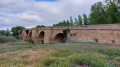
(28) Turn left, pass a crossroads keeping south-west, before arriving at the Ermita de San Nicolás Municipal Hostel and continue to the BU-403, opposite the Fitero Bridge.
(29) Cross the bridge and continue to the picnic area and the signpost indicating that you are entering the province of Palencia.
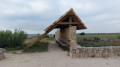
(30) Turn right, follow the edge of the woods on your right and continue until you reach the Ermita de Nuestra Señora de la Piedad and a picnic area.
(31) Carry on straight ahead to enter the village of Itero de la Vega. Walk on for about a hundred metres and turn right past the Hostal Fitero, which appears to be closed. Carry on straight through the woods to reach the banks of the River Pisuerga and find a place to camp for the night (E).
 Visorando Member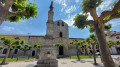
 Very difficult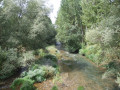
 Easy
Easy