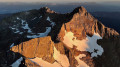
Grand Morétan

The panoramic view from the summit of the Grand Morétan is exceptional, with the highest peaks of the French, Swiss and Italian Alps all in view.

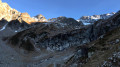
This route, half of which is off-trail, crosses the wild glacial cirque of the Glacier du Gleyzin and reaches the summit via the Col Nord du Gleyzin. A variant described here also allows you to pass via the Col Morétan.

Details

4330897
Creation:
Last update:
Last review:
  • Walking
    Activity: Walking
  • ↔
    Distance: 8.93 mi
  • ◔
    Duration according to the author: 8 hrs 
  • ▲
    Difficulty: Very difficult

  • ⚐
    Back to start: Yes
  • ↗
    Ascent: + 5,866 ft
  • ↘
    Descent: - 5,873 ft

  • ▲
    Highest point: 9,101 ft
  • ▼
    Lowest point: 3,566 ft

Photos

Description of the walk

Warning
Information on how to reach the starting point, as well as details regarding difficulties, alternative routes and precautions to take, are grouped under the sections ‘Practical information ’ and ‘During the hike’. Any difficult hike requires preparation, and this very difficult hike is no exception

Route

GR®® 738 marked in red and white

(S/E) From La Bourgeat Noire, follow theGR®® which takes the track heading south-southeast. Ignore the track branching off to the right shortly afterwards and continue past the Plan shelter. The track then turns into a path that follows the Gleyzin stream upstream, still heading south-southeast. Upon reaching the foot of a scree couloir, known as the Pertuis, the path winds its way up to the east to reach a level track.

(1) Ignore the path heading north towards the Chalet du Vay and follow the level path heading south, marked GR®®. After crossing the Gleyzin stream bed and making a slight bend to the north, it climbs up to a flat area where the Oule ruins and a signpost are located

Yellow markings

(2) Follow the direction indicated by the sign for the Refuge de l’Oule (the other sign points to Lac Léat), and take the path that climbs the left bank of the Gleyzin, first south-east, then winding its way north-east, to reach the refuge.

Sporadic fluorescent orange circles

(3) Pass the refuge and continue south on the path marked with fluorescent orange dots until you come to steeper slopes. The path then veers left to go round the obstacle (southeast then south) and the markings disappear. After a steep climb, you reach a flat area in the scree, at around 2150 m.

Cain

(4) From this flat area, there is no longer really a path. Climb by sight south-eastwards over boulders and scree towards a narrowing between a moraine on the right and the foot of a rocky spur on the left (visible in this location photo ).

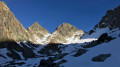
Once you reach the base of this spur, at around 2300 m, climb up its southern base to enter the couloir leading up to the Cols du Gleyzin directly from the east. After a flat section, head to the right-hand side of the couloir and note a small pass on the left; see this reference photo.

(5) Ignore this pass (it is a crossing point for a variant described below) and climb up towards the pass to its right; see the same location photo to reach it.

(6) From the pass, the summit you are aiming for is visible at the end of its ridge.
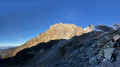
If snow conditions allow, pass through the boulders to the left of the pass (north) to maintain altitude (otherwise descend a few metres) and go round a rock outcrop on the left, then climb diagonally upwards to the east-northeast towards the ridge. Reach the ridge by aiming for the summit of a rocky spur at 2646 m (see the same reference photo ). From there, the ascent to the summit along the ridge is merely a formality.

(7) From the summit, the descent follows the same route as the ascent, down to the car park (S/E). See the variant below for an alternative route.

Waypoints

  1. S/E : mi 0 - alt. 3,573 ft - Bourgeat Noire car park
  2. 1 : mi 1.51 - alt. 5,154 ft - Junction at the Pertuis Pass
  3. 2 : mi 1.9 - alt. 5,449 ft - The Oule - Signpost
  4. 3 : mi 2.29 - alt. 6,007 ft - Refuge Antoine Cros, dit de l'Oule
  5. 4 : mi 2.87 - alt. 6,991 ft - Flat area in the Gleyzin glacial cirque
  6. 5 : mi 3.88 - alt. 8,100 ft - Foot of the pass (alternative route via the Col du Morétan)
  7. 6 : mi 4.07 - alt. 8,458 ft - Col Nord du Gleyzin
  8. 7 : mi 4.64 - alt. 9,101 ft - Summit - Grand Morétan
  9. S/E : mi 8.93 - alt. 3,573 ft - Bourgeat Noire car park

Notes

🅿️ Park at the Bourgeat Noire car park in Gleyzin, N 45.335348° / E 6.119641°. It is possible to drive a little further along the track leading south towards Plan de la Combe Grasse, where there is an unmanned shelter.

💧Water is plentiful up to the Oule refuge but becomes scarcer thereafter.

🦮 Dogs are allowed in this part of Belledonne. It is best to keep your dog on a lead so as not to disturb the wildlife and livestock.

🥾The hike is classified as Very Difficult due to the route being mainly off-trail and the significant elevation gain.

☀️ Best undertaken in good weather to ensure easy navigation. In foggy conditions, a GPS or compass is essential between (4) and (5).

⛺️ The hike is short and not suitable for camping. Furthermore, the Gleyzin glacial cirque is rarely sunny. However, you can stay at the Oule refuge (3).

⛏️ Standard hiking kit is sufficient. Before summer, ice axes and crampons may be necessary to climb to the pass and then to the summit, and in any case provide reassurance for those less comfortable on steep snow slopes.

⏰ The aspect allows for a relatively late start (after sunrise).

🧭 Navigation is easy in good weather, but a GPS — or, of course, the Visorando app — is recommended.
- The right and left banks are always defined in the orographic sense, i.e. relative to the direction of water flow.
- A tributary is a stream or watercourse feeding into a lake (the opposite is an outlet).
- Upstream is the direction towards the top (the mountain), downstream is the direction towards the bottom (the valley).
- The sun-facing slope is the side that receives the sun; the north-facing slope is its opposite.

🆘 There is only one emergency number in France: 112. Other numbers (15, 17, or direct numbers…) have no priority on mobile networks, do not switch to other operators’ networks when there is no signal, and in the event of an overload of calls, ongoing calls are cut off to prioritise 112. So forget about them as soon as possible; they are dangerous and no longer serve any purpose (contrary to what some outdated training materials claim). If you cannot speak or hear, use 114 to communicate via text message. 112 works on any mobile phone (and landlines, of course), including on a locked phone and even if the SIM is blocked (however, since 2004, France has been in breach of European recommendations and blocks calls to 112 when there is no SIM in the phone. This blocking has required special investment, as the GSM standard naturally allows calls without a SIM card. Taxpayers will appreciate this particularly clever use of public funds).

⚠️ Please note: if your call is cut off, it is your responsibility to call the emergency services again: they have no way of contacting or locating you if your network provider does not provide coverage. Remember to note down your GPS coordinates before calling, as the French government has still not deigned to equip mountain rescue centres with AML (Advanced Mobile Location) technology, despite this having been made mandatory by the EU since 2018.

📱In the mountains, switch your phone to 2G: the range of this technology is 4 to 8 times greater than that of newer technologies, and it uses significantly less power. Remember to switch off your Wi-Fi, which drains the battery quickly and serves no purpose outside homes and offices. ? Bear in mind that your phone’s GPS tracking works even in flight mode (GPS has nothing to do with mobile phone signals).

✅ Checklist
☑︎Essential in addition to standard hiking gear
☑︎helmet (because of the chamois and ibex below the pass)
☑︎1.5 L water bottle

optional
☐telescopic or non-telescopic poles
☐ice axe (for the pass and summit at the start and end of the season, or if it gives you confidence on a steep snow slope)
☐crampons (ditto: go with the ice axe)

☒not required
☒climbing equipment
☒rope (unless you know exactly how to use it without risking dragging your rope partners down with you)

⚠️ Generally speaking, remain critical of IGN topographic maps (from experience, the institute never corrects reported errors, even after serious accidents caused by these errors). The base maps of the IGN topographic maps date back more than 25 years and have not been updated since (!). The free OpenStreetMap, updated by volunteers, is usually much more up to date; it is best to consult its OpenTopoMap version, which is easier to read.

Worth a visit

Alpine wildlife is present, particularly chamois, ibex, marmots and vultures, but the north-facing slope of the Gleyzin glacial cirque does not attract them much. They are therefore more likely to be seen beyond the pass (6).

The entireChartreuse rangeGrand Morétan summit The views from the summit are splendid. To the north, the view extends to the Pic du Frêne, Mont Blanc and the Grandes Jorasses, which lie ahead of the Valais Alps, where the Grand Combin, the Weisshorn, the Dent Blanche, the Dent d’Hérens and the Matterhorn are clearly visible. To the west, the entire Chartreuse range is visible. To the east lie the Vanoise, the Cerces, the Écrins and the Grandes Rousses. This spherical panorama is interactive and allows you to view the peaks visible from the Grand Morétan. However, the resolution is not high enough to make out the Matterhorn. Higher-resolution photos are available in this public album, which allows you to view the Swiss peaks.

Arrival below the Cols duGleyzinThe small pass on the alternative route and the Col Nord du Gleyzin
The most interesting alternative route involves passing via the Col Morétan. To do this, once you reach the glacial plateau at (4), head due east on level ground towards the pass situated to the left of the rock outcrop beneath the Pointe du Gleyzin (the photo on the left shows this rock outcrop viewed from higher up on the main route). A few cairns vaguely mark the obvious route. At the Col Morétan, head off again south-south-west, keeping level, and cross steep but well-gripped rocky slopes, the aim being to climb a maximum of twenty metres whilst heading for the south-west spur of the Pointe du Gleyzin. A pass (photo on the right, view from the other side, from the couloir leading up to the Col du Gleyzin) allows you to switch to the couloir leading to the northern pass of the Gleyzin.

Personally, I prefer to do this variant in the opposite direction, descending from the Col du Gleyzin to climb back up to the pass and then on to the Col Morétan.

From the Col Morétan, it is possible to descend via the Aup du Pont and then rejoin theGR®® 738 in the Veyton valley, but this adds nearly 10 km to the hike.

? Explanation of a few terms:

  • ‘aup’ or ‘aulp’ refers to an ‘alpe’, i.e. a place where herds graze in summer.
  • A cairn is a pile of stones used as a landmark along a route. You can add cairns if you are sure of the route, and it is useful to replace stones that have fallen from a cairn.
  • A combe is a relatively wide valley or the hollow of a fold in the terrain.

Always be cautious and plan ahead when you're outdoors. Visorando and the author of this route cannot be held responsible for any accidents occurring on this route.

The GR® and PR® markings are the intellectual property of the Fédération Française de Randonnée Pédestre.

Reviews and comments

3.7 / 5
Based on 1 review

Reliability of the description
3 / 5
Ease of following the route
3 / 5
Route interest
5 / 5
Nic0las
Nic0las

Great! I find the description much clearer. Thanks!

Machine-translated

bouvierjr
bouvierjr ★

Thank you. I do indeed recommend including an ice axe in the list of equipment for the hike, and the description text includes this photo alongside instructions on how to gain a foothold on the ridge.
I’ll add the photo caption directly to the description.

Machine-translated

Nic0las
Nic0las

As for kit, I’d still recommend taking an ice axe, and if there’d been more than two of us when we went, we would have roped up. As for the route, I can’t say, as I couldn’t work out which way to go. Once we’d crossed the North Col, we descended about 30 metres and found nothing but really steep rock faces, so we gave up. Perhaps you have a photo showing the route?
Have a good day,

Machine-translated

bouvierjr
bouvierjr ★

Thanks for your feedback, Nic0las. What extra kit do you think would be needed for this hike? Apart from, of course, what I’ve already mentioned:
☑︎Essential in addition to standard hiking kit
☑︎helmet (due to the chamois and ibex below the pass)
☑︎1.5 L water bottle

☐optional
☐telescopic or non-telescopic poles
☐ice axe (for the pass and the summit; essential at the start and end of the season)
☐crampons (ditto)

☒not required
☒climbing equipment
☒rope

Also, what details do you think would best describe the off-trail route between (6) and the summit?

Machine-translated

Nic0las
Nic0las

Overall rating : 3.7 / 5

Date of your route : Aug 18, 2023
Reliability of the description : ★★★☆☆ Average
Ease of following the route : ★★★☆☆ Average
Route interest : ★★★★★ Very good
Very busy route : No

Hello,
Having completed this hike, I found that the route to follow between sections 6 and 7 is really unclear and could do with some clarification. As for the necessary equipment, I also find it very minimal given the difficulty and danger of this hike.
Kind regards.

Machine-translated

bouvierjr
bouvierjr ★

Thanks, Pit,

I can confirm all these points; in particular, the Pertuis corridor is particularly dangerous due to its frequent avalanches. I’ve made a correction regarding the dogs: indeed, the Oule herd means you should keep them on a lead in summer. The same applies to the section from (4) to (5) in foggy conditions.

Happy hiking, - jr

Machine-translated

Pit
Pit

Hello.
It’s been quite a while since I’ve been round there.
I’d still like to let dog owners know that the Oule mountain pasture is occupied between June and September by a shepherd and his flock.
In foggy conditions, the route after the flat section (point 4) requires a GPS with the track.

As for the alternative route, from the Col du Morétan, you can head down towards the lakes of the same name – at least towards Lac Supérieur – and from there climb up to the Col du Vay, reach the Chalet du Vay (a good shelter, see refuges.infos) and then take the path up to the Oule. That’s what I used to do back in the day.
Take care at the Col du Pertuis: in winter and spring, it is a dangerous avalanche corridor.

Machine-translated

Other walks in the area

For more walks, use our search engine .

The GPS track and description are the property of this route's author. Please do not copy them without permission.