Country:

 City:
City:


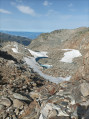
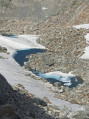
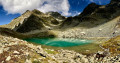
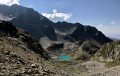
See the practical information for the car park and ⚠️read the warnings regarding the difficulty and the equipment you’ll need to bring.
Park in the car park below the Embarolin, on the forest track leading from Grand Thiervoz.
(S/E) Head back down to the car park entrance and turn left onto a track that climbs the steep slope through the forest to the north-east, winding its way up in numerous hairpin bends. The markings are yellow and those ofthe GR®® (red and white). At the Embarolin signpost, continue the climb along a forest track, still heading north-east. When you reach a clearing, a path branches off the forest track (small cairn) and runs alongside the first chalet in Petite Valloire.
(1) The path continues winding through the forest and veers eastwards to reach the Fouetterie chalet (unmanned but very well maintained).
(2) Walk past the chalet to reach a junction where a sign points towards Lac Léat to the north (left).
(3) Pass the Second Tigneux Chalet. Follow this direction to join theGR®® Tour du Pays d’Allevard and continue along it, heading north and then north-west, descending slightly.
(4) At Crêt du Tambour (signpost), follow the direction indicated for Lac Léat, visible below to the north-east. You will then reach the lake and the Chalet du Léat (unmanned chalet, in perfect condition).
(5) Near the chalet is a signpost. Do not follow theGR®® but take the path that heads up the grassy ridge to the north-east and climbs up the bottom of the valley towards the ridge overlooking the lake to the north. Reach the ridge and turn left (north-west) to descend towards a cross that you will soon spot.
(6) At the Croix du Léat viewpoint, turn back after admiring the valley and head off towards the Pierre du Pin (south-east) and then the Refuge de l’Oule. The path follows a long traverse along the hillside towards the east and is not always very well marked (note that the IGN map is incorrect in several places, but the OpenStreetMap Rando map is accurate). You will eventually reach a flat area and a junction where a sign points to the Refuge de l’Oule on the right.
(7) Follow the path which climbs up the left bank of the Gleyzin towards the refuge, initially heading south-east, then winding its way north-east. Pass the refuge and continue south on the path marked with fluorescent orange dots until you come to steeper cliffs. The path then veers left to bypass the obstacle (south-east then south) and the markings disappear. After a steep climb, you’ll reach a flat area amongst the scree.
(8) From this flat area, the path is very difficult to follow and only a few cairns indicate the direction to take. Cross the flat area heading south-east, aiming for a gully surrounded by rocky spurs at its base and blocked by a moraine at its upper end. Climb straight up the slope, still heading south-east within this gully, keeping to the right of the spurs, until you reach the moraine barrier blocking the gully.
(9) Climb onto the crest of the moraine barrier without descending to the other side (see orientation photo). Once on the ridge of the moraine, continue up it towards the south-west, trying to stay as close as possible to the ridge and favouring its western flank. When you reach the base of the Col de Comberousse, return to the valley floor to reach the pass by climbing due south.
(10) At the pass (also known as the Col du Grand Glacier), look out for the Selle du Puy Gris, a steep ice couloir to the right of the north face of the Puy Gris (see location photo). Head south-west towards the Col de la Valloire, but veer off the slope just before reaching it to descend to the foot of the couloir. Put on your crampons and take out your ice axe to climb the rest of the glacier up to the pass. Alternatively, skirt the rocks by climbing between them and the ice lip (watch out for rockfalls).
(11) From the Selle du Puy Gris, you may wish to climb to the summit (see variations below), then retrace your steps to descend the ice couloir and climb back up to the Col de la Valloire on the left.
(12) From the Col de la Valloire, follow the edge of the scree at the foot of the rocks towards the Lac Noir ridge to the south-south-west, aiming for a gap in the ridge from which you can see the landscape to the east towards the Cime du Sambuis and the Aiguilles de l’Argentière; see the reference photo.
Then descend through the scree to the west until you reach the bottom of the valley and what remains of the Valloire glacier. Continue down to the bottom of the valley, following the numerous cairns, until you reach Lac Noir and the well-marked path.
(13) At Lac Noir, find your footing and descend along the main path heading towards Lac Blanc, which is clearly visible (south-west).
(14) Just as this path turns right (north-west) to avoid crossing a torrent, leave the path to cross the torrent to the south-west (flat section) and thus go round Lac Blanc along its southern shore.
Continue due west, following the view, to climb the easy, grassy scree that forms the barrier around Lac de la Folle.
(15) After exploring Lac de la Folle, return via the clearly visible path that descends due east towards the northern end of Lac Blanc. Once you reach the lake’s outlet, cross it and turn left (north-west) to rejoin the main path, which descends west-north-west towards the first chalet at Grande Valloire.
(16) Do not go as far as the footbridge beneath the chalet; instead, head up to the right (north) towards the chalet to pass over it and rejoin theGR®® de Tour du Pays d’Allevard heading north.
As you come within sight of the Fouetterie chalet, veer left to reach the junction leading to it, then head due west down to the chalet.
(2) From the Fouetterie chalet, retrace your steps along the ascent route until you reach the car park (S/E).



 Visorando Member

 Tourism professional
 Moderate
 Difficult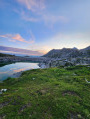
 Easy
Easy