


Refine your search for walks in Florac
Florac walks


 Florac - Cassagnas
 Visorando Member
 12.36 mi
 +1,818 ft
 -971 ft
 7h 15
7h 15
 Difficult
 Departure from Florac (Lozère)
Tenth stage of a complete journey on the Chemin de Stevenson between Le Puy-en-Velay and Alès. This stage may involve significant changes to the GR®70 signposting. This stage essentially follows the Mimente valley before it flows into the Tarnon at Florac.
Short circuit starting from La Condamine
4.34 mi
+423 ft
-423 ft
2h 20
 Easy
Departure from Montbrun (Lozère) (Lozère)
Easy
Departure from Montbrun (Lozère) (Lozère)
An easy hike in the mineral world of the Causse Méjean: a plateau marked by both austerity and gentle tranquillity. You will stroll through a landscape full of curves, between hills and sinkholes at the bottom of which you will discover a lavogne (a small, circular depression in the ground) or a small cultivated field: one of the characteristic landscapes of the UNESCO-listed sites. (Route information provided by the Gorges du Tarn, Causses & Cévennes tourist office).
The Bieissette Chestnut Grove and the gardens of Ispagnac
3.82 mi
+801 ft
-801 ft
2h 25
Easy
Departure from Ispagnac (Lozère)
Located at the crossroads of the Grands Causses, Mont Lozère and the Cévennes valleys, the Ispagnac valley boasts a wide variety of geological features. Limestone, granite and schist blend together, creating diverse landscapes shaped by the nature of the subsoil. This trail, which runs along the foot of the Causse Méjean, offers you a walk through a schistose terroir.
The Petit Poucet trail on the Cham des Bondons
9.07 mi
+1,250 ft
-1,237 ft
5h 15
 Moderate
Departure from Les Bondons (Lozère)
Moderate
Departure from Les Bondons (Lozère)
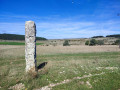
Menhirs are found in Brittany. The proof: the name itself is of Breton origin (maen hir = long stone). And even more so when they are made of granite.
But if I told you that one of Europe's main megalithic sites is in Lozère, would you believe me?
The standing stones along this route at the foot of Mont Lozère are like those scattered by Tom Thumb: just follow them to find your way.
On the Causse de Sauveterre from Molines
7.86 mi
+1,762 ft
-1,749 ft
5h 10
Moderate
Departure from Ispagnac (Lozère)
To the west, the Ispagnac valley is closed off by the Causse de Sauveterre, which overlooks it by about 500 metres. The route takes you up from this pleasant countryside to the much harsher landscape of the causse. The two hamlets of Paros and Mas André mark this route, which winds through the woods for almost half of its length.
The Runes waterfall
 0.73 mi
+285 ft
-289 ft
0h 35
Easy
Departure from Fraissinet-de-Lozère (Lozère)
0.73 mi
+285 ft
-289 ft
0h 35
Easy
Departure from Fraissinet-de-Lozère (Lozère)
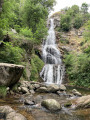
A very short hike to admire a magnificent waterfall that flows all year round.
Circular of Paros
 Association / Club / Walk leader
 6.46 mi
+1,175 ft
-1,181 ft
4h 00
Moderate
Departure from Ispagnac (Lozère)
6.46 mi
+1,175 ft
-1,181 ft
4h 00
Moderate
Departure from Ispagnac (Lozère)
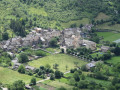
Starting from the small village of Paros (no, don't dream, it's not the Cyclades!) above Molines (commune of Ispagnac) in Lozère, this is a beautiful hike with views of the Tarn in the first part, then of the Causse du Sauveterre.
Menhirs and the hamlet of La Fage
 7.08 mi
+1,066 ft
-1,060 ft
4h 10
Moderate
Departure from Saint-Étienne-du-Valdonnez (Lozère)
7.08 mi
+1,066 ft
-1,060 ft
4h 10
Moderate
Departure from Saint-Étienne-du-Valdonnez (Lozère)
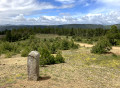
The first part of the hike follows the Balade au pays des Menhirs discovery trail. The rest of the route continues to the hamlet of La Fage. In addition to the Clocher des Tourmentes bell tower marked on the IGN map, you can admire beautiful granite houses covered with slate tiles. Unfortunately, while some have been restored, others are partly abandoned.
The hamlet of Fretma from Nivoliers
 9.21 mi
+846 ft
-817 ft
5h 00
Moderate
Departure from Hures-la-Parade (Lozère)
9.21 mi
+846 ft
-817 ft
5h 00
Moderate
Departure from Hures-la-Parade (Lozère)
An easy hike on the Causse Méjan starting from Nivoliers via La Bégude Blanche and La Fretma, a remarkably restored hamlet on the Causse. TheGR®60passes through the wide open spaces reserved for Przewalski's horses... but you'll need a bit of luck to spot them!
Discover the Causse Méjean starting from the chaos of Nîmes le Vieux
 12.37 mi
+1,066 ft
-1,053 ft
6h 35
Difficult
Departure from Fraissinet-de-Fourques (Lozère)
12.37 mi
+1,066 ft
-1,053 ft
6h 35
Difficult
Departure from Fraissinet-de-Fourques (Lozère)
Starting from the hamlet of L'Hom, this hike first takes you to discover the endless spaces of the southern part of the Causse Méjean. Endless grassy and rocky hills, interspersed with cultivated plots and coniferous woods, allow you to take in the immensity of the landscape. It concludes with a visit to the discovery trail of the chaos of Nîmes le Vieux, bristling with hundreds of strangely shaped rocks sculpted by erosion. Informative panels are strategically placed along the trail to complement the experience. A beautiful day, punctuated by visits to the Causse hamlets of L'Hom, Le Veygalier and Villeuneuve, with their remarkable architecture.
Pont-de-Montvert - Florac
 13.33 mi
+1,276 ft
-2,323 ft
7h 15
Difficult
Departure from Le Pont-de-Montvert (Lozère)
13.33 mi
+1,276 ft
-2,323 ft
7h 15
Difficult
Departure from Le Pont-de-Montvert (Lozère)
Ninth stage of a complete journey on the Chemin de Stevenson between Le Puy-en-Velay and Alès. This stage features significant changes to the GR®70 signposting, taking an alternative route to the GR®70 for much of the way. This means that the stage is substantially shorter than the official route. This stage marks the entry of the Chemin de Stevenson into the Cévennes region.
From Pont de Montvert to Pont du Tarn via Finiels
 15.03 mi
+2,159 ft
-2,159 ft
7 hrs
15.03 mi
+2,159 ft
-2,159 ft
7 hrs
 Very difficult
Departure from Le Pont-de-Montvert (Lozère)
Very difficult
Departure from Le Pont-de-Montvert (Lozère)
A beautiful route that takes you from Pont-de-Monvert along part of the Stevenson Trail (GR®70), then through heathland and forests to Pont du Tarn.
From Pont-de-Montvert to Florac via the Signal du Bougès
 15.52 mi
+2,457 ft
-3,668 ft
10 hrs
Very difficult
Departure from Le Pont-de-Montvert (Lozère)
15.52 mi
+2,457 ft
-3,668 ft
10 hrs
Very difficult
Departure from Le Pont-de-Montvert (Lozère)
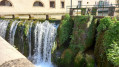
Of the various routes on offer, this one is a compromise: it first follows the Stevenson Trail via the high point of Le Bougès, then stays on the left bank of the Tarn all the way to Florac
Circular route in the north of the Causse Mejean
 7.77 mi
+1,234 ft
-1,240 ft
4h 40
Moderate
Departure from Mas-Saint-Chély (Lozère)
7.77 mi
+1,234 ft
-1,240 ft
4h 40
Moderate
Departure from Mas-Saint-Chély (Lozère)
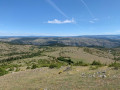
A lovely, easy circular walk in the north of the Causse Mejean with little elevation gain and stunning panoramic views.
Cassagnas - Saint-Étienne-Vallée-Française (Lébou)
 11.81 mi
+1,204 ft
-3,015 ft
6h 30
Difficult
Departure from Cassagnas (Lozère)
11.81 mi
+1,204 ft
-3,015 ft
6h 30
Difficult
Departure from Cassagnas (Lozère)
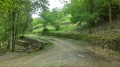
Eleventh stage of a complete journey on the Chemin de Stevenson between Le Puy-en-Velay and Alès. This stage includes significant changes to the GR®70 signposting. This stage lies in the heart of the Cévennes National Park.
On the heights of Cassagnas
4.76 mi
+1,037 ft
-1,037 ft
3h 05
Easy
Departure from Cassagnas (Lozère)
A short, fairly easy circular route that takes you up to the heights of the village via a pretty path through heathland covered with broom, heather and ferns, then gently back down through a forest of pine, oak and chestnut trees. Some beautiful viewpoints.
Col des Laupies circular starting from Plan de Fontmort
 9.61 mi
+1,565 ft
-1,565 ft
5h 45
Moderate
Departure from Cassagnas (Lozère)
9.61 mi
+1,565 ft
-1,565 ft
5h 45
Moderate
Departure from Cassagnas (Lozère)
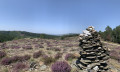
This hike is accessible to everyone, young and old, in the Plan de Fontmort massif.
Part of the circular route is along the ridges with a view of Mont Aigoual, then descends to the refreshing Mimente before climbing back up the Chemin de Stevenson to Plan de Formont.
Bramont Gorges and the hamlet of La Borie
 7.99 mi
+1,306 ft
-1,283 ft
4h 50
Moderate
Departure from Saint-Étienne-du-Valdonnez (Lozère)
7.99 mi
+1,306 ft
-1,283 ft
4h 50
Moderate
Departure from Saint-Étienne-du-Valdonnez (Lozère)
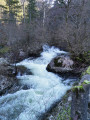
Walk up the Bramont Gorges and explore a magnificent and picturesque area with its steep cliffs and turbulent river. This unusual landscape offers a pleasant cool spot in summer.
Pass through the small village of drystone shelter, with its typical Causse houses, located in the foothills of the Mont Lozère massif.
Circular route on the Causse Méjean from Galli
 6.95 mi
+581 ft
-591 ft
3h 40
Moderate
Departure from Vebron (Lozère)
6.95 mi
+581 ft
-591 ft
3h 40
Moderate
Departure from Vebron (Lozère)
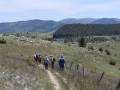
Starting from Galli, this is a lovely circular route on the Causse Méjean that passes through the beautiful setting of the charmingly restored Fretma farm. A short detour allows you to see the Berre reservoir, not to be confused with the lake of the same name.
The Pont du Tarn via the hamlet of L'Hôpital
 9.25 mi
+1,378 ft
-1,378 ft
5h 25
Moderate
Departure from Le Pont-de-Montvert (Lozère)
9.25 mi
+1,378 ft
-1,378 ft
5h 25
Moderate
Departure from Le Pont-de-Montvert (Lozère)
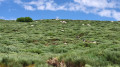
This hike will take you to the source of the Tarn. You will follow drovers' roads through the woods, cross the hamlet of L'Hôpital and its ruins, then follow the path winding through heather, pastures and granite rock formations to reach the Roman-style bridge over the Tarn.
Finally, you will walk along the Tarn with its clear water dotted with rocks emerging from the surface, offering the opportunity for a swim before heading back down to the starting point.
Béal de Felgerolles and the Tarn from Frutgères
 4.65 mi
+1,014 ft
-1,037 ft
3h 00
Moderate
Departure from Le Pont-de-Montvert (Lozère)
4.65 mi
+1,014 ft
-1,037 ft
3h 00
Moderate
Departure from Le Pont-de-Montvert (Lozère)
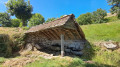
This is an easy hike that allows you to discover the different landscapes of Lozère, the Béal de Felgerolles, the Tarn and a few picturesque hamlets typical of Mont Lozère. It also offers beautiful views of the Cévennes landscape. The wooded sections make it particularly pleasant in hot weather.
The Bramont Gorges, La Fage and Bassy
 5.66 mi
+1,122 ft
-1,102 ft
3h 35
Moderate
Departure from Saint-Étienne-du-Valdonnez (Lozère)
5.66 mi
+1,122 ft
-1,102 ft
3h 35
Moderate
Departure from Saint-Étienne-du-Valdonnez (Lozère)
An alternative route to walkno. 2842225:the Bramont Gorges and the hamlet of La Borie. Explore the Bramont Gorges starting from Saint-Étienne-du-Valdonnez, passing through the hamlet of La Fage and returning via Bassy. Most of the route runs through woodland. Beautiful views over the Cham des Bondons, the Echino d’Aze and one of the puechs, as well as the Truc de Balduc.
 Canoe descent from Sainte-Enimie to La Malène
8.85 mi
+417 ft
-495 ft
4 hrs
Easy
Departure from Sainte-Enimie (Lozère)
This descent between the two beautiful villages of the Gorges du Tarn is ideal for those who want to explore the gorges at a leisurely pace, with an easy route and plenty to see.
From Sainte-Enimie to La Malène
 9.13 mi
+1,483 ft
-1,572 ft
5h 30
Moderate
Departure from Sainte-Enimie (Lozère)
9.13 mi
+1,483 ft
-1,572 ft
5h 30
Moderate
Departure from Sainte-Enimie (Lozère)
Stage 5 in the heart of the Gorges du Tarn via the Sentier des Gorges du Tarn (left bank) from Sainte-Enimie to La Malène, passing through the picturesque hamlet (with no road access) of Hauterives.
Mont Lozère from Finiels
 9.37 mi
+2,031 ft
-2,034 ft
6h 05
Moderate
Departure from Le Pont-de-Montvert (Lozère)
9.37 mi
+2,031 ft
-2,034 ft
6h 05
Moderate
Departure from Le Pont-de-Montvert (Lozère)
Mont Lozère rises to 1,699 metres, making it the highest point in the Cévennes. However, its geological nature sets it apart from the rest of the massif. This imposing granite wall closes off the schist valleys of the Cévennes and heralds the high plateaus of southern Auvergne. It also offers magnificent views of all the peaks of the southern Massif Central, as far as Mont Ventoux. Best explored in good weather.
Limestone and schist circular loop at Le Pompidou
6.95 mi
+1,394 ft
-1,414 ft
4h 25
Moderate
Departure from Le Pompidou (Lozère)
This circular route starting from Le Pompidou offers varied landscapes and atmospheres, beginning on the heights of the Vallée Borgne, with beautiful views of the valley, before reaching the limestone plateau of the Can de l'Hospitalet, a mini-causse isolated in the middle of the Cévennes. The return journey is on the other side of the Corniche des Cévennes, on the Vallée Française side, with more beautiful views and a visit to the Old Church of Saint-Flour.
Bézuc trail
 10.28 mi
+1,171 ft
-1,165 ft
5h 45
Moderate
Departure from Le Pompidou (Lozère)
10.28 mi
+1,171 ft
-1,165 ft
5h 45
Moderate
Departure from Le Pompidou (Lozère)
This lovely circular starting from Le Pompidou takes you through three different types of landscape: schist, granite and limestone. There are beautiful panoramic views at various points along the way. The varied vegetation consists of beech, ash, ferns and broom. You will also pass through fields of cereal crops, chestnut groves and pastures.
Clocher de Tourmente: from the hamlet of Les Sagnes to the Étang de Barandon
 8.80 mi
+1,017 ft
-1,014 ft
4h 55
Moderate
Departure from Saint-Julien-du-Tournel (Lozère)
8.80 mi
+1,017 ft
-1,014 ft
4h 55
Moderate
Departure from Saint-Julien-du-Tournel (Lozère)
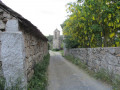
Route starting from the Clocher de Tourmente in the hamlet of Les Sagnes. Hike in the Cévennes National Park. Former Étang du Peschio, Croix de Maitre Vidal, panoramic view of the Monts Lozère, Étang de Barrandon.
Clochers de Tourmente circular route starting from Les Sagnes
 5.39 mi
+1,047 ft
-1,050 ft
3h 25
Moderate
Departure from Saint-Julien-du-Tournel (Lozère)
5.39 mi
+1,047 ft
-1,050 ft
3h 25
Moderate
Departure from Saint-Julien-du-Tournel (Lozère)
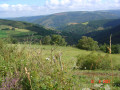
A circular route starting from Les Sagnes, passing through the hamlet of Auriac, across meadows and through woods.You can also see the two Clochers de Tourmente and, in the distance, the Château du Tournel.
Mont Lozère from the Col de Finiels
5.24 mi
+961 ft
-958 ft
3h 15
Moderate
Departure from Le Pont-de-Montvert (Lozère)
Discover Mont Lozère on a very pleasant circular route through alpine pastures and then forest. This is a very enjoyable walk that is sure to delight young and old alike.
 The Col de Finiels
 4.51 mi
+423 ft
-423 ft
4 hrs
Easy
Departure from Le Pont-de-Montvert (Lozère)
4.51 mi
+423 ft
-423 ft
4 hrs
Easy
Departure from Le Pont-de-Montvert (Lozère)
The Col de Finiels is the road crossing over Mont Lozère, between its two peaks, Finiels and Pic Cassini. This means that, once out of the woods, on the moors and peaks, the views are extraordinary, sometimes to the south over the Cévennes, to the north over the chain of volcanoes, and to the east, further away, when the weather is clear, over the Alps.
The Tarn: source of a great river at the Col de Finiels
 11.27 mi
+837 ft
-823 ft
5h 55
Difficult
Departure from Le Pont-de-Montvert (Lozère)
11.27 mi
+837 ft
-823 ft
5h 55
Difficult
Departure from Le Pont-de-Montvert (Lozère)
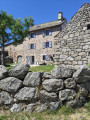
This hike, starting from the Col de Finiels in the heart of Mont Lozère, takes us along the ridge of Mont Lozère, where the magnificent views allow us to look out over the Cévennes National Park. We then witness the very source of a great river, from the very first stream known as ‘Le Tarn’, right up to the first stone bridge spanning it. The route passes through Mas Camargues, a farming village in the Causses des Cévennes, which may date back to the Knights Hospitaller of Saint John of Jerusalem. Returning via the ancient Roman road ensures we have completed a magnificent journey that brings together nature, history and geography.
Puech Pounchut
 5.53 mi
+1,371 ft
-1,191 ft
3h 45
Moderate
Departure from Meyrueis (Lozère)
5.53 mi
+1,371 ft
-1,191 ft
3h 45
Moderate
Departure from Meyrueis (Lozère)
This walk is located on the north side of the Aigoual massif in the Cevennes.
At the summit of the hike you will have a beautiful view of the Causse Mejean and the Valley of Jonte. On a clear day looking west you can see the Millau viaduct.
The peaks of Mont Lozère at the Col de Finiels
 8.92 mi
+942 ft
-945 ft
4h 55
Moderate
Departure from Mas-d'Orcières (Lozère)
8.92 mi
+942 ft
-945 ft
4h 55
Moderate
Departure from Mas-d'Orcières (Lozère)
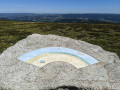
First and foremost, this is the Cévennes panorama walk starting from Mont Lozère. Indeed, the walk follows the ridges of Mont Lozère for over 5 km and offers magnificent 360° views, the most remarkable of which is from the Sommet de Finiels, complete with its three orientation tables.It is also the walk taking in the main peaks that make up the granite dome of Mont Lozère. This is because it takes in six of the mountain’s highest peaks, passing by cairns and historic boundary crosses or Maltese crosses along the way.
Mont Lozère from the ski resort
5.75 mi
+938 ft
-935 ft
3h 30
Moderate
Departure from Cubières (Lozère)
A pleasant hike accessible to all on the roof of the Cévennes with exceptional landscapes throughout the route.
Valats des Oules and Font Bonne valley
5.26 mi
+1,368 ft
-1,339 ft
3h 35
Moderate
Departure from Gabriac (Lozère) (Lozère)
A circular route with varied scenery, marked with attractive directional signs. Trails through the woods or overlooking the Vallée Française.
From Meyrueis to Nivoliers via Aures
 9.59 mi
+1,575 ft
-797 ft
5h 45
Moderate
Departure from Meyrueis (Lozère)
9.59 mi
+1,575 ft
-797 ft
5h 45
Moderate
Departure from Meyrueis (Lozère)
A stage that allows you to fully appreciate the wide open spaces of the Causse! A very pleasant walk, with some beautiful views along the edge of the plateau.
Route of the artisans of yesteryear in Sainte-Croix
1.30 mi
+135 ft
-125 ft
0h 45
Easy
Departure from Sainte-Croix-Vallée-Française (Lozère)
A short route to discover village life in Saint-Croix in the 1930s, through its shops and crafts.
Circular from Roquedols Castle and Col de Tribe to Meyrueis
 4.28 mi
+518 ft
-499 ft
2h 25
Easy
Departure from Meyrueis (Lozère)
4.28 mi
+518 ft
-499 ft
2h 25
Easy
Departure from Meyrueis (Lozère)
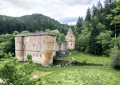
A short walk of a good two hours starting from the swimming pool car park. Pass by Roquedols Castle then the Col de Tribe before returning to Meyrueis.
Clockwise tour of the Causse Méjean starting from Meyrueis
 51.39 mi
+7,661 ft
-7,667 ft
6 days
Moderate
Departure from Meyrueis (Lozère)
51.39 mi
+7,661 ft
-7,667 ft
6 days
Moderate
Departure from Meyrueis (Lozère)
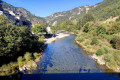
Exclusively on marked trails, this tour offers a comprehensive overview of the Causse: wooded or barren sections, ascents and descents through the Gorges de la Jonte, a walk along the Gorges du Tarn, beautiful villages, a famous karstic cave (Aven Armand), ancient remains (dolmens, menhirs), vultures – nothing is missing. The stages are generally easy, allowing you to focus on the beauty of the landscapes you pass through.
Planned as a six-day tour, it can be completed in five days by combining the last two stages.
Meyrueis – Hyelzas
 8.77 mi
+1,401 ft
-538 ft
5h 15
Moderate
Departure from Meyrueis (Lozère)
8.77 mi
+1,401 ft
-538 ft
5h 15
Moderate
Departure from Meyrueis (Lozère)
Thisfirst stage of the Tour du Causse Méjean takes the hiker up onto the Causse from Meyrueis on the banks of the Jonte. A gentle climb to get you going, featuring a picturesque stretch before reaching the Causse, the Aven Armand, and a renowned cheese dairy at the entrance to the pretty hamlet of Hyelzas. If you arrive early enough, you may be able to visit the Ferme Caussenarde in Hyelzas.
Meyrueis – L’Espérou
10.15 mi
+2,789 ft
-1,066 ft
7h 05
Moderate
Departure from Meyrueis (Lozère)
Walk from the village of Meyrueis (Causse Noir) in the Cévennes to get closer to Mont Aigoual.
Pauparelle
 National Park
 7.39 mi
+1,424 ft
-1,450 ft
4h 40
Moderate
Departure from Meyrueis (Lozère)
7.39 mi
+1,424 ft
-1,450 ft
4h 40
Moderate
Departure from Meyrueis (Lozère)
From the arid plateau of the Causses to the foothills of Puech Pounchut, this walk takes you on a journey of discovery through the upper Jonte valley and its contrasts.
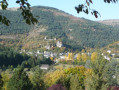
A very scenic trail; climb towards Pauparelle to discover the interlocking roofs of Meyrueis, nestled at the foot of the rock, leading to the Jonte gorges bordered by the Causse Méjean and the Aigoual massif: a journey between the Causses and the Cévennes.