Country:

 City:
City:


From Perpignan, take the RN 116 (2 x 2 lanes) towards Andorra until you reach Olette. Drive through the village and, before the exit, turn right onto the D4 towards Évol (be careful not to miss this junction). At the first bend in the road, continue on the D4a, which takes you through Évol to the hamlet of Thuir d'Évol. There are a few parking spaces at the entrance to the hamlet.
White and yellow signposts
(S/E) From the car park, climb the road that crosses the hamlet, following the Ribera d'Évol, which you will follow until you reach the Mouline refuge. Pass a wash house to reach a junction of a path and a track. Follow a good quality path, permanently marked in white and yellow.
(1) Ignore the wooden bridge that crosses the stream: there is a sign indicating the Mouline refuge via Camì Ramader. Continue along the left bank of the stream. The climb is fairly steady and runs above the stream, sometimes overlooking it by several metres.
(2) Pont de la Llosa (elevation 951): cross and continue along the right bank.
(3) Font Llebeja bridge: cross to return to the left bank. The path crosses old slate quarries where the slates still visible on some ruins encountered during the hike were extracted.
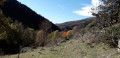
(4) Pont de les Agulles (elevation 1194): cross to continue on the right bank of the Ribera d'Évol, which you have been following since the start. Cross the ruins of Cortal d'en Broc (sheepfold), then the clearing to climb into the forest due north. As you climb, the landscape changes with the altitude. You will arrive at a flatter grassy area.
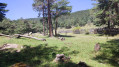
(5) Cross the stream for the last time on a beautiful wooden footbridge. The trail approaches a track that can be seen above, but it is not necessary to climb up to it. The trail heads towards a dilapidated refuge, the Mouline refuge, the end point of this beautiful hike.
(6) We stop for lunch in the shade by the stream, where we take the opportunity to splash around. The return journey is along the same route, back to the car park (S/E).

 Visorando Member
 Difficult