Country:

 City:
City:



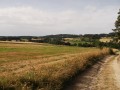
Car park, 800m north of Allègre, on a small lay-by to the left of the Sembadel-Gare road.
(S/E) Cross the Sembadel Gare–Allègre road (D13), head north-east (away from Allègre) to take the path 50 metres to the right, before a farm building, and immediately turn right again, heading south.
(1) After 890m, the path crosses its first road at a place called La Mouteyre; cross it and carry on straight ahead, following the direction indicated by a clearly visible green sign for ‘Mont Bar volcanic site’. Keep heading south, whilst passing alongside a residential area.
500 metres further on, at a larger junction, several signs point to the left, indicating the Tourist Office, the police station, the secondary school, the nursery and the Mont Bar site. Take this route to the left, marked in red and white (GR®® 40).
After 300 metres, this road continues as a footpath, with a small sign indicating ‘Mont Bar’ – head straight on. Follow this sign, ignoring the path to the left, and climb gradually through the forest. Head east at first, then south-east.
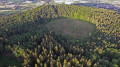
(2) You’ll reach the northern edge of the volcano’s crater, which is 790,000 years old. There’s an information sign here. Ignore the well-marked path on the right; head south-west, taking the path that descends towards the peat bog, slightly to the right. Continue to follow theGR®® 40. You’ll see another path on the left, heading south-west, which takes you closer to the Mont Bar Tower, a structure used in the early 20th century for the production of topographical maps.
Go round the bog to the west along a very picturesque path through a majestic beech forest. Several information boards provide details on the flora, fauna and human activity in the area. Before leaving the bog behind, note a small wooden footbridge on the left spanning an old drainage channel built in the early 19th century.
(3) Shortly after this footbridge, the path begins the steep descent down the volcano’s southern slope and heads south-east.
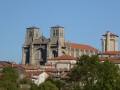
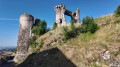
(4) After a 400-metre descent, you’ll come to a path which you should take to the right. You will still see the red and white markings of theGR®® 40 variant, which heads directly towards Allègre without climbing Mont Bar. This path, halfway up the massif, offers stunning views of the surrounding region and, finally, of the medieval village of Allègre, dominated by ‘La Potence’, a remnant of its castle.
(5) After 1.2 km along this path, you’ll reach a wooden gate, which you go through. You then leave theGR®® and continue along a grassy track to the left, which leads onto a small tarmac road near the first houses of the village of Allègre.
(6) At the bottom of the village, at the first junction, take the uphill lane opposite, Montée Saint-Martin. 200 metres further on, you’ll reach the main road running through the village; cross it and continue straight ahead along Rue Baptiste Marcet.
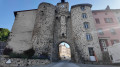
(7) You’ll find yourself facing the imposing Porte de Monsieur (remains of the old fortifications). Turn left onto a very steep cobbled lane leading up to the hill (Mont Baury), on which you can see ‘La Potence’ – the only significant remnant remaining today – where a magnificent castle once stood.
At the top of this alley, cross a small tarmac road and reach the hill via a final short grassy path. Behind “La Potence” is an orientation board. Walk round it to head back down into the village via the small road on the right, bringing you as close as possible to the foot of “La Potence”, where a large information board provides details about the castle’s architecture and the history of the family of the Baron d’Alègre (with a single “L”), who began its construction in the 14th century.
After the sign, turn left and join a road leading back up to the site’s car park (signposted). Take this small road to the right and, 30 metres further down, turn left one last time to leave the village. Follow this small road for 300 metres, heading north.
(8) Leave this road, which joins the Allègre–Sembadel Gare road further down, and continue to the left along the grassy track marked in yellow.
After walking 800 metres along this track, rejoin the road mentioned earlier and the disused track from the start (S/E).



 Tourism professional

 Visorando Member
 Easy
Easy