


Refine your search for walks in Claviers
Claviers walks


 Tour of the Puy Forest starting from Claviers
 Visorando Member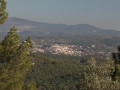
 4.22 mi
 +627 ft
 -627 ft
 2h 30
2h 30
 Easy
Easy
 Departure from Claviers (Var)
An easy family walk between sun and shade (between the south-facing and north-facing slopes, in fact), with lovely views of the sea on the south-facing slope and the coolness of the forest on the way back.
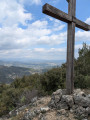
La Pigne, starting from Claviers
 8.26 mi
+1,312 ft
-1,316 ft
4h 55
8.26 mi
+1,312 ft
-1,316 ft
4h 55
 Moderate
Departure from Claviers (Var)
Moderate
Departure from Claviers (Var)
An easy, family-friendly route mostly along forest paths, ending with a magnificent viewpoint.
Sunny all the way; the return route is cooler as it’s on the north-facing slope.
In spring, it’s full of flowers.
In summer, make sure you take plenty of water and set off early.
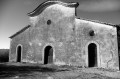
Sainte-Anne Chapel in Claviers
 3.36 mi
+643 ft
-633 ft
2h 05
Easy
Departure from Claviers (Var)
3.36 mi
+643 ft
-633 ft
2h 05
Easy
Departure from Claviers (Var)
Ascent to the Sainte-Anne Chapel, located 624 m above sea level on the western summit of the Plateau du Puy, passing by the ruins of a Ligurian oppidum. Easy hike in the Provence scrubland and forest (thyme, lavender, rock rose...)
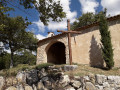
The Pigne lookout
 1.97 mi
+410 ft
-410 ft
1h 15
Easy
Departure from Seillans (Var)
1.97 mi
+410 ft
-410 ft
1h 15
Easy
Departure from Seillans (Var)
This is an easy hike offering magnificent panoramic views from the lookout point over Audibergue, Estérel, Fréjus, Colle du Rouet, Maures, Coudon, and more.
Circular Riou de Claviers loop and Garron track starting from L’Éouvière
3.23 mi
+361 ft
-361 ft
1h 50
Easy
Departure from Seillans (Var)
A pleasant, shaded walk through the Seillans forest and along the Riou de Claviers. No difficulty, even in summer. You may occasionally spot wild boars, which are numerous in the area. You can cool off on the way back, provided the Riou hasn’t run dry...
Around Montferrat
 7.63 mi
+1,942 ft
-1,919 ft
5h 10
Moderate
Departure from Montferrat (Var) (Var)
7.63 mi
+1,942 ft
-1,919 ft
5h 10
Moderate
Departure from Montferrat (Var) (Var)
A walk around a little-known village with hidden gems, close to home! Montferrat is located 14 km north of Draguignan. The hike starts at Place des Allées, west of the village in front of the pretty village school. The esplanade, a former transhumance site, is adorned with centuries-old plane trees and bordered by the Nartuby River. We are in the Var department in the Provence-Alpes-Côte d'Azur region. Most of the route is through woodland.
Promenade of drystone shelters in Seillans
 Tourist office1.88 mi
+135 ft
-135 ft
1h 00
Easy
Departure from Seillans (Var)
Tourist office1.88 mi
+135 ft
-135 ft
1h 00
Easy
Departure from Seillans (Var)
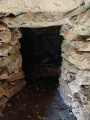
The shepherds of Provence offer us wonders along this short hike: the drystone shelters and their exceptional architecture. The Seillan drystone shelters were built between the18th and19th centuries, a period when land clearing and cultivation developed. The hills were then all cultivated in terraces, restanques and banquettes where chickpeas, wheat, barley, vines, olive trees and fruit trees grew. These huts provided shelter for farmers and their tools. Shaped like igloos, they maintain the same temperature in summer and winter, providing good protection against the heat or the mistral wind. Why are there so many drystone shelters in Seillans (more than 80!) and so few in neighbouring villages? It remains a mystery!
Walk through the Royal Forest in Saint-Paul-en-Forêt
4.99 mi
+456 ft
-449 ft
2h 40
Easy
Departure from Saint-Paul-en-Forêt (Var)
A very pleasant walk through the heart of the Royal Forest, with its downy oaks, cork oaks and hornbeams. Several species of birds can be observed, including woodcocks and kingfishers. During the hike, you will enjoy magnificent views of Lake Méaulx. The inhabitants of Saint-Paul, steeped in a strong forestry culture, have always known how to draw resources from this forest: timber for building houses and ships, acorns for feeding pigs, wood for heating and fuelling lime kilns and craft kilns, particularly for firing tiles and glassware. From the16th century onwards, the Royal Navy consumed large quantities of timber for its ships. Today, the Royal Forest is no longer exploited, but with its downy oaks, cork oaks and hornbeams, it is a very pleasant place to walk.
"Le Lac de Méaulx" walk in Saint-Paul-en-Forêt
4.61 mi
+331 ft
-305 ft
2h 25
Easy
Departure from Saint-Paul-en-Forêt (Var)
Between the Maures mountains and the forests of Fayence, Seillans and Saint-Paul-en-Fôret, this hike takes you to the 11-hectare Lac de Meaulx in a densely wooded and green environment. The Riou de Méaulx hillside reservoir was built by the Syndicat Intercommunal pour l'Aménagement du Cours Supérieur de l'Endre (Intercommunal Association for the Development of the Upper Endre River). Lac de Méaulx, straddling the municipalities of Saint-Paul-en-Forêt, Seillans and Fayence, was filled with water in December 1981. The reservoir has a capacity of 900,000 m3 and a surface area of 16 hectares. Its maximum length is 1 km and the dam is 20 metres high. The lake was used as a support area for forest fire defence. Following damage, it was emptied in October 2006. Currently owned by the Community of Municipalities, it was refilled in early 2017 after renovation work.
The National Forest of the Colle du Rouët and the Trou de Gournié waterfall on the river Endre
 6.00 mi
+243 ft
-253 ft
3h 00
Easy
Departure from Le Muy (Var)
6.00 mi
+243 ft
-253 ft
3h 00
Easy
Departure from Le Muy (Var)
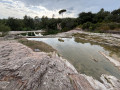
A pleasant walk letting you discover the National Forest of the Colle du Rouët, the Trou de Gournié, also called Cascade de l'Endre and the river Endre.
The Muéron Cave and the Blavet Gorges in Bagnols-en-Forêt
 3.90 mi
+646 ft
-630 ft
2h 20
Moderate
Departure from Bagnols-en-Forêt (Var)
3.90 mi
+646 ft
-630 ft
2h 20
Moderate
Departure from Bagnols-en-Forêt (Var)
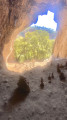
A walk in an exceptional location, discovering the Blavet Gorges and the Mueron Cave, inhabited during the Bronze Age.Ideal in summer and mid-season, avoid periods of heavy rain.
La Colle du Rouet at Le Muy
 6.76 mi
+1,004 ft
-991 ft
4h 00
Moderate
Departure from Le Muy (Var)
6.76 mi
+1,004 ft
-991 ft
4h 00
Moderate
Departure from Le Muy (Var)
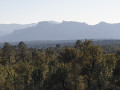
This is a beautiful hike of about 5 hours in the Colle du Rouët national forest in Le Muy, in a wild environment offering a 180° panorama to the south, with magnificent views of Saint-Raphaël, Fréjus and the sea to the east, and as far as Sainte-Baume and Montagne Sainte-Victoire to the west.
The second part of the hike includes a tricky off-trail section through vegetation, from (5) to (7). Description of the possible alternative route in the Practical Information section.
Walk through the Blavet Gorges in Bagnols-en-Forêt
3.90 mi
+604 ft
-581 ft
2h 20
Easy
Departure from Bagnols-en-Forêt (Var)
Carved into red volcanic rock, the gorges offer beautiful geological features such as the Grotte de Muéron, one of the major climbing sites in the Var, and at the heart of this hike. At the foot of one of these many cliffs, you will find the prehistoric Muéron cave, which was occupied 10,000 years BC. From its very wide entrance, it extends deep into the rock and still provides shelter from storms today. Its proximity to the Blavet river and forests (a source of fuel), its southern exposure and its commanding view of the valley made it possible to follow wild herds and made it particularly attractive for camps during the Bronze Age.
Pic du Castel Diaou via the Piste de la Colle Rousse
5.19 mi
+1,152 ft
-1,122 ft
3h 25
Moderate
Departure from Bagnols-en-Forêt (Var)
A moderately difficult circular route with superb views of the Mediterranean, the Rocher de Roquebrune-sur-Argens and the Haut Var. A fairly easy climb and a slightly steep descent.
Red trail at the Blavet site
 2.10 mi
+302 ft
-308 ft
1h 15
Moderate
Departure from Roquebrune-sur-Argens (Var)
2.10 mi
+302 ft
-308 ft
1h 15
Moderate
Departure from Roquebrune-sur-Argens (Var)
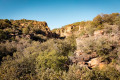
Nestled among vineyards and pine trees, La Bouverie is a pretty residential neighbourhood and the green heart of Roquebrune-sur-Argens. At the foot of the majestic Gorges du Blavet, where the red rock of the Estérel rises in steep cliffs, hiking trails lead in the footsteps of Homo Bouvérien. Archaeologists have recognised that the Roquebrune-sur-Argens area has been continuously inhabited throughout prehistoric times. The caves of La Bouverie are the earliest evidence of this.