Promenade of drystone shelters in Seillans

The shepherds of Provence offer us wonders along this short hike: the drystone shelters and their exceptional architecture. The Seillan drystone shelters were built between the18th and19th centuries, a period when land clearing and cultivation developed. The hills were then all cultivated in terraces, restanques and banquettes where chickpeas, wheat, barley, vines, olive trees and fruit trees grew. These huts provided shelter for farmers and their tools. Shaped like igloos, they maintain the same temperature in summer and winter, providing good protection against the heat or the mistral wind. Why are there so many drystone shelters in Seillans (more than 80!) and so few in neighbouring villages? It remains a mystery!

Details

88379838
Creation:
Last update:
Last review:
  • Walking
    Activity: Walking
  • ↔
    Distance: 3.02 km
  • ◔
    Average duration: 1h 00 
  • ▲
    Difficulty: Easy

  • ⚐
    Back to start: Yes
  • ↗
    Ascent: + 41 m
  • ↘
    Descent: - 41 m

  • ▲
    Highest point: 335 m
  • ▼
    Lowest point: 293 m
  • ⚐ Country: France
  • ⚐
    Area: Alps
  • ⚐ City: Seillans (83440)
  • ⚑
    Start/End: N 43.631354° / E 6.654517°
  • ❏
    IGN map(s): Ref. 3543ET, 3543OT
  • Hour-by-hour weather

Description of the walk

Access: coming from Fayence/Montauroux towards Seillans, just before entering the village, stop at the chapel on the left. GPS coordinates of the starting point: 43.631903, 6.654731

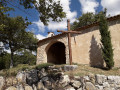
(S/E) From the Notre-Dame de l'Ormeau Chapel, in the car park opposite the farm, take the road on the left to reach a track on the right, which crosses a small concrete footbridge.

(1) At the end of the footbridge, take the gravel path on the right, which curves around to a stop sign on the D19. At the stop sign, take the D19 to the right for a few metres, staying on the hard shoulder, and before the sign indicating the village exit, turn right onto Chemin des Bas Plans until you reach the crossroads with the sign for "Chemin Rouvière".

(2) Turn right onto the gravel path to reach the first area of drystone shelters. Signs indicate their locations along the route. Several of them are on the right-hand side of the track.

(3) Then return to the track and turn right. Then turn right. Before the last drystone shelter, you will arrive at the "Gué de la Rouvière" marker.

(4) Turn back, turn right and then right again to see drystone shelter number 4.

(5) Return to the Ormeau chapel (S/E) by retracing your steps.

Waypoints

  1. S/E : km 0 - alt. 334 m - Chapel of Notre-Dame de l'Ormeau
  2. 1 : km 0.11 - alt. 333 m - End of the small footbridge
  3. 2 : km 0.53 - alt. 318 m - Chemin Rouvière
  4. 3 : km 0.86 - alt. 310 m - Drystone shelters area
  5. 4 : km 1.33 - alt. 299 m - Rouvière ford
  6. 5 : km 1.71 - alt. 296 m - Drystone shelter number 4.
  7. S/E : km 3.02 - alt. 334 m - Chapel of Notre-Dame de l'Ormeau

Notes

Open all yearround, weather permitting.

Contact:

Telephone: 04 94 76 01 02

Email:contact@paysdefayence.com

Website:www.paysdefayence.com

Terrain type:

Gravel
Earth

Animals: yes

Visitor alert:

During the summer, check the opening times of the mountain ranges before setting off on a hike.
This route is located in the Plateau de Canjuers mountain range.
Consult the map updated daily by the prefecture: www.risque-prevention-incendie.fr/var/

Alternative route via the D53: after the fourth drystone shelter, you can take a circular route that crosses the Riou de la Rouvière, then a wooded area, continue to the right along the small Bouques road and come out onto the D53. Turn right and continue for 500 metres, staying on the right-hand side of the road. At the Maisonnette de l'ancien garde barrière, turn right onto the old railway line. Pass under a bridge then over a bridge, walk alongside the Cairns farm and reach the Ormeau chapel. Circular loop: 5 km

Worth a visit

Tips and suggestions:

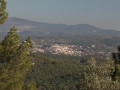
- Discover Seillans, one of the most beautiful villages in France.
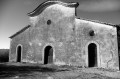
- Discover the12th-century Notre-Dame-de-l'Ormeau Chapel.
- Discover the drystone shelters, small round dry stone huts that served as shelters or seasonal storage for19th-century farmers.
- Guided tour of the village of Seillans and the Notre-Dame de l'Ormeau Chapel every Thursday (booking required).

Other walks in the area

For more walks, use our search engine .

The GPS track and description are the property of this route's author. Please do not copy them without permission.