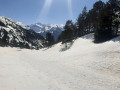
This description covers a solo hike undertaken at the start of the winter season (late November 2021) with moderate, recent snow cover.
Between (S/E) and (1), the track, although covered in snow (30 cm), is fairly visible. From (1) onwards, no track, path or signposting is visible! For most of the route, you’ll need to follow the description along with a GPS track, or even follow in the tracks of previous skiers or snowshoers.
Between (2) and (3) the scree was at ground level, which made progress difficult. Between (3) and (4) several sections were even bare, with no snow.
Only attempt this route if you are proficient in snowshoeing or ski touring and know how to use crampons and an ice axe. This hike can be done in summer, following roughly the same route and staying – as far as possible – on the slopes and paths, which are clearly visible throughout.
Car park at the start:
The car park is on the left as you drive up to Le Pourtalet. When there is snow on the road, it can be difficult to distinguish between the centre line and the kerb. If you arrive very early in the morning, the car park may not yet have been cleared of snow. In that case, please ensure you choose a parking space that does not obstruct traffic.
Estimated time
I completed this route on snowshoes in 6 hours, including breaks and a picnic, setting off from the car park at 9.15 am. This is a fairly tight estimate. Allow between 6½ and 7 hours. Be aware that it gets dark quickly in winter!
In summer, allow 5 hours to 6 hours 30 minutes.
Difficulty:
I’ve rated this as ‘Difficult’ due to the steep sections between (2) and (3) and the fact that the route is unmarked. It’s a fairly challenging route where you need a good sense of direction, but it’s not very complicated. The distance and elevation gain aren’t particularly significant,
However, there are four steep sections of 100 m or more, with a gradient of over 30% (but less than 40%).
In summer, the difficulty rating is Moderate.
The IBP Index (an automated system for assessing the difficulty of a route) is 86 HKG, which corresponds to a Difficult route for a hiker with Average physical fitness.
Water sources:
- in winter when there is snow, streams can be used as water sources without too much risk. However, allow for 1 litre of cold water per person and 1 litre of hot water in a thermos flask per person.
- In summer, allow 2.5 litres per person.
Shelters
In an emergency, shelter is available at all the huts in the vicinity.
Equipment
- In summer, bring standard high-mountain hiking kit: hiking boots, suitable clothing, rainwear, water, food, a survival blanket, a knife, a compass, a map and a whistle.
- In winter when there is snow, you must also bring snowshoes, a pair of poles, gaiters, sun cream, lip balm, a GPS or the Visorando app on your smartphone, gloves, suitable warm clothing, a flask with a hot drink, a hat, and sunglasses suitable for the glare off the snow. Some people will also take an avalanche transceiver (DVA), a shovel and a probe. Crampons and an ice axe are not always essential, but should be brought along.
Visitor numbers:
- in winter when there is snow, you can spend the whole day on your own, depending on the day chosen and the weather.
- In summer, the routes in the Cirque d’Anéou are very busy.
Whatever the season, don’t forget to let your friends and family know your exact route and keep them updated on any changes via text message or phone call.
Snowshoes + poles or crampons + poles or crampons + ice axe
In the depths of winter in the morning, it may be easier to use crampons than snowshoes or skis. Walking in crampons is almost identical to walking in ordinary shoes, with the added advantage of being able to safely navigate small flat sections or gentle icy slopes, and above all narrow, overhanging sections of hard or icy snow.
When putting on crampons on flat ground or gentle slopes, you keep your poles. As soon as the gradient exceeds 15–20 per cent, snowshoes and poles are stowed away and securely fastened to your rucksack, and you use the ice axe. Using an ice axe requires a good level of skill, particularly in the event of a fall or when descending.
Météo-France Mountain Bulletin and Avalanche Risk Assessment Bulletin (BRA or BERA)
Check the weather forecasts, particularly the Météo-France snow and avalanche bulletin for the Aspe-Ossau massif in the Pyrénées-Atlantiques.
Avalanche risk areas:
There are no known avalanche-prone areas on this route. However, remain vigilant on the north-east face immediately below the Pic de Canaourouye.
TheGR® andPR® trail markings are the intellectual property of the French Hiking Federation.
If, on your route or on the map you are using, you notice any errors in signposting or place names, or …, you can become a contributor and report them:
- signposting errors, safety issues, conflicts of use, environmental concerns: click here
- mapping errors, place names: click here



 Country:

 City:
City:



 Visorando Member


 Easy
Easy 
 Very difficult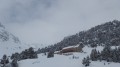
 Moderate