Refine your search for walks in Chênehutte-Trèves-Cunault
Chênehutte-Trèves-Cunault walks


 In the footsteps of Robrica in Chênehutte
 Tourist office
 5.16 mi
 +262 ft
 -246 ft
 2h 35
2h 35
 Easy
Easy
 Departure from Chênehutte-Trèves-Cunault (Maine-et-Loire)
A hilly, wooded route. Situated on the left bank of the Loire, downstream from Saumur, this village in the Loire Valley is a former Gallo-Roman settlement and home to one of the most important archaeological sites in Maine-et-Loire. Finds made on the plateau prove human presence dating back to the Neolithic period (4500 to 4000 BC).
From the Loire to the Authion
 8.37 mi
+20 ft
-20 ft
3h 50
8.37 mi
+20 ft
-20 ft
3h 50
 Moderate
Departure from Saint-Martin-de-la-Place (Maine-et-Loire)
Moderate
Departure from Saint-Martin-de-la-Place (Maine-et-Loire)
A flat route between the banks of the Loire and the Authion. It allows you to explore the birthplace of Aristide du Petit Thouars and its heritage.
Please note: The paths along the banks of the Loire are impassable during periods of high water
Between the Loire and the hillsides between Trèves and Chênehutte
 5.90 mi
+249 ft
-230 ft
2h 55
Easy
Departure from Chênehutte-Trèves-Cunault (Maine-et-Loire)
5.90 mi
+249 ft
-230 ft
2h 55
Easy
Departure from Chênehutte-Trèves-Cunault (Maine-et-Loire)
A hilly, wooded route between Trèves and Chênehutte, along the Loire and on the hillside. This route also winds through the historic streets of the village of Trèves.
South of Pompierre via Villemolle and Verrie
 Visorando Member6.90 mi
+52 ft
-52 ft
3h 15
Easy
Departure from Chênehutte-Trèves-Cunault (Maine-et-Loire)
Visorando Member6.90 mi
+52 ft
-52 ft
3h 15
Easy
Departure from Chênehutte-Trèves-Cunault (Maine-et-Loire)
An easy walk along paths through meadows and woodland
⚠️ At certain times of the year, hunting may take place along this route, particularly between (5) and (6) in the Verrie area.Hikers are free to abandon or alter their route if they consider the conditions to be unsafe.
Views of the Loire at Cunault
 4.89 mi
+203 ft
-184 ft
2h 25
Easy
Departure from Chênehutte-Trèves-Cunault (Maine-et-Loire)
4.89 mi
+203 ft
-184 ft
2h 25
Easy
Departure from Chênehutte-Trèves-Cunault (Maine-et-Loire)
Dominated by its Romanesque church, a former Benedictine priory, the village of Cunault was a place of pilgrimage and renowned fairs in the Middle Ages and until the end of the 19th century, an important port on the Loire specialising, like its neighbouring (and twin) port of Trèves, in the shipment of tuffeau stone.
Steep slope at the start, then flat, shaded paths.
From the Loire to Les Roches
 8.88 mi
+174 ft
-187 ft
4h 15
Moderate
Departure from Gennes (Maine-et-Loire) (Maine-et-Loire)
8.88 mi
+174 ft
-187 ft
4h 15
Moderate
Departure from Gennes (Maine-et-Loire) (Maine-et-Loire)
The settlement of Gennes dates back to the Neolithic period (4500 BC). Menhirs and dolmens, inherited from this distant era, stand proudly before the eyes of walkers. Its Gallo-Roman amphitheatre has also stood the test of time, offering a real journey through history. The Étang and the Forest of Joreau are a nature reserve and have been classified as a Natural Area of Ecological, Faunistic and Floristic Interest (Z.N.I.E.F.F.) since 1992.
The woods around Rou-Marson
 4.27 mi
+135 ft
-135 ft
2h 05
Easy
Departure from Rou-Marson (Maine-et-Loire)
4.27 mi
+135 ft
-135 ft
2h 05
Easy
Departure from Rou-Marson (Maine-et-Loire)
From the Place du Château de Marson, a short walk takes you through the woods, past water features and along the botanical trail, where you can discover the area’s plant biodiversity.
 Gennes-Val de Loire Route
18.45 mi
+755 ft
-758 ft
3 hrs
 Difficult
Departure from Gennes (Maine-et-Loire) (Maine-et-Loire)
Difficult
Departure from Gennes (Maine-et-Loire) (Maine-et-Loire)
A 30km mountain bike route between Gennes-Val de Loire, Saint-Georges-des-Sept-Voies and Le Thoureil. Dolmens, menhirs, cave dwellings and rural heritage can be explored along this undulating route, which is sure to delight mountain bikers. The route also offers beautiful views of the Loire.
Route de l'Île Ollivier
 3.15 mi
+16 ft
-16 ft
1h 30
Easy
Departure from Les Rosiers-sur-Loire (Maine-et-Loire)
3.15 mi
+16 ft
-16 ft
1h 30
Easy
Departure from Les Rosiers-sur-Loire (Maine-et-Loire)
A family-friendly route to explore the banks of the Loire. You can extend your route with a heritage trail that will take you to the village’s most iconic spots.
Please note! The path along the banks of the Loire is impassable during periods of high water.
Around the Thouet in Saumur
4.54 mi
+23 ft
-23 ft
2h 05
Easy
Departure from Saumur (Maine-et-Loire)
A short walk around the Thouet, ideal for families.
When the Romans lead us to Marson
 7.09 mi
+194 ft
-197 ft
3h 25
Moderate
Departure from Distré (Maine-et-Loire)
7.09 mi
+194 ft
-197 ft
3h 25
Moderate
Departure from Distré (Maine-et-Loire)
A lovely trip to the countryside through woods and meadows, taking in the Land Art, the castle and Marson Pond along the way.
Stroll in Saumur
4.20 mi
+138 ft
-138 ft
2h 05
Easy
Departure from Saumur (Maine-et-Loire)
This beautiful Loire city certainly deserves a more in-depth visit, here it is offered a short discovery loop, a good option for a stopover on a journey between Anjou and Touraine regions.
Vineyards and woods around Les Ulmes
 7.14 mi
+164 ft
-138 ft
3h 25
Moderate
Departure from Les Ulmes (Maine-et-Loire)
7.14 mi
+164 ft
-138 ft
3h 25
Moderate
Departure from Les Ulmes (Maine-et-Loire)
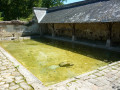
The name comes from the Latin word ulmus, meaning elm tree, and was given to the village because of the presence of this tree. The surrounding woods and estates were entrusted to the monks of Saint-Maur Abbey, and the village developed around a priory and its church. The priory, which was remodelled in the 16th and 17th centuries, is still attached to the Church of Saint Vincent of Spain, which features beautiful remains from the 11th and 12th centuries.
Dolmen Trail starting from Saugré
 4.67 mi
+131 ft
-131 ft
2h 15
Easy
Departure from Dénezé-sous-Doué (Maine-et-Loire)
4.67 mi
+131 ft
-131 ft
2h 15
Easy
Departure from Dénezé-sous-Doué (Maine-et-Loire)
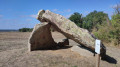
This walk is a revised version of the “Sentier des dolmens”, a 13-kilometre route illustrated on a sign at the Saugré washhouse. The route described here takes you past several dolmens and ends in hamlets where the houses have cave dwellings. The walk regularly offers very unobstructed views where the eye can see for miles.
Between Blou and Neuillé
 11.63 mi
+568 ft
-545 ft
5h 50
Difficult
Departure from Blou (Maine-et-Loire)
11.63 mi
+568 ft
-545 ft
5h 50
Difficult
Departure from Blou (Maine-et-Loire)
Perched atop its hill, at an altitude of over 100 metres, Blou bears the marks of its age and invites visitors to remember that it was one of the first inhabited settlements in Anjou. Further down the valley, the River Suzon winds its way through Neuillé, a village with equally timeless charm. All around, woods, fields and market gardens serve as a reminder that this is a rural area where life is peaceful.