


Refine your search for walks in Cadaqués
Cadaqués walks


 Cadaqués - Roses
 Visorando Member
 12.86 mi
 +1,765 ft
 -1,778 ft
 7h 25
7h 25
 Difficult
 Departure from Cadaqués (Girona)
The trail is initially mountainous inland, then runs along the coastline, providing access to coves and beaches, some of which belong to the Cap de Creus Natural Park. Panoramic views of Cadaqués and Cap de Creus. Between Cap Norfeu and the beginning of the urbanisation of Canyelles-Amaldrava, the coastal path overlooks the sea with magnificent landscapes. This route can be included in a longer route from Collioure to Roses.
El Far de Cala Nans in Cadaqués
 5.02 mi
+623 ft
-620 ft
2h 50
5.02 mi
+623 ft
-620 ft
2h 50
 Easy
Departure from Cadaqués (Girona)
Easy
Departure from Cadaqués (Girona)
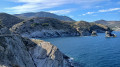
A coastal walk from Cadaqués to its lighthouse, offering numerous views of Cadaqués Bay, Port Lligat and Cap de Creus.
From Portlligat to Cap de Creus
 7.80 mi
+994 ft
-984 ft
4h 25
7.80 mi
+994 ft
-984 ft
4h 25
 Moderate
Departure from Cadaqués (Girona)
Moderate
Departure from Cadaqués (Girona)
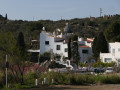
Did Salvador Dali, who lived in Portlligat for many years, often travel to Cap de Creus via the camino viell del far? This path hasn't changed much since it was the only overland route to Spain's most easterly point.
The route winds its way between low dry-stone walls, linking the many "calas" along the way. Some of these offer small, secluded beaches, a welcome invitation to take a dip in these rugged surroundings.
Cap de Creus
 9.21 mi
+1,407 ft
-1,401 ft
5h 30
Moderate
Departure from Cadaqués (Girona)
9.21 mi
+1,407 ft
-1,401 ft
5h 30
Moderate
Departure from Cadaqués (Girona)
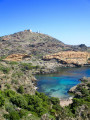
This hike starting from Cadaqués leads to Cap de Creus, avoiding the busy road that leads there. This headland is notable for being the easternmost point of the Iberian Peninsula and offers a unique, rugged landscape, with rocks of sometimes strange shapes, battered by wind and rain, bearing witness to the force of erosion. The return journey follows the "Cami Antic", a delightful winding path lined with dry stone walls, which has changed very little since the days when it was the only access route to the cape. If you wish, you can round off the day by visiting Salvador Dalí’s house in Port Lligat, located less than two kilometres from the starting point.
Cap de Norfeu
 8.22 mi
+1,713 ft
-1,719 ft
5h 15
Difficult
Departure from Roses (Girona)
8.22 mi
+1,713 ft
-1,719 ft
5h 15
Difficult
Departure from Roses (Girona)
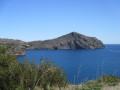
This hike, with its scents of heath, is ideal for Costa Brava enthusiasts looking to escape the crowded beaches. At the gates of Rosas, the route initially follows the coastal path (Cami de Ronda), passing by numerous rocky coves and a few secluded beaches. A steep climb then leads to the Torre de Norfeu and the cape of the same name, which you can walk around via the viewpoint. The return journey is via Cala Jóncols, then inland, climbing to higher ground to make the most of the sweeping views stretching as far as Cap de Begur. This is a medium-distance hike, but there are several steep sections that require a good level of fitness.
Montjoi
 6.59 mi
+1,152 ft
-1,175 ft
4h 00
Moderate
Departure from Roses (Girona)
6.59 mi
+1,152 ft
-1,175 ft
4h 00
Moderate
Departure from Roses (Girona)
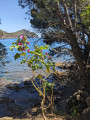
This is a two-part hike. The first part consists of a short detour inland to gain altitude and enjoy beautiful views of Roses Bay and the Catalan Pyrenees before returning to the coast at Montjoi. The return journey is along the coast via the Cami de Ronda, which follows the coastline and allows you to discover several small coves and magnificent beaches offering excellent swimming spots in the summer. At the end of the route, a short detour to the Falconera viewpoint and its immense panorama provides a beautiful conclusion to this circular route.
From Port de la Selva to Cala Tavallera
 9.08 mi
+1,496 ft
-1,496 ft
5h 30
Moderate
Departure from el Port de la Selva (Girona)
9.08 mi
+1,496 ft
-1,496 ft
5h 30
Moderate
Departure from el Port de la Selva (Girona)
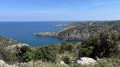
For a swim in turquoise water on a deserted beach, there's no need to go to the tropics. Just a two-hour walk from Port de la Selva, and halfway to Cap de Creus, there's a pretty cove just waiting for you. The only problem is that it'll take just as long to get back, and forget about the benefits of swimming. But it's worth it.
The coves of El Port de la Selva
 8.57 mi
+1,663 ft
-1,657 ft
5h 25
Moderate
Departure from el Port de la Selva (Girona)
8.57 mi
+1,663 ft
-1,657 ft
5h 25
Moderate
Departure from el Port de la Selva (Girona)
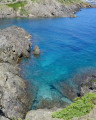
Starting from the charming village of El Port de la Selva, this hike initially follows the rugged coastline of the Cap de Creus Nature Reserve, where the jagged rocks bear witness to the force of erosion and shape the landscape. Along the way, you’ll discover several well-known coves that are popular in the summer, such as Cala Tamariua or Cala Fornells, or, for those who prefer peace and solitude, other tiny, secluded coves like Cala Cativa, Cala Torta or Cala Corquell. There’s plenty of choice for those wishing to enjoy the crystal-clear waters of the area. The return journey follows easy paths through magnificent pine woodland, offering welcome shade on hot days. Finally, do take the time to visit the charming village where the walk begins, where there is no shortage of cafés for a well-deserved break at the end of the hike.
Route of menhirs and dolmens around Roses
 6.10 mi
+1,135 ft
-1,152 ft
3h 50
Moderate
Departure from Roses (Girona)
6.10 mi
+1,135 ft
-1,152 ft
3h 50
Moderate
Departure from Roses (Girona)
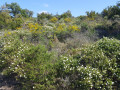
Starting from Plaça Catalunya by the sea in Roses, this short walk takes you past menhirs and dolmens on the hills above Roses, offering magnificent views of the bay and the hinterland. Walking through Roses allows you to pass by numerous shops and restaurants.
Castle of Sant Salvador de Verdera and Monastery of Sant Pere de Rodes
 2.28 mi
+610 ft
-584 ft
1h 35
Easy
Departure from el Port de la Selva (Girona)
2.28 mi
+610 ft
-584 ft
1h 35
Easy
Departure from el Port de la Selva (Girona)
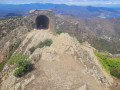
A short, easy circular route, even for children, to visit Sant Salvador de Verdera Castle and Sant Pere de Rodes Monastery. Very well-marked trails with superb views of the Mediterranean Sea and the region. Although the route is quite short, it is not shaded.
Sant Onofre Chapel
 2.21 mi
+276 ft
-289 ft
1h 15
Easy
Departure from el Port de la Selva (Girona)
2.21 mi
+276 ft
-289 ft
1h 15
Easy
Departure from el Port de la Selva (Girona)
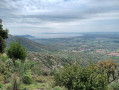
A lovely little walk overlooking Roses with an incredible panoramic view.
Hiking and a medieval gem above the Bay of Rosas
2.61 mi
+433 ft
-433 ft
1h 35
Easy
Departure from el Port de la Selva (Girona)
Starting from a car park offering breathtaking views of the Bay of Rosas, a hiking trail rises up, promising one of the most beautiful experiences on the Costa Brava. This walk, as beautiful as its destination, leads to an exceptional site: the Benedictine monastery of San Pere de Rodes. Perched on the mountainside, this masterpiece of Romanesque art awaits you for an unforgettable dive into history, all for the modest sum of €6. Prepare to fall in love with this place, where the beauty of the Mediterranean landscape meets architectural grandeur.
Monastery of Sant Pere de Rodes from Llança Cau del Llop beach
 9.54 mi
+1,900 ft
-1,916 ft
6h 00
Moderate
Departure from Llançà (Girona)
9.54 mi
+1,900 ft
-1,916 ft
6h 00
Moderate
Departure from Llançà (Girona)
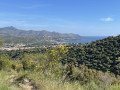
The path from Llança is well marked and climbs steadily to the monastery. As a bonus, a visit to the monastery can enhance your outing.
We started from Cau del Llop beach, but we recommend starting from km 2 of our route at the GR®11 in the village. The road infrastructure behind the fire station allows you to park your vehicle without any problems.
The descent from the monastery via a local trail allows you to discover the village of La Vall de Santa Creu and reach Llança via the cami de ronda along the coast.
Llança - Castel de Verdura Sant Pere de Rodes
8.33 mi
+2,871 ft
-2,858 ft
6h 20
Difficult
Departure from Llançà (Girona)
Stunning panoramic views of the sea, Llanca, Puerto de la Selva, Cap Creus, Rosas Bay and Les Albères.
Take a well-deserved break at the fountain square in the village of Serra de Rodes
Puig d’Esquers – Sant Miquel de Colera from La Valleta (Llançà)
 10.64 mi
+2,385 ft
-2,365 ft
7h 00
Difficult
Departure from Llançà (Girona)
10.64 mi
+2,385 ft
-2,365 ft
7h 00
Difficult
Departure from Llançà (Girona)
The walk is classified as difficult due to its distance, duration and the route along the stream, which must be crossed several times.
See Practical Information ². The elevation gain is around 850m.
This hike takes place in Spain and offers views of the Mediterranean on the Spanish side (Rosace Bay) and the sacred Catalan mountain, Canigò, for much of the day.
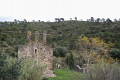
The route passes numerous sites including chapels, dolmens, mountain peaks and old farmhouses.
From Colera to Coll de Llaceres
 7.48 mi
+1,601 ft
-1,585 ft
4h 50
Moderate
Departure from Colera (Girona)
7.48 mi
+1,601 ft
-1,585 ft
4h 50
Moderate
Departure from Colera (Girona)
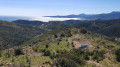
This hike allows you to explore the Albères from the southern side (on the other side of the border (Empurdan)). The route starts from Colera. The climb to Coll de Llacéres is steep and overgrown. Afterwards, the view opens up over the sea from Port Bou to Cap de Creus.
This hike should be avoided during periods of intense heat as the altitude remains low.
Torre de Querroig from Portbou, return along the Chemin Walter Benjamin
 7.15 mi
+2,346 ft
-2,346 ft
5h 20
Moderate
Departure from Portbou (Girona)
7.15 mi
+2,346 ft
-2,346 ft
5h 20
Moderate
Departure from Portbou (Girona)
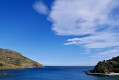
From Platja de Portbou, an ascent to Coll dels Belitres, a border ridge crossing. Then, after Coll de la Farella, the climb to Torre de Querroig. On the return journey, we pass Coll de Rumpissar and descend to Portbou along the Chemin de Walter Benjamin. See practical information. Constantly beautiful panoramas.
A gpx track is essential from (8) to (10). Steep gradients on some sections.Hike consists of trails (forbidden to all motorised traffic), paths (stony and steep), and a concrete track (at the finish).Warning: this hike is not recommended in very hot or scorching weather.
Cerbère via the French-Spanish border from Cap Cerbère
 3.05 mi
+728 ft
-758 ft
2h 00
Easy
Departure from Cerbère (Pyrénées-Orientales)
3.05 mi
+728 ft
-758 ft
2h 00
Easy
Departure from Cerbère (Pyrénées-Orientales)
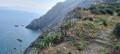
A circular loop starting from Cap Cerbère, climbing to follow the ridge line on the French-Spanish border, offering beautiful views on both sides, before dropping back down to Coll dels Belitres and the old border post, then descending to the Catalan village of Cerbère, and finally following the coast to return to the cape.
From Cap Cerbère to the Béar Lighthouse
10.97 mi
+2,165 ft
-2,149 ft
6h 55
Moderate
Departure from Cerbère (Pyrénées-Orientales)
From the Cap Cerbère car park, head towards the beaches of El Canu and El Saurel, passing through Cerbère and Banyuls-sur-Mer. A stop to visit the wine cellars is a must. Continue past the coves and the Anse de Paulilles, finishing at the car park by the Béar Lighthouse.Best avoided during heatwaves.
La Torre de Querroig from the Cerbère border post
7.18 mi
+1,795 ft
-1,801 ft
4h 50
Moderate
Departure from Cerbère (Pyrénées-Orientales)
It is at Cerbère that the Pyrenees plunge into the sea. Magnificent views of the Côte Vermeille and the Pyrenees mountain range, with Mont Canigou as a backdrop. Although this hike is of moderate difficulty, it requires good footwear and, in certain sections, you may need to use your hands.