Cap de Creus

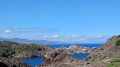
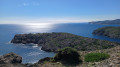
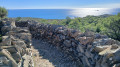
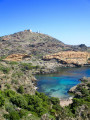
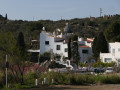
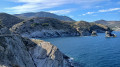
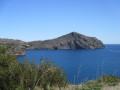
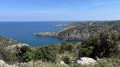
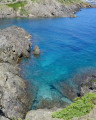
This hike starting from Cadaqués leads to Cap de Creus, avoiding the busy road that leads there. This headland is notable for being the easternmost point of the Iberian Peninsula and offers a unique, rugged landscape, with rocks of sometimes strange shapes, battered by wind and rain, bearing witness to the force of erosion. The return journey follows the "Cami Antic", a delightful winding path lined with dry stone walls, which has changed very little since the days when it was the only access route to the cape. If you wish, you can round off the day by visiting Salvador Dalí’s house in Port Lligat, located less than two kilometres from the starting point.

Details

72035660
Creation:
Last update:
Last review:
  • Walking
    Activity: Walking
  • ↔
    Distance: 9.21 mi
  • ◔
    Average duration: 5h 30 
  • ▲
    Difficulty: Moderate

  • ⚐
    Back to start: Yes
  • ↗
    Ascent: + 1,407 ft
  • ↘
    Descent: - 1,401 ft

  • ▲
    Highest point: 443 ft
  • ▼
    Lowest point: 26 ft

Photos

Description of the walk

Once in Cadaqués, take the clearly signposted road towards Port Lligat and Cap de Creus. Drive for about 2 km and park on the right, slightly downhill, in the large, unpaved car park at the departure point for the mandatory shuttle bus to the cape during the summer season.

No signposting

(S/E) Join the road, walk about 50 metres to the right, then cross carefully to take a small path opposite that runs alongside some houses before returning to the road. Continue in the same direction using the left-hand pavement and walk to the first junction at the recycling bins on the other side of the road.

(1) Turn left onto a wide, stony track suitable for vehicles and reserved for residents: a sign indicates that you are entering the Cap de Creus Integral Reserve. This track winds lazily past a few olive groves and isolated houses, leading to a junction marked by a yellow signpost.

(2) Turn right onto a narrower track lined with dry stone walls, which becomes a footpath after the last building. Cross the bed of a seasonal stream and continue along the path, which climbs steadily whilst offering beautiful views of the rugged coastline. At Puig Palau, the path veers left and heads north before opening out onto a vast, open meadow dominated by the imposing ruins of a sheepfold. The trail becomes indistinct, so head towards this building, taking care to keep your distance from the numerous beehives, which you should go round to the left. Then veer right to join a wide stony path.

GR®11 signposting: White and Red + Yellow

(3) Turn right and walk on almost flat ground to reach an open, flat area where a partially restored building stands, with, a little further on, an information board about the cape’s wetlands and a signpost.

(4) Head straight on along a path following the sign for "Cap de Creus". Then cross a track, continue straight ahead, keeping to the path which curves to the right further on and eventually leads out onto the road.

(5) Cross at the pedestrian crossing to rejoin the path opposite, which runs parallel to the road a little further on, then veers off to the right and reaches a junction marked by an information board on the conservation of the cape’s flora.

(6) Continue to the right until you reach the road again.

No signposting

Head left and follow the road to the Coll de ses Portes junction: signposted “Paratge de Tudela”.

(7) Turn right onto the concrete track, go through the gate and continue for about 200 m. Then take the path on the right, which narrows further on and leads to a change of direction that you must not miss.

(8) Head down to the right, resisting the temptation to take the path opposite, which is much more obvious. The path winds through a very wild landscape of bare rocks overlooking the Rec de Cala Bona, and begins a descent that is at times difficult before emerging onto the concrete track leading to Cala Culip.

(9) Turn right to follow the northern coast of Cap de Creus through a rugged landscape of strangely shaped rocks eroded by the sea. Pass Cala Culleró to reach Cala Culip, which marks the end of the concrete path.

Marked with wooden posts with red-painted ends

(10) Take the path, the start of which is marked by a signpost indicating the Cap de Creus lighthouse is 1.5 km away. This path descends to go round a small house by the sea, then climbs up a rugged rocky ravine and rejoins the tarmac road leading to the cape.

(11) Cross at the pedestrian crossing and rejoin the path opposite.

GR®11 red and white markings

Return to the road, follow it to the right, negotiating a left-hand bend, then another to the right. As you come out of the bend, take the path on the right which leads to a junction marked by an unsightly sign covered in stickers.

(12) Head left to stay parallel to the road above, then rejoin it. Follow it on the right-hand side using the verge, and continue to the ‘No Pedestrians’ sign.

(13) Turn right onto the magnificent stony path leading to the lighthouse. Go round the lighthouse on the right, passing in front of the bar, and cross part of the car park.

(14) Turn right, following the GR®11 markings, and carry on to the very tip of Cap de Creus to enjoy the view.

(15) Turn back and follow the route you came along until you reach the sign covered in stickers.

Red and green markings on the Cami de Ronda

(12) Go straight on, following the sign for "Port Lligat - Cadaqués".

(16) Continue straight on along the path overlooking Cala Jugadora and its small beach. Then continue for a long stretch along the beautiful path, often lined with dry stone walls, which winds through the heath, alternating between ascents and descents. You will reach a junction opposite the boundary wall of a beautiful property.

(17) Continue straight ahead to walk alongside it, then follow the wide, winding track to the junction marked by a signpost.

(18) Turn left onto the narrow path that winds its way through the olive groves before coming out onto the Cap de Creus road opposite a small car park.

(19) Turn left and walk alongside the road without crossing it, then leave it to take a path on the left at a signpost. Descend into a small, damp hollow, then climb back up to reach the first junction by the recycling bins.

(1) Cross with care and head left along the concrete pavement. Then turn right onto the path that cuts across the bend to reach the shuttle bus car park (S/E).


Waypoints

  1. S/E : mi 0 - alt. 46 ft - Shuttle bus car park
  2. 1 : mi 0.34 - alt. 141 ft - Crossing the circular loop
  3. 2 : mi 0.9 - alt. 282 ft - Junction, turn right
  4. 3 : mi 2.01 - alt. 381 ft - Junction with the GR®11, on the right
  5. 4 : mi 2.45 - alt. 256 ft - Crossroads, information sign
  6. 5 : mi 2.85 - alt. 358 ft - Cap de Creus Route
  7. 6 : mi 3.16 - alt. 308 ft - Junction, information sign
  8. 7 : mi 3.39 - alt. 226 ft - Coll de Ses Portes, on the right
  9. 8 : mi 3.68 - alt. 125 ft - Tricky junction, turn right
  10. 9 : mi 3.82 - alt. 30 ft - Concrete path, on the right
  11. 10 : mi 4.23 - alt. 66 ft - Cala Culip, end of the concrete path
  12. 11 : mi 4.58 - alt. 207 ft - Route du Cap de Creus, opposite
  13. 12 : mi 4.91 - alt. 62 ft - Crossroads, sign
  14. 13 : mi 5.07 - alt. 154 ft - Junction for both outbound and return routes
  15. 14 : mi 5.25 - alt. 236 ft - Cap de Creus Lighthouse
  16. 15 : mi 5.58 - alt. 26 ft - Pointe du Cap des Creus
  17. 16 : mi 6.37 - alt. 59 ft - Cami de Ronda junction, straight ahead
  18. 17 : mi 7.63 - alt. 217 ft - Crossroads, straight ahead
  19. 18 : mi 8.02 - alt. 246 ft - Signpost, left
  20. 19 : mi 8.41 - alt. 125 ft - Cap de Creus road, on the left
  21. S/E : mi 9.21 - alt. 46 ft - Shuttle bus car park

Notes

Access to Cap de Creus is restricted from June to September. During this period, you must park at the car park at (S/E). Outside the season, the road is quiet but there are few places to park. There is a car park at the cape itself, at the foot of the lighthouse.

Cap de Creus forms part of a Strict Nature Reserve with strict regulations. It is therefore compulsory to stay on the paths, and along the coast, signs frequently remind you that access to the shoreline is prohibited.

The signposting is good, supplemented by directional signs at major turns.

The cape is very windy and this hike will be more challenging during the tramontane season. However, there is no major risk if you stay on the paths.

No water sources have been identified on the route. Please bring sufficient supplies. You can, however, eat and drink at the cape: a restaurant and bar are available.

Hiking boots with good grip soles are strongly recommended. The section between (7) and (9) runs over sharp limestone pavement and eroded rocks with sharp points: caution is advised. Walking poles will also be useful.

Worth a visit

Always be cautious and plan ahead when you're outdoors. Visorando and the author of this route cannot be held responsible for any accidents occurring on this route.

The GR® and PR® markings are the intellectual property of the Fédération Française de Randonnée Pédestre.

Reviews and comments

4.9 / 5
Based on 3 reviews

Reliability of the description
5 / 5
Ease of following the route
4.7 / 5
Route interest
5 / 5
User 3268386
• Edited:

Overall rating : 5 / 5

Date of your route : Mar 19, 2026
Reliability of the description : ★★★★★ Very good
Ease of following the route : ★★★★★ Very good
Route interest : ★★★★★ Very good
Very busy route : No

A magnificent hike, with very few people around in the off-season.
Warning ⚠️ watch out for the beehives! We were attacked by bees whilst walking along the path to the right of the hives. Apparently you’re supposed to go round them on the left, but we hadn’t seen any other path. Be very careful – they took us by surprise and are very aggressive; we each got several stings.
No going back for us – we stopped at the restaurant at the headland and hitchhiked back. But the walk there is well worth it!

Machine-translated

kozyao
kozyao

Overall rating : 4.7 / 5

Date of your route : Mar 02, 2026
Reliability of the description : ★★★★★ Very good
Ease of following the route : ★★★★☆ Good
Route interest : ★★★★★ Very good
Very busy route : No

A superb hike, the first part to Cap de Creus is ultimately more interesting than the return trip, with magnificent countryside, whereas the path along the coast is rather hidden by vegetation and there is not much to see. For experienced walkers, it takes 3½ hours without breaks. Be careful, there are some steep sections when you reach the cape.

Machine-translated

trantole
trantole

Overall rating : 5 / 5

Date of your route : Nov 01, 2025
Reliability of the description : ★★★★★ Very good
Ease of following the route : ★★★★★ Very good
Route interest : ★★★★★ Very good
Very busy route : Yes

To reach the lighthouse, be sure to take this circular rather than the classic return route from points 12 to 1 that is usually suggested. You will enjoy superb, breathtaking views, no major difficulties, and not too many people on the section from 1 to 12. However, from 12 to 1, we came across quite a few hikers on 31 October, so I can't imagine what it's like in summer.
Thanks to JJ for this route. I still have stars in my eyes.

Machine-translated

Other walks in the area

For more walks, use our search engine .

The GPS track and description are the property of this route's author. Please do not copy them without permission.