Exploring the landscapes and eastern neighbourhoods of Vineuil

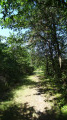
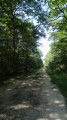
A chance to discover the diversity of Vineuil’s natural and rural landscapes, between the Cosson Valley and the Loire, from the plateau to the hillside. A lovely walk to enjoy with the family.

Details

n°7465445
Creation:
Last update:
Last review:
  • Walking
    Activity: Walking
  • ↔
    Distance: 6.37 mi
  • ◔
    Average duration: 3h 00 
  • ▲
    Difficulty: Moderate

  • ⚐
    Back to start: Yes
  • ↗
    Ascent: + 69 ft
  • ↘
    Descent: - 75 ft

  • ▲
    Highest point: 292 ft
  • ▼
    Lowest point: 230 ft

Photos

Description of the walk

Park in Rue de Nanteuil or Chemin des Bordes.

(S/E) Walk up this small street to the last houses to leave the Cosson valley and reach the plateau. After the last house, take the path on the left. After the copse, turn onto the country lane on the right. Walk past orchards, meadows and a small wood to reach the Pointes Maslives.

(1) Walk alongside the vineyards on your right, then take the path on the left which emerges from a copse of broom and birch trees. Just past the trees, turn right to join a country lane at a place called Les Longs Réages.

(2) Take the path on the left. About 150 metres further on, turn right onto the path leading to the gardens in the Noëls neighbourhood of Petit Chambord.

(3) Walk alongside the gardens on your right. At the corner of a fenced-off garden, take the narrow lane that joins Rue du Petit Chambord. Cross the road and continue straight ahead. You’ll arrive in a new housing estate.

(4) Take the central path to the right which crosses the housing estate. You’ll reach the schools and children’s play areas. Take Rue des Petits Chemins and, at the junction, continue straight ahead towards the old goods station. Walk alongside the stadium. At the end, turn left into Rue des Vergers. At the junction with Avenue des Noëls, head straight on, following the sign for the “Sentier du Viaduc”.

(5) Follow the path leading to the viaduct and carry on until you reach the Loire.

(6) Return to the previous junction via the same route.

(5) Turn left into Rue Ulysse Fleury, which is directly in front of you: it is flanked by two old stone walls. Head in this direction and, just past the wall on the left, take a very inconspicuous alleyway that leads down towards the valley. At the junction with Impasse du Pavillon, turn left, go under the viaduct and head up Rue Guignard. Watch out for traffic. Continue to No. 12 Rue Guignard.

(7) Take the alleyway that runs along the hillside and joins Rue Mesliers, then head up this street on the left. Return to Avenue des Noëls and turn right onto it for 100 metres. Watch out for the very narrow pavements and traffic. You’ll reach the junction at La Grande Maison on the corner of No. 90.

(8) Turn left onto this street, which is currently under construction, and head towards the junction with the Chemin Blanc that you passed on the way out.

(4) Turn right onto Rue des Jardins. At the end of this street, turn left until you reach the junction. Take care here: this is a dangerous junction at La Croix de Bois

(9) Cross the junction and enter the housing estate on the right, taking Chemin de la Banlive. A path, followed by a mound of earth, leads to a small road within the estate. After No. 28, take a dirt track on the left. Follow the path straight on. Walk alongside plots planted with fruit trees on the right, then through the Bois de Château Gaillard. You’ll reach the end of this woodland at a four-way junction.

(10) Turn left onto the path towards the water tower. Continue straight on until you reach Rue des Mangottes. At the junction, head down Chemin des Bordes towards the roundabout. Take Rue de Nanteuil to return to the car park (S/E).

Waypoints

  1. S/E : mi 0 - alt. 272 ft - Car park on Rue de Nanteuil
  2. 1 : mi 0.73 - alt. 289 ft - Les Pointes Maslives
  3. 2 : mi 1.06 - alt. 289 ft - Les Longs Réages
  4. 3 : mi 1.44 - alt. 279 ft - Le Petit Chambord
  5. 4 : mi 1.73 - alt. 272 ft - Junction of the circular loop
  6. 5 : mi 2.22 - alt. 259 ft - Le Pavillon
  7. 6 : mi 3.08 - alt. 243 ft - Along the - La Loire
  8. 7 : mi 4.34 - alt. 266 ft - 12 Rue Guignard
  9. 8 : mi 4.6 - alt. 272 ft - La Grande Maison
  10. 9 : mi 5.1 - alt. 279 ft - La Croix de Bois
  11. 10 : mi 5.65 - alt. 289 ft - End of the woods
  12. S/E : mi 6.37 - alt. 272 ft - Car park on Rue de Nanteuil

Notes

Remember to bring water as there are no water points along the route. The Centre des Noëls, behind the schools, has shops and a restaurant. The plateau is quite windy and offers little shade, as does the valley. Remember to wear suitable footwear, even though the entire route follows wide paths (wheelchairs and pushchairs are accessible except in the narrow alleys).

Worth a visit

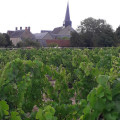
On the first part of the route, you’ll pass through an open natural area. Cultivated fields – wheat, barley, millet and sunflowers, depending on the crop rotation – alternate with orchards (cherry and apple trees) and coppices of various species: beech, oak, birch and conifers, as well as vineyards with Cheverny AOC status. You’ll see plots consisting of deep furrows and wide, fairly high ridges of earth: these are asparagus fields, the cultivation of which brought fame to Vineuil in the20th century.
Groves of broom and blackberry bushes line the country lanes.

This open space encourages biodiversity. It forms a corridor favourable to migratory birds, the clearings serve as a haven for pollinators, and the variety of tree species in the coppices helps to limit runoff and soil erosion. In this area, you can observe, throughout the seasons, numerous species of birds, such as the skylark: in spring, its loud call rings out as walkers pass by; look up – it flies high and waits for a moment of peace before returning to its nest on the ground. It is now a near-threatened species, as its breeding habits are undermined by the passage of farm machinery, whilst global warming disrupts both its egg-laying cycle and the timing of fieldwork.
You’ll also spot wagtails and crested lapwings – increasingly rare, but a magnificent sight as they move about in flocks. Of course, the cuckoo will herald the arrival of spring.
In the warmer months, the hoopoe will head off to its hunting grounds for earthworms near watercourses, as will the grey heron and the little egret, which you’re more likely to spot towards the end of the day.
Nor will you want to miss the spectacular flight of the greylag geese in early spring or the passage of the storks in autumn, which usually stop off a few times during their migration south.
Less striking, given their constant presence, are the pheasant and its mate, who are sure to accompany you on your walk. Their characteristic call and the heavy take-off of these birds amidst a jumble of ruffled feathers will undoubtedly catch your attention. More discreet, you may spot partridges running across ploughed fields, almost invisible as their plumage blends in with the colour of the earth.
In May and June, do not crush those curious black insects you’ll find in great numbers along the paths: these 1-centimetre-long black larvae are the baby ladybirds that are so useful in the garden.

A bit of history on arriving in Les Noëls
The Noëls district has been documented since the Middle Ages. It was during the Renaissance that the wealthy bourgeoisie of Blois built their ‘closeries’ there, bringing prosperity to the village. A ‘closerie’ is a holiday home that combined the comforts of modern urban dwellings for the time with agricultural activities, particularly viticulture. You can explore these superb historic residences by taking the narrow lane at the exit of the viaduct, which leads you down into the valley and takes you through a neighbourhood of beautiful ‘closeries’, including the Pavillon, which has been documented since the late16th century.

Inthe 20th century, at Christmas time, it was asparagus that brought recent prosperity to the neighbourhood.
Introduced by a local around 1875, the white Argenteuil asparagus thrived in the valley’s light soil. By around 1970, nearly 150 hectares were devoted to this crop, which carried a quality label and was sold by the trainload from Les Noëls goods station to the finest restaurants in Paris.

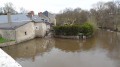
As you cross the viaduct, you are following the old railway line built in the19th century. The valley unfolds before your eyes: there is a wide variety of crops – cereals, market garden produce and vineyards – growing on the sandy soils of the Loire riverbed, protected by the embankment, known as a ‘levée’, built as far back as the Middle Ages to shield the land from the river’s devastating floods. The ‘noues’ are watercourses that you can see winding through the valley: their purpose is to drain excess water during floods, as well as the marshes formed by the rising groundwater table. The Noëls neighbourhood takes its name from these ‘noues’.
Finally, since 2020, the return of eco-grazing and the presence of sheep in the valley serve as a reminder that this region once practised mixed farming. Here, in Les Noëls, cows used to graze beneath the viaduct and their milk was used to make a local Camembert that is no longer produced.

If you enjoyed this walk, please do share your thoughts and comments on the Facebook page of our association, Vineuil Patrimoine, to support us and encourage us to develop our projects.

Reviews and comments

5 / 5
Based on 1 review

Reliability of the description
5 / 5
Ease of following the route
5 / 5
Route interest
5 / 5
Bernard Habert
Bernard Habert

Overall rating : 5 / 5

Date of your route : Jan 02, 2024
Reliability of the description : ★★★★★ Very good
Ease of following the route : ★★★★★ Very good
Route interest : ★★★★★ Very good
Very busy route : No

An interesting walk as it takes you through the countryside, part of historic Vineuil, a new neighbourhood in Vineuil, and the viaduct. There’s a wide variety of things to see, then. We enjoyed it. A good choice for a first walk using Visorando.

Machine-translated

Other walks in the area

For more walks, use our search engine .

The GPS track and description are the property of this route's author. Please do not copy them without permission.