Vallant Saint Georges
In the north-west of the Aube department, between the Troyes-Paris road and Anglure, on the road to Sézanne, in a depression in the Champagne plain, Méry-sur-Seine is mainly built on the right bank of the River Seine, at an altitude of 82 metres. The village of Méry-sur-Seine is bordered to the north by the Haute Seine Canal, which originally linked the River Aube, near Marcilly-sur-Seine, to the heart of the city of Troyes. In Méry-sur-Seine, the River Seine is joined by the small River Moulin.
The village of Vallant Saint Georges witnessed an episode of the Battle of the ‘Catalaunian Fields’, which pitted the Huns and their leader Attila against the Romans, Franks, Burgundians and Visigoths. This was in the 5th century. A chapel was built on the hill conquered by the Gallo-Romans and took the name of Saint Georges en Gaonay. Saint Georges
was the patron saint of the victors; Gaonay meant ‘carried off by the tip of the sword’. Gallo-Roman coins and graves have been discovered within the commune’s boundaries.
The village suffered greatly during the Hundred Years’ War and was left in ruins. Courageously, the inhabitants
rebuilt their village, but the Treaty of Troyes in 1420, which handed France over to the English, heralded the occupation of the village by the English forces of Henry V. In 1440, Vallant was surrounded by walls and moats.
History
In 451, at Méry, the Roman general Aetius, Theodoric I, King of the Visigoths, and Merovech, King of the Franks, joined forces to fight and defeat Attila. After the siege of Orléans was lifted, Attila retreated towards the Seine and the Marne. The two armies met once more at the river crossing at Méry, where more than 30,000 men fell on the battlefield. Attila nevertheless managed to cross the Seine and took up position at the Catalaunian Fields.
It forms part of the province of Champagne.
On 22 February 1814, during the French Campaign, the Battle of Méry-sur-Seine took place between the armies of the Empire, commanded by General Antoine Gruyer, and Russian troops. General Joseph Boyer de Rebeval distinguished himself there for his bravery.
The old buildings of Méry
Built of wood and cob, the town was repeatedly ravaged by destructive fires.
The most significant of these was undoubtedly the fire during the French Campaign in 1815, during the battle between Prussian troops and Napoleon’s army. The then Emperor, deeply moved, bequeathed the town in his will. This enabled, decades later, the construction of the town hall and the schools for girls and boys.
The fire of 1908 destroyed the Chapelle district. At that time, there was no running water, and chains of buckets were passed from hand to hand.
Postcards from the time have immortalised the events. The arrival of running water finally made it possible to eradicate these devastating disasters.
A fire hose drying tower still stands behind the town hall.
Only chalk buildings could withstand the fire. There were very few of them at the time. Notre Dame Church is one of them, built from phosphatic chalk from the Coniacian period, quarried at Méry or Charny-Le-Bachot.
The old Porentru farm on Rue de Verdun is among them, as is the former watch strap factory on the same street. Added to these is an old hotel on Rue de l’Hôtel de Ville, with a garden overlooking the Seine.
The wooden buildings left no traces, apart from vaulted chalk cellars.
The most recent chalk building is the former Gendarmerie on Rue de Verdun. Planned in 1776, it was built shortly after a major fire. It withstood the fire of 1815 as well as the bombings of 1940.
Following the construction of the new Gendarmerie on the Route de Soissons, the building became a fire station, before being converted into rental accommodation.
The site is of historical significance. The Gendarmerie Museum in Melun holds the project plans…
Pierre Benoit
Source: the town’s official website
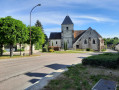
Saint Julien Church
A 12th-century church dedicated to Saint George was remodelled in the 16th century. The statues of John and George come from the Priory of Saint George.
The church, in the form of an oriented Latin cross, is 27.5 m long and 19.4 m wide at the transept; the nave is 7 metres high.
The baptismal font has a base carved from limestone and a basin of veined black marble. A sculpted group depicts the Annunciation, featuring Christ, Mary and two angels, carved in white marble with gilding.
Source: Wikipedia (excerpts)
The Old Upper Seine Canal
(Based on the book by Mr Pierre PORCHERET)
On 2 April 1805, Napoleon, on his way to Italy, stopped at Troyes where he decided, in order to make the Seine navigable, to build a navigation canal. The initial project envisaged several branches leading in and out of the Seine, rather than a side canal. Work began at the end of 1806 at Méry-sur-Seine. Male and female labourers, as well as prisoners of war, were hired. The work was poorly organised, there was a shortage of tools, and the invasion of 1814 led to the closure of the site, even though almost all
of the earthworks had been completed between Troyes and Marcilly-sur-Seine and several locks remained to be built.
Left to fall into disrepair, the sites were overrun by weeds and silt deposits; the embankments were damaged by livestock, and the building materials disappeared. No work was carried out until 1840. Work then resumed and the plan for a side canal was adopted. It would be 1.50 m deep and widened, with locks measuring 34 m long by 5.20 m wide, like those of the Burgundy Canal.
On 1 November 1845, the canal between Marcilly-sur-Seine and Méry-sur-Seine was opened and officially inaugurated on 25 October 1846. The volume of goods was greater on the downstream journey. These included timber, cereals, other foodstuffs, building materials and industrial goods; on the upstream journey, there were building materials, industrial goods, cotton and groceries. The materials required for the construction of the railway line and the water supply for the city of Troyes were transported via the canal. The journey from Paris to Troyes took 4 to 5 days; the return journey took 7 days for horse-hauled boats and 2 days for steamboats. On 16 April 1848, a breach opened at Clesles, causing four houses to collapse. Farmland and meadows were devalued due to the damp and the reeds and scrub that grew there. During the great floods of 1910 and 1955, the Beauregard aqueduct at Droupt-Sainte-Marie acted as a dam; the water thus held back flooded the village, and the canal embankment had to be breached to divert the flow.
It was thanks to the canal that wash houses sprang up along its course, alongside boat and steamboat trips, water festivals, regattas, swimming competitions and fishing contests... In 1865, a boat with a 20 hp engine and fitted with a paddle wheel was in service on the canal. Economic crises and the ravages of war affected traffic, which continued to decline from 1871 onwards. The railway was preferred by entrepreneurs and hosiery manufacturers in the Aube region. In 1940, the last boat loaded with sugar travelled up the canal to Troyes and was the last to pass through Lock No. 10 on 13 June on its way down. With the aim of making the canal more tourist-friendly, improvements were carried out by the Aube Departmental Council. Work on the greenway between Barberey-Saint-Sulpice and Saint-Oulph was carried out between 2008 and 2010. It was inaugurated on 1 July 2010. The canal is now a very popular place for walks.
The Beauregard Aqueduct
It allows the canal to cross the River Beauregard. It consists of three stone arches. The topography of the site did not allow them to be raised high enough, so that during periods of high water, it acts as a barrier to the flow of water. During a major flood, the difference in level between upstream and downstream could reach 6.65 m. It was rebuilt in 1899, but was not widened; only the width of the piers was reduced. This brought no improvement. This was clearly evident during the flood of 1910, which destroyed eight houses in Droupt-Sainte-Marie and was felt as far as Droupt-Saint-Basle. The inhabitants were then forced to breach the canal dyke in two places, which reduced the pressure of the water on the village. The flood of 1955, though less devastating, nevertheless forced the inhabitants to breach the canal dyke once again.
Source: brochure published by the Nogentais and Seine Valley Tourist Office
Droupt Sainte Marie
The Church of the Nativity of the Virgin in Droupt-Sainte-Marie.
The nave and the portal date from the 12th century, whilst the rest is from the 16th century, built on a Latin cross plan with an apse and a vaulted transept. The nave has two aisles and two bays. Human figures adorn the pillars with small columns.
The Brun Pond
The Étang du Brun, which belongs to the local council, covers an area of 11 hectares. It is a former alluvial quarry that was excavated in the 1980s. Development was completed in 1990. The lake is currently leased to a local fishing club.
Source: brochure published by the Nogentais and Seine Valley Tourist Office
Droupt Saint Basle
The town owes the addition of ‘Saint-Basle’ to its name to the patronymic of a 6th-century hermit, Saint Basle of Verzy.
Droupt-Saint-Basle Castle.
Droupt-Saint-Basle Castle is a late 16th-century residence, remodelled in the 18th and 19th centuries, situated in the French commune of Droupt-Saint-Basle in the Aube department, in the Grand Est region. The castle now houses a private museum dedicated to folk art.
To find out more:
Ruez Castle.
It stands on a seigneury mentioned in 1139 as ‘Grangia de Ruellis’ in a cartulary of Larrivour Abbey. On 14 November 1494, the monks acquired the land of Ruez, which was not sold until 1596 to Nicolas Largentier, Lord of Vaucemain, for 1,400 écus.
In 1649, it passed to the Chavaudon family through Pierre Guillaume, Abbot of Mores, who also owned the other castle at Doupt. The present buildings date from 1818.
Church of Saint-Léonard-et-Saint-Basle in Droupt-Saint-Basle.
Its nave, with rectangular pillars, dates from the 12th century, whilst the rest, dating from the 16th century, forms a Latin cross. Its apse is three-sided and its tower is Romanesque.
Source: Wikipedia (excerpts)
The Perthuis Washhouse
In 1894, the local council had two wash houses built on the River Beauregard. The only surviving one, the Perthuis wash house, was falling into ruin when the council decided to restore it in 2001. By the end of that year, it had been completely rebuilt according to the original plans. The movable floor was refurbished; a new
mechanism with gears and chains was installed.
An exhibition tracing the history of the wash house is on display at the site.
Source: brochure published by the Nogentais and Seine Valley Tourist Office



 Country:
 City:
City:



 Local authority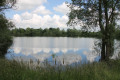

 Visorando Member
 Easy
Easy