


Christian g

 Visorando Member
 Premium user
 - Gender: man
Sign up:
Published route(s)
 Exploring the Calorguen countryside
 9.15 mi
 +328 ft
 -302 ft
 4h 30
4h 30
 Moderate
 Departure from Calorguen (Côtes-d'Armor)
This walk allows you to explore the typical villages of the Pays des Faluns along stony paths. The towpath of the Ille and Rance Canal will take you past its lock-keeper’s houses and lead you to the old watermills on the River Rance.
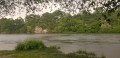
Tour of the lake at Jugon-les-Lacs
 11.21 mi
+745 ft
-735 ft
5h 50
Moderate
Departure from Jugon-les-Lacs (Côtes-d'Armor)
11.21 mi
+745 ft
-735 ft
5h 50
Moderate
Departure from Jugon-les-Lacs (Côtes-d'Armor)
The route follows the shaded shores of the lake, small gravel roads and a few short stretches of quiet roads.It will take you through villages with old houses, often beautifully restored.To round off your walk, you can explore the streets and alleyways of the village, following the stream alongside which the wash houses have been restored.
The banks of the Rance from Ville Ger to Mordreuc
 4.08 mi
+79 ft
-79 ft
1h 55
4.08 mi
+79 ft
-79 ft
1h 55
 Easy
Departure from Pleudihen-sur-Rance (Côtes-d'Armor)
Easy
Departure from Pleudihen-sur-Rance (Côtes-d'Armor)
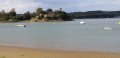
This hike will allow you to discover the flora and fauna of the Rance estuary.
The Rance is a wintering ground for migratory birds.
Mordreuc's mascot, seal L 214, will let you take photos with him if the water level allows him to lounge on the slipway. Otherwise, look in the water to see if a whiskered snout is peeking out.
In Mordreuc, if you continue 100 metres along the shore, you will discover the old lime kiln.
The Iron Route - Discovering the mining region of Orne
8.01 mi
+568 ft
-564 ft
4h 10
Moderate
Departure from La Ferrière-aux-Étangs (Orne)
During this hike, you will discover surprising mining remains: iron mine shafts, calcination furnaces from before and after 1938, and a mining town.
The hike begins along a Way of the Cross that will take you to the Calvary of Mont Brûlé.
The hike winds through the undergrowth and follows a few sections of road.
During your journey, you will discover a castle and an old watermill nestled in a green setting.
Around Saint-Lormel
 9.74 mi
+554 ft
-577 ft
5h 00
Moderate
Departure from Saint-Lormel (Côtes-d'Armor)
9.74 mi
+554 ft
-577 ft
5h 00
Moderate
Departure from Saint-Lormel (Côtes-d'Armor)
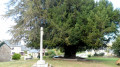
Between the Arguenon and the Guébriand, you’ll discover the banks of an estuary, a windmill, small villages that have retained all their charm, a chapel, an old church, its calvary and its yew tree. Castles hidden away in lush greenery will emerge as you round a bend in the woods.
Dinard between land and sea
 9.31 mi
+410 ft
-420 ft
4h 40
Moderate
Departure from Dinard (Ille-et-Vilaine)
9.31 mi
+410 ft
-420 ft
4h 40
Moderate
Departure from Dinard (Ille-et-Vilaine)
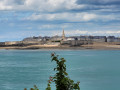
You will start by winding your way through the Dinard countryside to reach the sea. Take the customs officers' path, the Clair de Lune promenade, and discover the many islets of the Bay of Saint-Malo. You can also explore the Goule aux Fées cave, where the Lumière brothers took their first photographs in 1877.
From the Mordreuc tide mill to the Prat tide mill
 3.63 mi
+220 ft
-200 ft
1h 50
Easy
Departure from Pleudihen-sur-Rance (Côtes-d'Armor)
3.63 mi
+220 ft
-200 ft
1h 50
Easy
Departure from Pleudihen-sur-Rance (Côtes-d'Armor)
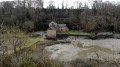
From the Mordreuc tide mill, follow the shaded cliffs along the banks of the Rance, which will take you to the Prat tide mill. You will pass an old lime kiln and see the village of La Moinerie in Plouër-sur-Rance through the trees. On the mudflats, you will see common shelducks.
At the end of the Moulin du Prat pond, you will see Quincourbe Castle and its dovecote. You will pass by the ferruginous fountain.
Passing by Pointe Saint-Efficace in Matignon
 7.02 mi
+371 ft
-394 ft
3h 35
Moderate
Departure from Matignon (Côtes-d'Armor)
7.02 mi
+371 ft
-394 ft
3h 35
Moderate
Departure from Matignon (Côtes-d'Armor)
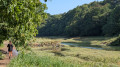
Right from the start, you will travel back in time. You will discover a medieval motte-and-bailey castle, then jump back a few centuries further to discover the Guerches, the ancestors of motte-and-bailey castles. Before reaching Pointe Saint-Efficace, you will pass the ruins of a watermill, then those of a tide mill and finally an old tide mill. As you walk along the sea, you will see Fort La Latte. On the way back, the Chapelle Saint-Germain is worth a detour.
Between lakes and forest in Pleven
 8.20 mi
+476 ft
-505 ft
4h 10
Moderate
Departure from Pléven (Côtes-d'Armor)
8.20 mi
+476 ft
-505 ft
4h 10
Moderate
Departure from Pléven (Côtes-d'Armor)
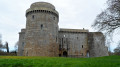
You will follow a very varied route, taking in a reservoir, a castle mound and the medieval Château de la Hunaudaye. Most of this hike takes place in woodland or fields.
Cap Fréhel and Fort La Latte from Plévenon
 10.90 mi
+476 ft
-476 ft
5h 25
10.90 mi
+476 ft
-476 ft
5h 25
 Difficult
Departure from Plévenon (Côtes-d'Armor)
Difficult
Departure from Plévenon (Côtes-d'Armor)
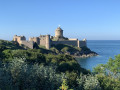
After a few kilometres through the Plévenon countryside, you will come to the sea with Saint-Brieuc Bay on your left and Cap Fréhel on your right. Once you have passed Cap Fréhel and Fort la Latte, you will discover Saint Malo Bay and Fresnaye Bay. Gorse, heather and oak trees of various species line the coastal part of the path.
Stop for a moment at Cap Fréhel to discover the colonies of birds nesting on the rocks.
The Floubalay route in Ploubalay
 8.30 mi
+236 ft
-236 ft
4h 00
Moderate
Departure from Ploubalay (Côtes-d'Armor)
8.30 mi
+236 ft
-236 ft
4h 00
Moderate
Departure from Ploubalay (Côtes-d'Armor)
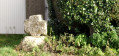
This route takes you along the Floubalay Stream through the woodland. After passing through a few villages, you arrive at Baie de la Beaussais, with Saint-Jacut-de-la-Mer and Île des Hébihens on the opposite bank. You will pass by Manoir de Bel-Être and Tour de Brenan. The second part of the walk takes you through the Ploubalay countryside before returning to the stream.
In the footsteps of the Rance bargemen
 6.68 mi
+220 ft
-223 ft
3h 15
Moderate
Departure from Pleudihen-sur-Rance (Côtes-d'Armor)
6.68 mi
+220 ft
-223 ft
3h 15
Moderate
Departure from Pleudihen-sur-Rance (Côtes-d'Armor)
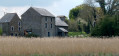
For centuries, right up until the 1920s, the Rance bargemen supplied the bread ovens of Saint-Malo with bundles of firewood. They built stone-paved crossings across the Rance so that they could load their barges.
These little paths leading out into the Rance will allow you to discover the village of Les Bas Champs from a unique perspective.
Les Granges de Nabias and the Lactoduc
 3.08 mi
+830 ft
-804 ft
2h 10
Moderate
Departure from Adervielle-Pouchergues (Hautes-Pyrénées)
3.08 mi
+830 ft
-804 ft
2h 10
Moderate
Departure from Adervielle-Pouchergues (Hautes-Pyrénées)
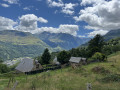
After exploring the village of Granges de Nabias, you will walk to the Col d'Azet, which offers a superb view of Lac de Génos. As you round a bend, you may spot a marmot.
In the 1960s, to prevent their land from becoming a desert, the farmers of Granges de Nabias set up a dairy cooperative. They built a milk pipeline that allowed them to transport milk from the mountains to the village in just a few minutes!
Coëtquen Castle and its forest
 5.42 mi
+164 ft
-197 ft
2h 40
Easy
Departure from Saint-Hélen (Côtes-d'Armor)
5.42 mi
+164 ft
-197 ft
2h 40
Easy
Departure from Saint-Hélen (Côtes-d'Armor)
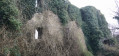
The highlight of this walk is exploring the remains of the feudal motte and Coëtquen Castle, built in the 15th century (private property). The route takes in small roads and beautiful forest paths.
The name Coëtquen can be translated as ‘white forest’. The Coëtquens were lords who became part of a branch of the Dinan family.