Walk around the fountains of Paizay-le-Tort

A pleasant walk combining heritage discoveries with a chance to enjoy nature.

Details

1000845
Creation:
Last update:
Last review:
  • Walking
    Activity: Walking
  • ↔
    Distance: 2.25 mi
  • ◔
    Average duration: 1h 05 
  • ▲
    Difficulty: Easy

  • ⚐
    Back to start: Yes
  • ↗
    Ascent: + 75 ft
  • ↘
    Descent: - 75 ft

  • ▲
    Highest point: 348 ft
  • ▼
    Lowest point: 249 ft

Photos

Description of the walk

(S/E) Leave the car park by heading towards Rue de l’Église Saint-Pierre, which runs below. Turn right to walk past the cemetery and in front of the church towards the hamlet of Pontioux. Walk carefully.

(1) At the junction with Chemin de Ponthioux, continue straight ahead. Just as the street turns left and becomes Rue du Pont de Perouzeau, turn right onto Rue des Cassis. At the next junction, continue straight ahead onto Chemin de la Conciergerie, walking alongside a wood on your right and a football pitch on your left.

At a sharp left-hand bend, the path becomes a road. Continue along this road, leaving behind a blocked track leading to Château de Melzéar (private property). The road heads towards La Bouchonnerie. Continue with care until you reach Rue du Pont de Perouzeau.

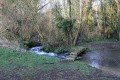
At the crossroads, turn right and follow Rue du Pont de Perouzeau with care. Cross the bridge over the Berlande and look out for an old bridge made of rough stone over the stream below the road on the left-hand side. Pass the junction with Rue de la Folie on the right.

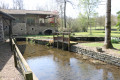
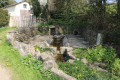
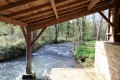
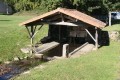
(2) A little further on, turn left onto a small lane that runs away from the houses of La Barette (to the north). Admire the Groie wash house on your left, down below. The path eventually joins Rue de la Barette at a crossroads. Turn left and follow this road, leaving Rue de la Chandeurie straight ahead.

(3) Shortly afterwards, turn left into a small street, Impasse de la Planche du Perré, at the corner of a house.
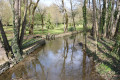
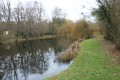
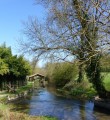
Continue along this cul-de-sac, which runs round the pink farmhouse, to the banks of the Berlande. Note the two stone bridges allowing you to cross the stream depending on its level. It is impossible to continue as the slope on the other side of the stream is private property. Retrace your steps.

(3) Turn left. Continue straight ahead with care along this small road until you reach Rue de la Fontaine du Gradouillet, walking on the right-hand side. When you reach the hamlet of Le Colombier, just as the road runs alongside a small wood on your right and before the wall of a stone property, turn left and join Route de Bel Air at a bend.

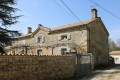
(4) Look out for a magnificent house with a coat of arms on the façade. At this point, the Chemin de Ponthioux branches off to the left, heading towards the Moulin de Ponthioux. At the property entrances, follow the wall to the right and, at the corner, turn left onto a narrow path running alongside a wall towards La Berlande. Cross the stream and continue straight ahead along Chemin de Ponthioux, which climbs until it joins Rue de l’Église Saint-Pierre.

(1) When you reach this junction, cross carefully and continue straight ahead up the street. At the first crossroads, turn right into a street that curves round the buildings a little further on. This street soon leads back to the car park, which marks the end of this walk (S/E).

Waypoints

  1. S/E : mi 0 - alt. 325 ft - Car park at the Town Hall
  2. 1 : mi 0.15 - alt. 318 ft - Crossroads of roads and paths
  3. 2 : mi 0.9 - alt. 256 ft - Road-path junction
  4. 3 : mi 1.11 - alt. 285 ft - Road junction. Return to the - Berlande (rivière)
  5. 4 : mi 1.9 - alt. 282 ft - Crossroads
  6. S/E : mi 2.25 - alt. 325 ft - Car park at the Town Hall

Notes

The car park is located at Place Château-Gaillard, in the car park opposite the Town Hall (near and above the church). Alternatively, there is a second car park near the Village Hall behind the Town Hall.

This hike across varied terrain requires suitable footwear.

This route is marked in blue as it corresponds to the “Walk around the fountains” route published by the Deux-Sèvres Department and the Syndicat du Pays Mellois. A white pictogram on a blue background is present throughout the walk. In addition, it is advisable to follow the directions in this description and the map provided by Visorando, whilst also taking note of the landscapes you pass through. Distance markers from the starting point, and even the GPS coordinates of waypoints (including the start), can also help hikers find their way.

Walk completed by the author on 27 March 2022. A quiet route (Sunday afternoon)

Worth a visit

Paizay-le-Tort
Paizay-le-Tort is about 5 km from the district town, Melle. The village is crossed by the Berlande, a tributary of the Béronne.
The village comprises numerous hamlets stretching on either side of the Berlande, up onto the surrounding plateaus.
The economy of Paizay-le-Tort relies mainly on agriculture and livestock farming.
However, there are also local tradespeople (carpentry, garage, masonry/timber framing).

Places and monuments
Melzéard Castle, partially destroyed, whose keep and tower date from the 15th century
“The keep was built around 1419 for Pierre Frotier, Seneschal of Poitou, son of Jean Frotier and grandson of Jeanne Ravart, Lady of Melzéard. In 1452, King Charles VII granted him, by letters patent, the right to high, middle and low justice. In 1470, Prégent Frotier sold the seigneury of Melzéard to Guyon de Puygirault, who converted a turret within the enclosure into a chapel. The date of construction of the main residence, built near the keep, is unknown but may predate the 16th century. Through marriage alliances, the estate passed in the 17th century into the hands of the Vernou de Bonneuil family and their descendants, the Aubusson de la Feuillade and Levis Ventadour families. Sources indicate construction and refurbishment work on the manor house in the last quarter of the 17th century and on the eve of the Revolution. In 1859, the estate was sold to Louis-Maire Émile Aymé de la Chevrelière. At the end of the 19th century, his son had the old main house and part of the outbuildings demolished and, in 1890, commissioned the Poitiers architect Ojam to build a new château accompanied by numerous outbuildings. In the last quarter of the 20th century, the buildings belonging to the estate were sold separately. In 1992, a fire damaged the main body of the château and destroyed its roof.
Further information on the monuments of Paizay-le-Tort: and on its history and architecture:

Saint Pierre Church
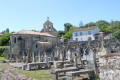
Saint Pierre Church is built on the northern slope of the Berlande valley. It is oriented, with its apse facing east, as were almost all churches in the Middle Ages.
The recent discovery of a fragment of an early medieval sarcophagus near the town hall – the former
priory, an imposing building of medieval origin – may indicate the existence of a necropolis.
The church is mentioned in a charter dating from 955. On 23 October 1118, a papal bull from Pope Gelasius II, issued in Marseille, placed it under the protection of the Holy See. Around the same time, a certain Isengarde founded the priory-parish, which was dependent on the Abbey of Nouaillé, near Poitiers, and which was abandoned around 1769.

Decommissioned in the mid-20th century, the cemetery, once more extensive, is now pressed up against the north wall of the church. One cannot help but admire the beautiful uniformity of its 19th- and 20th-century graves and its hosanna cross (17th century?), which features, either engraved or in relief, various craftsmen’s tools: a adze, a square, metal fittings...
''Source: (excerpts)"

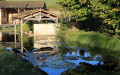
Washing houses
The village wash house located near the old church (Lat/Lg N 46°10.738' W 000°09.759')
La Bouchonnerie wash house (Lat/Lg N 46°10.513' W 000°10.317')
La Combe wash house (Lat/Lg N 46°10.417' W 000°09.745')
Taillepied wash house (Lat/Lg N 46°10.689' W 000°09.681')
La Groie wash house (Lat/Lg N 46°10.355' W 000°10.280')

Notable figures associated with the commune
Pierre Frotier, Baron of Preuilly, (c. 1390–1459), Lord of Saint-Faziol in Pouffonds (Deux-Sèvres), Melzéart in Paizay-le-Tort (Deux-Sèvres) and Miserit in Chail (Deux-Sèvres), Baron of Preuilly (Indre-et-Loire) and Le Blanc (Indre), was squire to King Charles VI in 1418, Grand Master of the King’s Stables in 1419, then Seneschal of Poitou in 1424, during the reign of King Charles VII.
Ernest Jousseaume, organiser of the Fernand maquis in June 1944, lived there from his retirement until his death.
Eugène ‘Michey’ Proust, born on 8 January 1921 in Paizay-le-Tort in the Deux-Sèvres and died in November 1989 in Foucherans in the Jura, was a French footballer and manager.
André Jolly, a writer who wrote in the local dialect, was born and lived there. The schools in Paizay-le-Tort have borne his name since September 2014.
René Hardy, known as Chauvy, alias Bardot alias Didot, born on 31 October 1911 in Mortrée (Orne) and died on 12 April 1987 in Melle (Deux-Sèvres), was a French Resistance fighter and writer, an SNCF technician, famous for the controversy surrounding his role in the arrest of Jean Moulin and General Charles Delestraint.
Despite his double acquittal, Hardy’s responsibility in the Caluire affair remains a matter of controversy, with numerous figures—whether involved in the case or not—having offered contradictory testimonies or analyses regarding various aspects of the case. For a long time, the causes and circumstances of the case were confused. After the war, Hardy became a writer. The defence speech by his lawyer, Maurice Garçon, followed by Nicholas Ray’s film adaptation of *Amère victoire*, contributed to his literary fame in the 1950s and 1960s.
Eric Guérit, a former professional footballer, lives there.

Other walks in the area

For more walks, use our search engine .

The GPS track and description are the property of this route's author. Please do not copy them without permission.