Green spaces in Paris’s 9th arrondissement

The ninth arrondissement of Paris is distinguished by its lively and central character. It has historical links to the world of entertainment, with numerous theatres, cinemas and concert halls. As a shopping district, it is home to department stores, boutiques and iconic covered arcades. It blends Haussmann-style architecture with more recent buildings, whilst remaining a residential area.
After the first two arrondissements, the ninth has the least amount of green space. These are mainly local, much-frequented gardens that play an important social role. The area as a whole reflects an old urban fabric, not particularly conducive to the creation of large natural spaces.

Details

36029193
Creation:
Last update:
Last review:
  • Walking
    Activity: Walking
  • ↔
    Distance: 4.86 km
  • ◔
    Average duration: 1h 30 
  • ▲
    Difficulty: Easy

  • ⚐
    Back to start: No
  • ↗
    Ascent: + 37 m
  • ↘
    Descent: - 47 m

  • ▲
    Highest point: 75 m
  • ▼
    Lowest point: 33 m
  • ⚐ Country: France
  • ⚐ City: Paris (75000)
  • ⚑
    Start: N 48.882886° / E 2.344263°
  • ⚑
    End: N 48.883558° / E 2.32791°
  • ❏
    IGN map(s): Ref. 2314OT
  • Hour-by-hour weather

Photos

Description of the walk

From Anvers Metro station – Line 2.

(S) On leaving the metro, turn left, cross Boulevard de Rochechouart at the pedestrian crossing and enter Square Anvers. Walk the length of the square along a winding cobbled path and exit onto Avenue Trudaine. Cross at the pedestrian crossing and take Rue de Turgot downhill opposite. At the end, cross Rue Condorcet and continue straight on across a small triangular square. Turn right onto Rue Marguerite de Rochechouart, still going downhill, then cross Rue Louise-Émilie de la Tour d’Auvergne. At the next junction, cross Rue de Maubeuge at the pedestrian crossing and turn right to continue along Rue Marguerite de Rochechouart, still going downhill. Turn left into Rue Mayran and enter Square Montholon opposite.

(1) Cross the square diagonally to the right, exit at the far end on the right-hand side, take a few steps to the right and turn right onto Rue Lafayette. Continue for a few dozen metres and cross Rue Lafayette at the pedestrian crossing by the traffic lights to continue on the left-hand pavement. Pass Rue Papillon, Rue Ribouté, Rue de Trévise, Rue Bleue and Rue de Saulnier on your left; leave Cadet metro station on your right, and take the next left onto the charming little Rue Cadet.

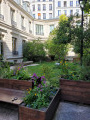
(2) At No. 9, push open a heavy door and enter the Jardin Cromot Dubourg – Cour Cadet.

(2) Leave the courtyard, head back along Rue Cadet to the right and, at the end of the street, turn right onto Rue du Faubourg Montmartre. Cross Rue Lafayette and continue straight ahead. At the next junction, cross Rue de Châteaudun, Rue de Maubeuge, and a little further on, Rue Lamartine and Rue des Martyrs.

(3) Cross Rue Notre-Dame de Lorette and turn right to follow this uphill street on the left-hand pavement. Cross Place Saint-Georges, in the centre of which stands a statue of Paul Gavarni, a 19th-century draughtsman and caricaturist. Walk past the Saint-Georges metro station and, a little further on, turn left into Square Alex Biscarre.

(4) Walk around the square.

(4) Take Rue Notre Dame de Lorette on the left. Then turn left onto the uphill Rue La Bruyère. At the end, turn left onto the downhill Rue Catherine de la Rochefoucauld and cross Rue d’Aumale on the left. Pass on the right by the Espace La Rochefoucauld, a neoclassical mansion that now offers workspaces and an events venue, and on the left by the Gustave Moreau Museum. Turn right onto Rue de la Tour aux Dames, running alongside the imposing building of the Compagnie Parisienne de Distribution d’Electricité on your right.

(5) Cross Rue Blanche and continue straight ahead along Rue de la Trinité for a few dozen metres. Then turn left onto Rue de Chevrus, walking past the church on your right, go down Place d’Estienne d’Orves and enter Square d’Estienne d’Orves.

(6) Walk around the square.

(6) On leaving, turn right, walk up Rue de Clichy then turn right onto Rue de la Trinité, passing behind the church.

(5) Turn left onto Rue Blanche, going uphill, with the fire station on your right and the German Evangelical Church on your left. Take thesecond right onto Rue Escudier, then left onto Rue Henner, left again onto Rue Chaptal, and head for number 26.

(7) Enter the Pauline Garcia-Viardot Garden and then come back out.

(7) Take Rue Chaptal on the right, then Rue Blanche on the right, then thesecond on the left, Rue de Calais, with its green pavement, and arrive at Place Adolphe Max.

(8) Turn right into Square Hector Berlioz and walk around it.

(8) On leaving, head across the road, slightly to the right, onto Rue de Bruxelles, then right onto Rue de Clichy, to reach the Place de Clichy metro station on the right, lines 2 and 13 (E).

Waypoints

  1. S : km 0 - alt. 75 m - Anvers metro station
  2. 1 : km 0.75 - alt. 52 m - Montholon Square
  3. 2 : km 1.28 - alt. 34 m - Cromot Dubourg Garden - Cour Cadet
  4. 3 : km 1.82 - alt. 35 m - Crossroads - Église Notre-Dame de Lorette (Paris)
  5. 4 : km 2.09 - alt. 55 m - Square Alex Biscarre
  6. 5 : km 2.78 - alt. 50 m - Rue Blanche - Église de la Sainte-Trinité (Paris)
  7. 6 : km 3.01 - alt. 44 m - Square d'Estienne d'Orves
  8. 7 : km 4.12 - alt. 62 m - Pauline Garcia-Viardot Garden
  9. 8 : km 4.53 - alt. 58 m - Square Hector Berlioz
  10. E : km 4.86 - alt. 59 m - Metro - Place de Clichy

Worth a visit

Square Anvers
10bis, Avenue de Trudaine
Created in 1877 (4,610 m²)
Drinking fountains, play areas, table football, multi-sports pitch, chess tables, boules court, table tennis table, bandstand, book box.
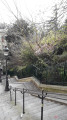
The garden is situated on part of the site of the former Montmartre abattoirs, built around 1808 and demolished shortly after the inauguration of the Villette central abattoirs in 1867. Originally designed under the supervision of Alphand and renovated in 2006, the park brings together all the features of the current park: children, teenagers, adults and senior citizens – there is something for everyone. Rectangular in shape, the square features a path that winds its way along a lawn. It stretches from Boulevard de Rochechouart to the chic, tree-lined Avenue Trudaine, bordered to the west by the imposing building of the Lycée Jacques Decours. It is named after the Belgian city of Antwerp, which was captured by the French in 1832 during the Ten Days’ Campaign of the Franco-Dutch War. In 2021, the name of Jean Claude Carrière (1931–2021) was added; he was a French writer and director who lived in the neighbourhood and was a regular visitor to the square.

Montholon Square
2, Rue Mayran
Created in 1863 (4,350 m²)
Play areas, drinking fountain, table tennis tables, chess boards, multi-sports pitch, book box, sandpit, toilets.
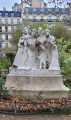
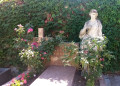
Spanning two levels, the square was once part of the gardens of a private mansion, designed by Alphand in 1863. Redesigned in 1981, it features two flower-filled lawns in the centre and all the amenities of a modern park. Here you can see a marble sculpture group depicting the “Catherinettes” (unmarried women over the age of 25 who were expected to wear a hat on Saint Catherine’s Day), in tribute to the neighbourhood’s female workers. The cast-iron railings with heart-shaped motifs and the two hundred-year-old plane trees are the only remnants of the original garden. The square is named after the nearby Rue de Montholon, which in turn refers to the mansion of Nicolas de Montholon, Councillor of State (1736–1869), which stood nearby.

Jardin Cromot Dubourg - Cour Cadet
9, Rue Cadet
Book box.
The former residence of Jules-David Cromot Dubourg, Baron du Bourg (1725–1787), where aresidential building was constructed around a courtyard in the 18th century. It was later converted into a private mansion. In 1807, Ignace Pleyel (1757–1831) set up a piano factory here. He invited his friend, the composer Frédéric Chopin (1810–1849), to give his first major recital here. In 2019, the building was converted into social housing and the courtyard became a garden.

Square Alex Biscarrre
31, Rue Notre-Dame de Lorette
Created in 1964 (1,180 m²)
Drinking fountains, playground, book box, toilets.
Located next to the picturesque Place St Georges, the current square was once the private garden of the mansion to which it is attached, now a library of the Institut de France. Its oval lawn is surrounded by a path lined with benches. It features a pretty covered courtyard with a slate roof that appears to have once housed a wash house, and a trompe l’œil wall streaked with green trelliswork. This square is named after Alex Biscarre, a Paris city councillor in 1959.

Square d'Estienne d'Orves
1, Place d'Estienne d'Orves
Created in 1965 (3,164 m²)
Drinking fountain, playground, toilets, book box.
The garden is situated at the foot of the Church of the Trinity. Designed by Alphand, the architect remained faithful to the number 3: at the top of the staircase leading to it, three statues, "Faith", "Charity" and "Hope", protect three children, at whose feet three bronze vases allow water to gush forth, falling onto the three triple-basin fountains, embraced by the arms of the staircase. Two lawns stretch out in front of the church’s three-arched porch. Originally named Square de la Trinité, it was renamed in honour of Honoré d’Estienne d’Orves (1901–1941), a naval officer and martyr of the Resistance, whose gravestone with a medallion stands in the square.

Pauline Garcia-Viardot Garden
26, Rue Chaptal
Created in 2021 (100 m²)
A tiny garden consisting of a square of lawn shaded by tree-lined flowerbeds at the foot of an 18th-century mansion, now a library. The garden is closed on Sundays. This garden pays tribute to the singer and composer Pauline García Viardot (1821–1910).

Square Hector Berlioz
1, Place Adolphe Max
Created in 1959 (897 m²)
Drinking fountain, play areas, book box.
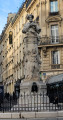
This small oval square, an oasis of greenery in the centre of an open square, features a colourful playground for young children. In the centre stands a majestic statue of the musician Hector Berlioz (1803–1869), erected in 1948.
The square is named after the composer, who died at No. 4 Rue de Calais, which leads onto Place Adolphe-Max.

Other walks in the area

For more walks, use our search engine .

The GPS track and description are the property of this route's author. Please do not copy them without permission.