A stroll around Passy Cemetery

Passy Cemetery is one of the largest cemeteries within the city limits of Paris. It is the final resting place of many notable figures, including musicians and aviation pioneers. This route takes you on a stroll through this place of contemplation, where you can discover around sixty of these notable figures.

Details

97603904
Creation:
Last update:
Last review:
  • Walking
    Activity: Walking
  • ↔
    Distance: 0.88 mi
  • ◔
    Average duration: 0h 25 
  • ▲
    Difficulty: Easy

  • ⚐
    Back to start: Yes
  • ↗
    Ascent: + 26 ft
  • ↘
    Descent: - 26 ft

  • ▲
    Highest point: 226 ft
  • ▼
    Lowest point: 200 ft
  • ⚐ Country: France
  • ⚐ City: Paris (75000)
  • ⚑
    Start/End: N 48.862403° / E 2.286651°
  • ❏
    IGN map(s): Ref. 2314OT
  • Hour-by-hour weather

Description of the walk

Start from the Place du Trocadéro. Access via the metro (line 6 or 9). Take exit 5, Cimetière de Passy.

(S/E) As you exit the metro station, turn right to view the War Memorial for the 1914–1918 War, designed by the sculptor Paul Landowski. Retrace your steps, turn right onto Avenue Paul Doumer and walk alongside the cemetery wall on your right-hand side. After about a hundred metres, turn right into Rue du Commandant Schloesing and you will soon reach the entrance to Passy Cemetery.

The route within the cemetery is a guide only and can be varied in various ways. In the description that follows, the names appearing on the graves may be highlighted for three different reasons:
1) Graves of notable figures, in which case one or two lower-case letters in brackets refer to a short entry in the ‘Places to see’ section, where the names are listed in the order in which they appear on the route.
2) Particularly original monuments.
3) Useful landmarks within the cemetery.

(1) Enter the cemetery and immediately climb the steps on the right. At the top, note the grave of Renée Vivien (a). Then walk past the Guerlain family chapel, where Jacques Guerlain is buried (b). Turn right at the corner by the Pierquin family grave. Shortly afterwards, at the corner by the Salmon-Legagneur family grave, turn right again to reach the modest grave of André Morizet (c).

Retrace your steps. Turn left to walk past the imposing chapel where Marie Bashkirtseff is buried (d). Turn right and note, on the left, the grave of Marie Leconte (e) and then that of Togrul Narimanbekov (f), whose headstone is adorned with a painting.

Retrace your steps, leaving the imposing chapel on your right, and turn left onto a grassy path where you will find the grave of Robert Mallet-Stevens (g). Next, on your left, note a gravestone decorated with a blue-toned mosaic depicting a horse. Turn left immediately, at the corner by the de Saint-Angel family grave.

(2) You’ll emerge onto a small path; follow it to the left until you reach the grave of Haroun Tazieff (h), decorated with a pre-Columbian fresco. Retrace your steps to the previous junction.

(2) Go straight on. Then turn right, passing a chapel on your left (seen from the rear) bearing the inscription ‘Perpetual concession 1848’. At the end of the path, turn sharply left, passing at the foot of the bust of Antoine Sulpice Fauvel (i). Walk up a cobbled path and note, on the right-hand side, the grave of Gérard de Villiers (j) and then that of Joseph Gibert (k).

At a junction with a fountain, go round the Talleyrand-Périgord family chapel on the left and note André Piot’s grave (l). Then cross the cobbled path (note a Pietà under glass on the left, high up), continue along the path opposite and note a grave shared by two people named Roland Cadet, the father (m) and the son (n).

Then turn left and walk behind the Pietà seen earlier. Note, on the right, a stele with a bas-relief depicting the Entombment; then, on the left, the grave of Rosemonde Gérard (o) and Maurice Rostand (p). At the T-junction, turn right until you reach the next intersection, at the corner marked by General Huntzinger’s grave (q).

(3) Then turn right and walk past the foot of General Nivelle’s grave (r) on the right-hand side. Continue on, still keeping to the right, and note the grave of Loulou Gasté (s). At the junction that follows immediately, with the Patou family’s grave (t) on the right, go straight on. Note, on the right-hand side, the grave of François Raynouard (u). Further on, still on the right-hand side, is the grave of Henri Farman (v), adorned with a bas-relief by the sculptor Paul Landowski.

Then turn left and note the grave of Pierre de Bénouville (w). Continue straight ahead and, at the end of the path, you will reach the grave of Édouard Balladur (x). Then turn right and you will soon reach the grave of Jean Giraudoux (y).

Retrace your steps and continue straight on, walking alongside a wall on your right. Note the grave of Georges Mandel (z) on the left. Continue straight on, then turn left at the corner by the Coulon family’s grave. Shortly afterwards, on the right-hand side, you will find the graves of Réjane (aa), Jacqueline Porel (ab) and François Périer (ac).

Then turn left to quickly reach the grave of Louis Castex (ad) and Béatrice Bretty (ae). Retrace your steps and turn left, passing the grave of Jean Drucker (af) before arriving at a rotunda.

(4) Take the first path on the left and you will immediately reach the grave of Edgar (ag) and Lucie (ah) Faure. Retrace your steps back to the rotunda.

(4) Take the second path on the right, passing Marcel Dassault’s grave (ai) on your right. Note, on the left-hand side, the grave of Francis Bouygues (aj). You’ll come to a junction and, on the right, you’ll see a grave topped with a cross bearing the inscription ‘Pour toi France’ (‘For you, France’), which holds the remains of two brothers who died in action in 1918, André (ak) and Henry (al) Wessbecher.

Then take a gravel path to the left. Note, on the right-hand side, the grave of Thierry Roland (am). Just before a crossroads, at the corner of a chapel, turn left to quickly reach the grave of Bảo Đại (an). Retrace your steps and follow the path to the left.

At the crossroads, go straight on and you will immediately see, on the right, the grave of Marcel Ichac (ao). Turn right at the corner by the Binay family’s grave and, in the third row, you will find the grave of Fernandel (ap). Continue along the main path, noting the grave of Dieudonné Costes (aq) on the left, and you will soon reach a rotunda.

(5) Then turn right onto a small path flanked by chapels. At the end, turn left and pass between a chapel adorned with a sculpture depicting a cherub holding a skull and a chapel at the far end decorated with a painting. Turn left immediately at the foot of a chapel featuring a large statue of a mourner.

Shortly afterwards, turn right, leaving a chapel on your left decorated with a bas-relief depicting two angels. Immediately after this, note the Bluzet family grave, which commemorates a father and his son, both of whom died in the war in 1915 and 1917 respectively. Three graves further on lies the Boucher family’s grave, featuring yet another father and son who died in the war, both in 1914.

Then turn left and walk alongside a wall on your right. Pass the grave of Henriette (ar) and Jane (as) Henriot, mother and daughter laid to rest together. Make a detour to the left to see the graveof Alexandre Millerand (at). Go round the Lourmand family chapel on the right and follow a small path to the foot of a tall monument topped with a sculpture. Retrace your steps, turn left and walk along the wall on your right.

At the corner by the Gillon family grave, turn left onto a small path and you’ll immediately spot Gabriel Fauré’s grave (au) on your left. Turn right straight away and walk between two graves. You’ll come out onto a wide path; follow it to the left. After about ten metres, first turn right then left, leaving the Boulot-Viguier grave on your left. Then turn left and follow a small path to the graves of Claude Debussy (av) and Emma Bardac (aw).

Continue along the narrow path. At a T-junction, turn right. Then turn left onto a narrow path, leaving the Benat family’s grave on your left. At the end, first turn right then left. You’ll come out onto a wide path; follow it to the right and immediately turn left onto a cobbled lane. Turn left immediately at the corner by the Guiband-Marceaux family grave and you will soon come across, on the left-hand side, the graves of Madeleine Renaud (ax) and Jean-Louis Barrault (ay). Retrace your steps and follow the cobbled path to the left until you reach a rotunda you passed earlier.

(4) Take the first path on the right and note, at the corner, hidden amongst the vegetation, the grave of Maurice Genevoix (az). Go straight on and note, on the right-hand side, the grave of Maurice Bellonte (ba). Then note, on the left-hand side, the grave of Léon (bb) and Suzy (bc) Volterra, adorned with a bas-relief depicting a pastoral scene, the work of Alfred Pina.

At the crossroads, turn right and walk slightly downhill. On the right-hand side, note the statues adorning the Dupont-Charton family grave, followed by the statue of a woman holding a sword. Then turn left to leave the cemetery.

(1) Follow Rue du Commandant Schloesing to the left, continuing onto Avenue Paul Doumer, and you’ll soon reach Trocadéro metro station (S/E).

Waypoints

  1. S/E : mi 0 - alt. 200 ft - Place du Trocadéro
  2. 1 : mi 0.09 - alt. 217 ft - Entrance to Passy Cemetery
  3. 2 : mi 0.19 - alt. 223 ft - T-junction
  4. 3 : mi 0.26 - alt. 223 ft - Junction with the eastern circular loop
  5. 4 : mi 0.39 - alt. 223 ft - Rotunda
  6. 5 : mi 0.48 - alt. 226 ft - Rotonde
  7. S/E : mi 0.88 - alt. 200 ft - Place du Trocadéro

Notes

A simple pair of trainers is sufficient for this short urban walk.

Inside the cemetery, drinking fountains are marked on the map and there are toilets on the left after the entrance. There are bars and restaurants in the surrounding neighbourhood.

It is recommended that you obtain the map provided by Paris City Hall, which indicates the locations of the graves of several notable figures. Allow around two hours for a visit to the cemetery.

Passy Cemetery opening hours:
- Opening: weekdays, 8.00 am; Saturdays, 8.30 am; Sundays and public holidays, 9.00 am.
- Closing: from 6 November to 15 March, 5.30 pm; from 16 March to 5 November, 6.00 pm.

Please bear in mind that a cemetery is a place of contemplation and that discreet and respectful behaviour is required.

Walk undertaken by the author on 12 September 2026.

Worth a visit

Some facts about the history of Passy Cemetery:
The cemetery was established in the early 19th century, at a time when Passy was a separate commune from Paris. It was expanded in successive phases until 1860, when Passy was incorporated into Paris. Covering an area of 1.7 hectares, it is not among the largest cemeteries in Paris by this measure. However, it is the cemetery with the highest density of famous people buried there.

Entrance to the cemetery:
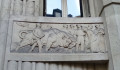
The entrance to Passy Cemetery consists of a monumental gate leading to a reception pavilion; these structures, dating from 1934, were designed by the architect Berger. The bas-reliefs adorning the pavilion, dating from 1935, are the work of the sculptor Louis Janthial (1904–1965).

Graves of notable figures (non-exhaustive list):
a – Renée Vivien (1877–1909), born Pauline Mary Tarn, a British poet and writer who wrote in French.
b – Jacques Guerlain (1874–1963), perfumer.
c – André Morizet (1876–1942): politician and founding member of the French Communist Party in 1920, from which he resigned in 1923 to join the French Section of the Workers’ International (SFIO) in 1928. A senator for the Seine department from 1927 to 1942, he was mayor of Boulogne-sur-Seine from 1919 to 1922 and then from 1925 (the year the municipality took the name Boulogne-Billancourt) to 1942. He modernised the town’s urban planning, commissioned the construction of workers’ housing estates and a new town hall (now situated on the avenue that bears his name). He commissioned young architects who later became renowned (Le Corbusier, Mallet-Stevens – see below) to build Art Deco-style blocks of flats and villas.
d – Marie Bashkirtseff (1858–1884) Painter and sculptor, author of a diary written in French.
e – Marie Leconte (1869–1977) Born Marie Anne Lacombe, actress and member of the Comédie Française.
f – Togrul Narimanbekov (1930–2013) Painter from Azerbaijan.
g - Robert Mallet-Stevens (1886–1945) Architect, designer and film set designer, an icon of the Art Deco style. He was director of the École des Beaux-Arts in Lille from 1935 to 1939.
h - Haroun Tazieff (1914–1998) A volcanologist regarded as a pioneer of modern volcanology. Having initially trained in agronomy in Belgium, he held numerous scientific posts in France and abroad. He proved himself to be an innovator throughout his career, particularly in the field of instrumentation. He was also a great populariser of his discipline through feature-length documentary films. He was mayor of Mirmande (Drôme) from 1979 to 1989, and served as a departmental councillor in Isère and a regional councillor in Rhône-Alpes. From 1983 to 1884, he served as Secretary of State for Major Natural and Technological Risks. An accomplished sportsman, he competed at a high level in mountaineering, rugby and boxing, winning the title of Belgian university boxing champion in the mid-1930s and that of Katanga champion in the late 1940s.
i – Antoine Sulpice Fauvel (1813–1884) A doctor specialising in cholera, who distinguished himself in particular during the Crimean War (1853–1856).
j – Gérard de Villiers (1929–2013) Journalist and writer, best known as the author of spy novels that enjoyed great popular success.
k – Joseph Gibert (1892–1972) Bookseller.
l - André Piot (1894–1974) Poet and writer of the 1914–1918 war.
m - Roland Cadet (1861–1934) An officer who distinguished himself in Tonkin and Madagascar, and later during the First World War, in which he was wounded several times. He ended his career with the rank of general.
n – Roland Cadet (1909–2003) Senior civil servant and member of the Council of State.
o - Rosemonde Gérard (1886–1953) Writer, poet and actress. She was the wife of the playwright Edmond Rostand.
p - Maurice Rostand (1891–1968) Poet, novelist and playwright, eldest son of Edmond Rostand and Rosemonde Gérard.
q - Charles Huntzinger (1880–1941) An officer who served in the Army of the Orient during the First World War. During the Second World War, he commanded the Fourth Army Group in the Ardennes sector. He headed the French delegation that signed the armistice of 22 June 1940 with Germany, and subsequently the delegation that signed the armistice of 24 June 1940 with Italy.
r – Robert Nivelle (1826–1924) An officer who distinguished himself particularly during the 1914–1918 war, at the start of which he was promoted to general. He achieved notable local successes in August and September 1914. In April 1916, at the height of the Battle of Verdun, he replaced General Pétain as commander of the Second Army, which was holding the sector at the time. In December 1916, he became Commander-in-Chief of the French Army, succeeding General Joffre. He decided to launch the Chemin des Dames offensive, which began on 16 April 1917; this proved to be a disaster and resulted in very heavy casualties. Nivelle was subsequently relieved of his command on 15 May 2017.
s – Loulou Gasté (1908–1995) Born Louis, a composer of hit pop songs and husband of Line Renaud.
t – Jean Patou (1887–1936) Fashion designer and perfumer.
u - François Raynouard (1761–1836) A historian, philologist and playwright, he was appointed permanent secretary of the Académie Française in 1817.
v - Henri Farman (1874–1958) A top-level sportsman, first in cycling and then in motor racing, he was a pioneer of aviation. On 13 January 1908, in Issy-les-Moulinaux, he made the first certified flight of one kilometre on a closed route. On 30 October 1908, he made the first ‘city-to-city’ aerial journey, covering a distance of 27 kilometres. He held numerous records for distance and flight time. Together with his two brothers, Dick and Maurice, he embarked on aircraft construction, establishing their first factory in Boulogne-Billancourt in 1911. The company expanded and diversified into the construction of boats and cars.
w – Pierre de Bénouville (1914–2001) A politician who joined the Resistance in the summer of 1941, he was a Member of Parliament for Paris from 1970 to 1993.
x – Édouard Balladur (1929–2026) A politician, Member of Parliament for Paris from 1986 to 2007, Minister for the Economy, Finance and Privatisation from 1986 to 1988, and Prime Minister from 1993 to 1995.
y - Jean Giraudoux (1882–1944) Diplomat, writer and playwright.
z - Georges Mandel (1883–1944) Born Louis Rothschild, journalist and politician. He served several terms as a Member of Parliament and held a number of ministerial posts in the interwar period. Deported to Germany in 1942, he was handed over to the French militia in July 1944 and murdered shortly afterwards in the Forest of Fontainebleau.
aa – Réjane (1856–1920), born Gabrielle Charlotte, a stage actress who enjoyed a reputation comparable to that of Sarah Bernhardt.
ab - Jacqueline Porel (1918–2012) A theatre and film actress, and Réjane’s granddaughter.
ac - François Périer (1919–2002) Born François Pillu, Jacqueline Porel’s first husband. He appeared in numerous films. In the theatre, he was both an actor and a director. He also narrated many children’s records.
ad – Louis Castex (1896–1968) Aviation pioneer and writer.
ae - Béatrice Bretty (1893–1982) Born Béatrice Bolchesi, theatre and film actress, member of the Comédie Française, and partner of Georges Mandel.
af – Jean Drucker (1941–2003) Television executive, CEO of Antenne 2 in 1985 and founder of the M6 channel in 1987.
ag - Edgar Faure (1908–1988) Lawyer and politician of the Radical Party. He served several terms as a Member of Parliament and was President of the National Assembly from 1973 to 1978. He held several ministerial posts under the Fourth and Fifth Republics. He chaired the Franche-Comté Regional Council from 1982 to 1988. He was elected to the Académie Française in 1978.
ah – Lucie Faure (1908–1977) Writer and novelist, member of the Resistance and anti-colonialist.
ai – Marcel Dassault (1892–1986) Born Marcel Bloch, an industrialist who founded an aircraft manufacturing company and a politician.
aj – Francis Bouygues (1922–1993) A business leader in the construction sector and later in the television industry.
ak - André Wessbecher (1898–1918) Pilot killed in action.
al - Henry Wessbecher (1892–1918) Second Lieutenant who died in the Chemin des Dames sector.
am - Thierry Roland (1937–2012) Sports journalist.
an - Bảo Đại (1913–1997) Last Emperor of Vietnam, from 1926 to 1947.
ao - Marcel Ichac (1906–1994) Film-maker, documentary-maker and mountaineer.
ap - Fernandel (1903–1971) Fernand Contandin by birth, actor, director, comedian and singer-songwriter. An iconic comedian of 1930s and 1940s cinema, he played the lead roles in numerous films by Marcel Pagnol. In the 1950s and 1960s, he played the priest Don Camillo in a series of six films.
aq – Dieudonné Costes (1892–1973) An aviator who made the first non-stop crossing of the South Atlantic in 1927 and the first non-stop east-west crossing of the North Atlantic in 1930 with Maurice Bellonte (see below).
ar - Henriette Henriot (1857–1944) A stage actress, she was one of the favourite models and a friend of the painter Auguste Renoir.
as - Jane Henriot (1878–1900) An actress and member of the Comédie Française.
at - Alexandre Millerand (1859–1943) Lawyer, journalist and politician. He served as President of the Council in 1920 and then as President of the Republic from 1920 to 1924.
au – Gabriel Fauré (1845–1924) Composer, organist and pianist. Chapel master and later titular organist at the Église de la Madeleine in Paris, he was professor of composition at the Paris Conservatoire, which he directed from 1905 to 1920. His compositions are characterised by a profound sense of inner depth, without any ‘showboating’.
av – Claude Debussy (1862–1918) Composer, best known for his numerous works for piano. His style quickly moved away from academicism and was considered avant-garde in his day.
aw – Emma Bardac (1862–1934) Opera singer, lover of Gabriel Fauré and later wife of Claude Debussy.
ax - Madeleine Renaud (1900–1994) Theatre and film actress. After serving as a member of the Comédie-Française, she founded the Renaud-Barrault theatre company with her husband.
ay - Jean-Louis Barrault (1910–1994) Theatre and film actor; he founded the Renaud-Barrault theatre company with his wife. He was director of the Théâtre de l’Odéon in Paris from 1959 to 1968.
az - Maurice Genevoix (1890–1980) Writer and poet. He was elected to the Académie Française in 1946 and served as its permanent secretary from 1958 to 1973. His body of work includes accounts of the First World War, during which he fought and was seriously wounded, notably *Ceux de 14*. It also comprises numerous works inspired by the Sologne and the Loire Valley. Maurice Genevoix was interred in the Panthéon in 2020.
ba - Maurice Bellonte (1896–1984) An aviator who, together with Dieudonné Costes (see above), made the first non-stop east-west crossing of the North Atlantic in 1930. He served in the air force during the First World War and was a member of the Resistance during the Second.
bb - Léon Volterra (1888–1949) Producer and theatre manager, owner of a racehorse stable.
bc - Suzy Volterra (1912–2006) Initially a dancer at the Paris Opera, she managed and expanded her husband’s racing stable following his death.

Sources: Paris City Hall and Wikipedia.

Other walks in the area

For more walks, use our search engine .

The GPS track and description are the property of this route's author. Please do not copy them without permission.