Country:
 City:
City:


Starting point and access: Place du Trocadéro.
- Metro – Lines 6 and 9. Take Exit 5 (Cimetière de Passy).
- Bus – Lines 22, 30, 32, 63.
The main animal depictions and key features to look out for are indicated in italics within the body of the description.
(S) As you exit the metro station, turn right and walk past the monument to the glory of the French Army 1914–1918 (Paul Landowski, 1956): a soldier on horseback and, on the central figure’s shield, Saint George on horseback slaying the dragon. Walk round the Place du Trocadéro in a clockwise direction (equestrian statue of Marshal Foch in the centre) and cross, in turn, the Avenues Georges Mandel, d’Eyaud, Kléber and du Président Wilson.
(1) At the entrance to the Théâtre de Chaillot (built in 1937), note the two high reliefs at the top of the stairs. On the left, a scene evoking India: gazelles at the bottom left; a horse pulling a chariot at the top right; elephants at the bottom right. On the right, a medieval scene featuring: a bull in the centre; an unidentified bird of prey at the bottom left; a knight and his steed at the top left; and, at the top right, a hunting scene with horses, dogs and a falcon.
With your back to the theatre entrance, head right along Avenue du Président Wilson and note the first high relief on the Palais de Chaillot on your right , depicting a bovine figure. Shortly afterwards, turn right to stay as close as possible to the building (more high reliefs). Walk past the base of the monument honouring the sculptor Paul Adam, created in 1937 by Paul Landowski (lion, horses, a sacrificed bull, a snake, a camel). Continue along the building and go down a few steps.
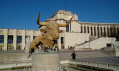
(2) At the corner of the building, turn right. Immediately ignore a path on the right and take the next one on the right. Pass an artificial pond on the left, walk gently uphill, climb a flight of steps and arrive at the foot of the statue (1937) of Apollo Musagetes (a large serpent; cattle and birds on the lyre held by Apollo). Climb a few more steps and cross the Trocadéro esplanade (beautiful panoramic view of the gardens, the Seine and the Eiffel Tower). On the other side, go down a few steps to reach the foot of the statue (1937) of Hercules and the Cretan Bull (above, a high relief depicting a horse and a mermaid).
Then go down a flight of steps on the left, followed by another flight on the right (in March 2024, access to the pond on the left was closed for works). At the bottom, turn left and walk down with the pond some distance to your left (two gilded sculptures: the nearest depicts a bull’s head and a fallow deer, whilst the one further away depicts two horse’s heads and a dog). At the bottom, cross Avenue des États-Unis and then, in two stages, Avenue de New York. Turn left to reach the Pont d’Iéna immediately.
(3) Cross the bridge over the Seine. The bridge is flanked by four statues dating from 1853, each depicting a horseman on foot holding his mount by the bridle: on the right bank, a Greek horseman downstream and an Arab horseman upstream; on the left bank, a Roman horseman downstream and a Gallic horseman upstream. As you reach the left bank, look out for a modern metal sculpture below on the right, depicting two prawns.
On the other side, cross the Quai Jacques Chirac in two stages and follow it to the right at the foot of the Eiffel Tower and along the translucent partition that surrounds it. At the corner of this partition, turn left onto a concrete path. Walk past the queues for the tower, then turn left onto Avenue Gustave Eiffel and pass by the foot of the tower once more.
(4) Just before the eastern pier, take the second wide path on the right, Avenue Anatole France. Carry on straight ahead until you reach Place Jacques Rueff. Then turn left and walk along a tarmac avenue on your right. Carry on straight ahead. Then go round a junction on the left, take the third left onto Rue Saint-Dominique, then the first right onto Rue Augereau. Take the first left onto Rue du Gros Caillou, then turn right onto it.
At the end, turn left twice onto Rue de l’Exposition and note a stuffed fox in the shop window at No. 23. Pass under a portico and arrive at the foot of the Fontaine de Mars. On each of the three sides of the monument’s plinth, there is a lion and a ram, both with fish tails, and, at the bottom, a mascaron with the head of an unidentified animal. The side parallel to Rue Saint-Dominique also depicts the god Mars with a cockerel at his feet and Hygieia, the goddess of health, with a snake coiled around her arm.
(5) With your back to the statue of Mars, first turn left then right onto Rue Sédillot. At No. 12, note the façade of the Lycée Léonard de Vinci, adorned with foliage and featuring two dragons at the base of a window. At number 8, look out for a lion’s head. On the corner of number 1, look out for two ram’s heads framing a window and a lion’s head above them. Turn left, cross Avenue Rapp and follow it to the right. Take the first left, Rue Franco-Russe, then turn right onto it.
At the end, cross Rue de l’Université and enter the Quai Branly Museum Gardens. At the junction you’ll soon come to, first turn left then right, pass under a building and cross the garden. On exiting, cross the quayside in two stages and take the Passerelle Debilly to cross the Seine. On the other side, cross Avenue de New York at the pedestrian crossing.
(6) Follow the avenue to the right. After about a hundred metres, climb the steps on the left to reach the lower courtyard of the Palais de Tokyo. A walk around this courtyard allows you to admire its many Art Deco-style high reliefs, dating from 1937. With your back to Avenue de New York:
- Immediately on the right, a man fighting snakes, with a lion at his feet, and a little further on, a couple with birds.
- At the back in the centre, by the edge of the pond, two sea horses.
- At the back on the right, a large fresco featuring, from top to bottom and from right to left: a horse; a bird; a triton (a male mermaid with two tails); birds; Erato, the muse of music; Venus with a dolphin.
- At the back on the left, a vast fresco depicting, from top to bottom and from left to right: four rearing horses; a centaur; a bull; a snake.
Climb a flight of stairs and walk past the base of the statue honouring the Free French volunteers (several snakes of various sizes). Cross the palace’s upper courtyard (at the side gates, there are some ironwork decorations featuring horse heads). Leave the palace and cross Avenue Wilson at the pedestrian crossing in two stages.
(7) Enter the Square du Palais Galleria and walk around it. There are several statues, including: *The Childhood of Bacchus* (1857); *Protection and the Future*, the adult figure wearing a lion’s head; *The God Pan and a Tiger* (1899).
(7) On leaving the square, follow Avenue du Président Wilson to the right. Continue straight on until you reach Place d’Iéna (equestrian statue of George Washington). Turn sharply right onto Avenue Pierre Ier de Serbie. When you reach the Palais Galleria, veer left and walk past the base of the statue of the Comte de Rochambeau (hero of the Battle of Yorktown in 1781).
At the traffic lights, turn left onto Rue Freycinet (lion-headed fountain on the right). Walk up the street and note a lion’s head at No. 26. At the end of the street, cross Avenue d’Iéna. Then turn right and head towards Place des États-Unis and the monument honouring the American soldiers who arrived in France in 1917.
(8) Continue straight on along Avenue d’Iéna. Cross the avenue at the first set of traffic lights and turn diagonally left into Rue de Bassano (lion’s head on the gate at No. 2). Keep going straight on and cross Rue Jean Giraudoux. Then cross Avenue Marceau at the pedestrian crossing on the left (lion’s head at No. 54). Continue along Rue Christophe Colomb and head slightly downhill.
(9) At the first junction, turn left into Rue Magellan. At the next junction, take the second left, Rue Euler (at no. 6, there is a lion on the flag of the Belgian region of Flanders). At the end of the street, turn sharply right into Rue Gallilée. At the next junction, turn left onto Rue Vernet. At the end (Wallace fountain with fish and scallop shells), turn right twice to join Rue de Presbourg.
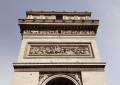
At the traffic lights, cross the Avenue des Champs-Élysées and follow it to the left. After about fifty metres, take the underpass leading to the Arc de Triomphe. Walk past the queue at the ticket office and climb the first flight of steps on the left, which takes you to the foot of the monument (free entry).
(10) At the top, turn right and walk round the Arc de Triomphe in a clockwise direction. As well as the Tomb of the Unknown Soldier (on the east side), you can see numerous sculptures (dating from 1836 or a few years earlier):
- All round the top of the monument, two friezes, one above the other: one featuring numerous horses, the other featuring many lion-headed mascarons.
- On the inner faces of the pillars are imperial eagles.
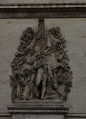
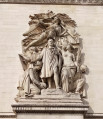
- On the east face, a high relief at the base of the right-hand pillar, *The Departure of the Volunteers of 1792* by François Rude: at the bottom, a lion on the shield at the feet of the central figure; lion’s heads on his knee guards; and lion’s paws on the top of his breastplate; in the centre, a horse’s head firmly held by the bit; at the top, a cockerel surmounting a pylon bearing the initials of the French Republic and a dragon on the Phrygian cap of the winged allegory of victory.
- East side, above, bas-relief *The Funeral of General Marceau*: a horse.
- East side, high relief at the base of the left pillar, *The Triumph of 1810* by Henri Lemaire: a bird’s head above the woman holding Napoleon’s laurel wreath and a cockerel surmounting a pylon bearing the initials of the French Empire.
- East side, above, bas-relief *The Battle of Aboukir*: a horse.
- South side, bas-relief depicting *The Battle of Jemappes*: horses.
- South side, above: a bas-relief featuring a bull and several horses.
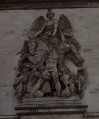
- West side, high relief at the base of the right-hand pillar, *The Resistance of 1814* by Antoine Étex: two horses.
- West side, above: bas-relief depicting ‘The Crossing of the Arcole Bridge’: a horse.
- West side, high relief at the base of the left pillar, *The Peace of 1815*, by Antoine Étex: a bull.
- West side, above, bas-relief depicting *The Capture of Alexandria*.
- North side, bas-relief depicting ‘The Battle of Austerlitz’: numerous horses.
- South side, above: bas-relief featuring several horses.
(10) Once you have completed the tour, go down the exit staircase. At the bottom, turn left. Climb a flight of stairs and exit the underpass. You will soon find, opposite and slightly to the right, the entrance to the metro and the RER (E).
To get back home:
- Metro – Lines 1, 2, 6.
- RER – Line A.
- Bus – Routes 22, 30, 31, 52, 73, 92, 341.

 Visorando Member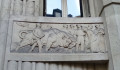
 Association / Club / Walk leader
 Moderate