Country:
 City:
City:


Start from Porte de Montreuil metro station (line 9). Take exit 3 onto Rue d’Avron.
Access is also possible via the tram, line T3b.
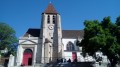
(S/E) Upon exiting the metro station, turn round and head north along Boulevard Davout. On your left, you’ll pass Rue des Réglises, Rue des Orteaux and Rue de la Croix Saint-Simon. Take the next left onto Rue Saint-Blaise. Walk up this street to its end, passing Rue du Clos and then Rue Vitruve. Cross Rue de Bagnolet and climb the steps leading to the Church of Charonne. Walk round the church on the left to reach the southern entrance to the cemetery straight away.
The route within the cemetery is indicative and can be varied in several ways. In the description below, the names appearing on the graves may be highlighted for three different reasons:
1) Graves of notable figures, in which case a lower-case letter in brackets refers to a short entry in the ‘Places to see’ section, where the names are listed in the order in which they appear on the route.
2) Particularly original monuments.
3) Useful landmarks within the cemetery.
(1) Enter the cemetery and walk up a cobbled path (Avenue Principale). Soon turn right at the corner by the church and walk alongside a hedge on your left. You will reach the grave of Maurice Cazaux (a).
(2) Then turn right, still walking alongside the church, then immediately left between the Mathet-Deletaz and Bourgouin-Rebillet graves. Walk past the grave of Alain de Mijolla (b). Continue along the path, then walk alongside the cemetery wall on your right.
Turn left at the corner of a grave (seen from the back) marked by a large headstone. Viewed from the front, you’ll see an engraving depicting the biblical figure of the Good Shepherd; note that this is the grave of Marie de Miribel (c). Facing the grave, turn right and follow the path to the grave of Maurice Cazaux, which you saw earlier.
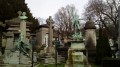
(2) Walk a few metres and turn right at the corner of the Bonnet grave. Then turn left onto a grassy path interspersed with flagstones, leaving the Larray grave on your right. On the right is the Chenus grave, adorned with a statue of a mourner surmounted by a bust.
At the end of the path, pass between two graves, cross the Avenue Principale (paved) and continue straight ahead along the Chemin Latéral. Note the richly decorated grave of Bernard Meyer on the right. Shortly after a small building, look out for the plaque on the wall to the left paying tribute to the federal troops shot in 1871.
Retrace your steps, walk past the small building and turn left at the corner by the L’Étang grave. Then turn left between the second and third rows of graves. On the right, you will find the grave of Daniel Milhaud (d), adorned with one of his own sculptures, *La Montagne*. At the end of the path, turn right.
After two rows of graves, turn right into a wide avenue, the Avenue Transversale. Note, in turn, on the left-hand side, the graves of Josette Clotis (e) and her two sons, Gauthier and Vincent Malraux; of Léonard Schoonheere (f); and of Bernard Ganachaud (g) and his family. Just behind this last grave, slightly to the left, is that of Emmanuelle Riva (h).
(3) Cross the Avenue Principale and continue along the Avenue Transversale. On your left, you’ll see a gravestone adorned with two mosaics: one depicting the dove of peace, the other the character of The Little Prince. At the end of the path, turn left onto a track and walk alongside the cemetery wall.
At the end of the path, turn left at the corner by the Ismard grave. Note, on the right, a statue of a woman wearing a hat and holding a bouquet of flowers. Turn left straight away and you will immediately come to the grave of Jacques Boni (i). Then turn right and walk past the grave of Jean-André Fieschi (j). Facing a large black headstone (seen from behind), first turn right then left to reach the northern entrance to the cemetery.
(4) Continue straight ahead along the path and you will find, on the right, the grave of Pierre Blanchar (k). Go round the left-hand side of the grave of François Bègue (l), topped by a statue of a figure in 18th-century costume. Then turn left and walk along the cemetery wall on your right.
Then take a path on the left, leaving the Guerin-Courtry grave on your left. Note the grave of Gabriel Petitjean (m) on the left. Further on, still on the left-hand side, is the grave of Rached (n). At the end of the path, you’ll find the grave of Emmanuelle Riva on the right; turn left. At the end, turn right to return to the northern entrance of the cemetery.
(4) Here, you have two options:
- Turn right and walk back down the Avenue Principale. Leave the cemetery via its southern entrance and, following the reverse route of your outward journey, return to the Porte de Montrueil (S).
- As shown on the map, turn left, leave the cemetery via its northern entrance and turn left again. At the junction, turn right into Rue Stendhal and walk past an urban farm. Just after passing Villa Stendhal on your right, turn left into Rue Charles Renouvier. Cross Rue des Pyrénées and continue to the end of Rue Renouvier. Then turn right onto Rue des Rondeaux. Walk along the left-hand side of the Père Lachaise cemetery wall until you reach its entrance.
(5) Here, you have two options:
- As a complement to this walk, follow the‘A tour of the Père Lachaise Cemetery’ walk starting from this point (6).
- As shown on the map, turn right onto Avenue Gambetta and continue straight on until you reach the square of the same name. You’ll find the Gambetta metro station (lines 3 and 3bis) on your right (E).
 Visorando Member