

 Country:

 City:
City:


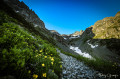
To park, continue past the car park at the IGN elevation of 1294m and, after the next hairpin bend, turn right onto a forest track suitable for vehicles; park 200m further on at the Ravin des Trois Fontaines.
Important warning: this walk was described before the creation ofthe GR®®738; there was very little (if any) signposting and the paths were barely visible. Nowadays, it is possible to reach (6) from (2) by staying entirely on a wide track marked in white and red. If you do this and leave a review of the walk, please do not state that the track or the description is unreliable (as you will not have followed it). Please note that theGR®® does not pass through Les 3 Laux at (4), which is a shame at the start of the season (until mid-June); from July onwards, current weather conditions make this section less appealing.
(S/E) From the car park, continue along the track on the right which crosses the stream at a ford near a pumping station. Stay on the wide path heading uphill (do not head towards the Betta bridge), which heads west and climbs slightly before descending to join theGR®®549at the Ravin de l’Avalanche.
From there, follow the red and white-marked path on the left, which leads to Lac de Crop via the two hamlets of the same name.
(1) At Lac de Crop, keep the lake on your right as you walk alongside it, staying on theGR®®549(red and white) trail leading to the Col de la Mine de Fer.
Early in the season, it’s easy to cut across the snowfields to make faster progress; otherwise, take the switchbacks of the path, which heads broadly south. Below the Petit Replomb, the path veers eastwards across the scree (or snowfields) and the slope levels off. After a flat section above the cliffs overlooking Lac Bleu, it heads south and then south-west to reach the Col de la Mine de Fer.
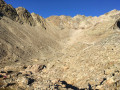
(2) Once at the pass, look back to locate the Brèche de Roche Fendue to the east-north-east: from here, the route is marked with yellow and, in places, blue dots. Retrace your steps for about 150 metres, then head due east beneath the foothills of the Colomb before descending towards the IGN elevation of 2,296 metres. Do not descend any lower than the neighbouring cliffs, and climb back up to the east through the scree-filled gully leading to the Brèche de Roche Fendue.
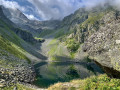
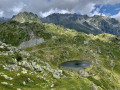
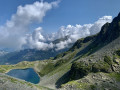
(3) At the Brèche, descend due east along the steepest slope for about 250m before veering northwards when the Trois Laux lakes come into view. Then descend, keeping the lakes in sight, until you reach the right bank (southern bank) of the largest one.
(4) Stay on this bank and turn right (east) to follow the stream bed, which acts as the lake’s outlet. You will soon come across a well-marked path that veers northwards to cross the stream and climbs slightly up a ridge (it is also possible to go round the ridge at the same level, but there are a few rounded boulders making this option more difficult: when the terrain becomes too steep, you must descend due east to go round these rocks at the base and then head northwards back towards Le Clot). After this ridge, you’ll arrive above the Clot du Ban shepherd’s shelter and descend towards it as the terrain dictates, for example via a small gully flanked by rock (see GPS track) to the west-north-west.
(5) At Le Clot, do not continue along the level path sloping gently down towards the east, but head straight up off-trail, aiming for the right-hand side of a small dome (IGN elevation 2,134 m) to the north-east. From there, join a path linking Le Sifflet to the Pas de la Coche (sparsely marked in yellow). Continue along this path, heading north-east, slightly below the crest of a ridge, to reach the Pas de la Coche and its lake.
(6) From the Pas de la Coche, a well-marked yellow path heads west. It crosses a stream just below the Habert d’Aiguebelle, before winding its way through meadows and woodland back to the starting point (S/E).





 Visorando Member
 Very difficult
 Extremely difficult