


Refine your search for walks in Thorigné-sur-Dué
Thorigné-sur-Dué walks


 In the shade of the hedgerows towards Thorigny-sur-Dué
 Tourism professional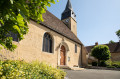
 7.30 mi
 +203 ft
 -213 ft
 3h 30
3h 30
 Moderate
 Departure from Thorigné-sur-Dué (Sarthe)
A few archaeological finds attest to human presence in Thorigné as far back as the Neolithic period. In Gallo-Roman times, a large agricultural estate (villa) is thought to have been the origin of a permanent settlement, which is better documented from the Middle Ages onwards. Despite the destruction of its medieval castle, which was replaced by a bourgeois house in the19th century, Thorigné stands out as a fairly large village offering a wide variety of civil architecture, spread out along the main axis linking the Dué valley to the church. Probably of Romanesque origin, the church was enlarged in the16th century and remodelled inthe 18th century . It houses interesting stained-glass windows and furnishings, such as the high altarpiece dating from 1669 and the18th-century side altarpieces.
Around Duneau
 Visorando Member2.42 mi
+138 ft
-138 ft
1h 15
Visorando Member2.42 mi
+138 ft
-138 ft
1h 15
 Easy
Departure from Duneau (Sarthe)
Easy
Departure from Duneau (Sarthe)
The village of Duneau is located in a dominant position on the left bank of the Huisne, on a route that has been highly sought-after since prehistoric times. The Pierre Fiche menhir and the Pierre Couverte dolmen, dating from the Neolithic period (around 4000 BC), bear witness to this. These are the only visible archaeological remains among many others covering the periods of Antiquity and the Middle Ages.
An unusual walk in Dollon
 14.36 mi
+715 ft
-689 ft
7h 15
14.36 mi
+715 ft
-689 ft
7h 15
 Difficult
Departure from Dollon (Sarthe)
Difficult
Departure from Dollon (Sarthe)
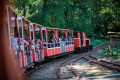
This route will allow you to discover the villages of Lavaré, Dollon and Semur-en-Vallon. These villages developed in the Middle Ages on land that was often sandy or stony, not particularly suitable for farming before modernisation. The villagers therefore found additional sources of income through textile crafts and the extraction of building materials. Situated away from major transport routes, these villages have retained their vitality despite the rural exodus that affected them following the decline of rural industries and traditional activities. Furthermore, these villages have managed to maintain a vibrant community life, fostering the development of unique events and venues such as the tourist train in Semur-en-Vallon and the Museum of Mechanical Music in Dollon.
Bird trail from Nuillé-le-Jalais
 4.43 mi
+151 ft
-174 ft
2h 10
Easy
Departure from Nuillé-le-Jalais (Sarthe)
4.43 mi
+151 ft
-174 ft
2h 10
Easy
Departure from Nuillé-le-Jalais (Sarthe)
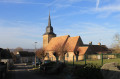
Nuillé-le-Jalais, first mentioned in the9th century , still has a small Romanesque church. Surprisingly, many of the local place-names refer to birds: La Pie qui Couette, La Grande Oiselerie and Le Chardonneret. The route’s signposting is a nod to this unique feature.
The Two Oaks of Luart Route
 4.15 mi
+69 ft
-69 ft
2h 00
Easy
Departure from Le Luart (Sarthe)
4.15 mi
+69 ft
-69 ft
2h 00
Easy
Departure from Le Luart (Sarthe)
This rural village had a population of just over 1,000 in themid-19th century before seeing its population gradually decline due to rural depopulation until 1962, when it fell to 643 inhabitants. The closure of many small farms gradually freed up the least productive agricultural land for building. Thanks to a proactive policy by the local council and the presence of a construction company in the village, Le Luart experienced considerable suburban development, leading to a spectacular rise in its population, which reached 1,445 inhabitants in 2012. Since then, the population has tended to stabilise.
The Beillé meadow
5.58 mi
+135 ft
-135 ft
2h 40
Easy
Departure from Beillé (Sarthe)
This walk follows the Huisne Valley and crosses the meadow where an American airfield was set up following the liberation of France in August 1944. A sign on site recounts the history of this temporary airfield.
The Pescheray Estate
 7.19 mi
+174 ft
-174 ft
3h 25
Moderate
Departure from Le Breil-sur-Mérize (Sarthe)
7.19 mi
+174 ft
-174 ft
3h 25
Moderate
Departure from Le Breil-sur-Mérize (Sarthe)
Le Breil and Nuillé are two villages of ancient origin. In the Middle Ages, Le Breil, or Breuil, was a seigneurial hunting ground. Nuillé, first mentioned in the9th century, still has a small Romanesque church.
The Maquis des Bois de la Croix in Connerré
 3.50 mi
+233 ft
-220 ft
1h 50
Easy
Departure from Connerré (Sarthe)
3.50 mi
+233 ft
-220 ft
1h 50
Easy
Departure from Connerré (Sarthe)
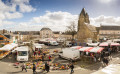
Situated in the Huisne valley, inhabited since prehistoric times, Connerré developed in the Middle Ages around a religious centre comprising the Church of Saint-Symphorien and a priory. The town, enclosed by a wall at the end of the 16th century, opened up at the end of the Ancien Régime thanks to the construction of bridges replacing fords and the expansion of transport links: the construction of the Paris–Nantes royal road around 1780, followed by the opening of a station on the Le Mans–Paris line in 1854. These developments fuelled the economic boom of the 19th century through fairs and markets and the growth of industry. The market town modernised and expanded gradually, then more rapidly from the 1970s onwards. Today, Connerré is an attractive small town, situated halfway between Le Mans and La Ferté-Bernard.
Lutin route
6.33 mi
+331 ft
-331 ft
3h 10
Moderate
Departure from Soulitré (Sarthe)
This route owes its name to the shape of its route, which evokes the silhouette of a leprechaun for dreamers. It offers a path between Jalais, a bocage plain on the Soulitré side, and the Huisne valley.
In the footsteps of Gohan in Bouloire
 10.05 mi
+486 ft
-509 ft
5h 05
Moderate
Departure from Bouloire (Sarthe)
10.05 mi
+486 ft
-509 ft
5h 05
Moderate
Departure from Bouloire (Sarthe)
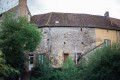
Bouloire is nestled in the heart of a vast, hilly agricultural region crossed by the Dué and Tortue rivers. Human presence along the ancient road between Le Mans and Orléans is attested to by a coin dating back to the Merovingian period. Its name comes either from a Celtic place name meaning "fortification" or from an etymology meaning "between two coasts ". The town centre is rich in ancient architectural heritage. The Church of Saint-Georges, destroyed by a fire that ravaged the village in 1680, bears the coat of arms of Marshal Guillaume Testu de Balincourt, who enabled its reconstruction. The town's coat of arms is also linked to this figure.
The angel musicians of Les Loges
 7.26 mi
+295 ft
-282 ft
3h 35
Moderate
Departure from Coudrecieux (Sarthe)
7.26 mi
+295 ft
-282 ft
3h 35
Moderate
Departure from Coudrecieux (Sarthe)
The present-day commune of Coudrecieux consists of the former parish of the same name, which was merged with that of Les Loges in 1808. Their place names reflect the wooded environment of these villages, which are still 50% forest today. Coudrecieux refers to the hazel wood known locally as ‘coudre’, and Les Loges to the light dwellings, made of branches and heather, temporarily occupied by charcoal burners and other forest workers. The Coudrecieux route will allow you to discover the rich architectural and landscape heritage of this commune. This is evidenced by the Manoir de la Cour, the Château des Loges, and the church of Les Loges (with its renowned stone bell tower dating from the year 1000)… These features are highlighted by information panels.
The starting point of the 24 Hours of Le Mans from Montfort-le-Gesnois
 5.15 mi
+230 ft
-230 ft
2h 35
Easy
Departure from Montfort-le-Gesnois (Sarthe)
5.15 mi
+230 ft
-230 ft
2h 35
Easy
Departure from Montfort-le-Gesnois (Sarthe)
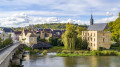
The present-day commune, formed by the merger of two former major market towns, stretches out parallel to the Huisne valley across uneven terrain. The old Pont de Gennes is at the lowest point (60 m), whilst the highest point (100 m) is at Montfort-le-Rotrou. The former is a crossroads village situated at the mouth of an old crossing point over the Huisne. The latter, situated on a strategic defensive site, is a linear settlement built under the protection of the castle. The two were joined by a gradual urban expansion in the 19th century. The walk takes you past the starting point of the first major motor race organised by the Automobile Club de France (ACF) in 1906, the forerunner of the 24 Hours of Le Mans.
The Chéronne stream
8.57 mi
+531 ft
-528 ft
4h 25
Moderate
Departure from Tuffé (Sarthe)
The route through the countryside around Tuffé takes us to the Château de Chéronne and the church of Saint-Denis-des-Coudrais. The Chéronne, which feeds the Tuffé lake, crosses and recrosses the sunken paths several times.
This route is best enjoyed in good weather as the dirt tracks can be quite wet.
Tuffé Abbey Circular Walk
 7.09 mi
+167 ft
-157 ft
3h 25
Moderate
Departure from Tuffé (Sarthe)
7.09 mi
+167 ft
-157 ft
3h 25
Moderate
Departure from Tuffé (Sarthe)
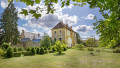
Tuffé-Val-de-la-Chéronne is a new commune formed in 2016 from the merger of the communes of Tuffé and Saint-Hilaire-le-Lierru. Inhabited since the Neolithic period, as evidenced by the Grandes Brières dolmen, Tuffé began to develop in the Early Middle Ages with the founding of an abbey around 650. From the Middle Ages to the Revolution, the monastery of Tuffé was also a large seigneurial estate bearing the title of barony; its power sparked emulation and, at times, rivalry with the neighbouring lay lords of Chéronne. At the end of the 19th century, the railway gave the village a new lease of life; it encouraged the establishment of an industrial estate on which the town’s current economic vitality still partly rests.
The Sourice Valley
 6.31 mi
+203 ft
-190 ft
3h 05
Moderate
Departure from Surfonds (Sarthe)
6.31 mi
+203 ft
-190 ft
3h 05
Moderate
Departure from Surfonds (Sarthe)
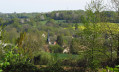
The parish underwent a re-demarcation in 1836: certain farms such as La Bardouillère and houses in the village were part of Volnay. Since then, the south-eastern boundary has been formed by the Ruisseau la Sourice. Under the Ancien Régime, the parish seigneury was annexed to the Château du Coudray, which you will see to the right of the hill as you head towards La Bardouillère. The village still has traditional houses near the church; it has gradually expanded towards the crossing point over the Sourice, where the roads from Surfonds to Bouloire and from Le Breil to Volnay used to meet, later transformed inthe 19th century into the main road from Tuffé to Le Grand-Lucé.
In the footsteps of the Crusaders, starting from Lombron
13.61 mi
+515 ft
-509 ft
6h 40
Difficult
Departure from Lombron (Sarthe)
Although local tradition places the first village at Bresteau, the Church of Saint-Martin, rebuilt by the monks of Saint-Vincent in the early 12th century, provides clear evidence of the antiquity of the village of Lombron. This beautiful church, open during the day, is well worth a visit both for the quality of its architecture (Romanesque choir and lantern tower, nave and chapels remodelled in the 14th and 15th centuries on their original foundations) and for its furnishings (16th-century statues including the Crucified Christ, the seigneurial bench of the Montmorency family, lords of Bresteau, terracotta bas-reliefs by Lebrun, circa 1760, 18th-century nave pews, etc.).
The Vow of Saint-Quentin
 5.43 mi
+266 ft
-269 ft
2h 45
Easy
Departure from Saint-Maixent (Sarthe)
5.43 mi
+266 ft
-269 ft
2h 45
Easy
Departure from Saint-Maixent (Sarthe)
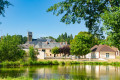
Bordering the Huisne valley to the west and the Vibraye forest to the east, Saint-Maixent is first mentioned in the13th century. Although the settlement is largely scattered (27 farms and 59 cottages in 1841), there are large hamlets such as Les Blousières, whose houses, clustered around a now-vanished pond, once housed up to 40 people, likely hemp workers. The village, crossed by the medieval road known as the “Chemin aux Bœufs” leading to Paris via Châteaudun, grew considerably in the 19th century thanks to the trade generated by this route.
The Trognes Route in Boëssé-le-Sec
 7.82 mi
+495 ft
-492 ft
4h 00
Moderate
Departure from Boëssé-le-Sec (Sarthe)
7.82 mi
+495 ft
-492 ft
4h 00
Moderate
Departure from Boëssé-le-Sec (Sarthe)
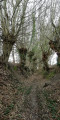
This route through valleys and bocage will allow you to explore the countryside around Boëssé le Sec. You’ll discover a beautiful avenue of pollarded trees.
The bellowing of the stag in Villaines-la-Gosnais
 2.53 mi
+190 ft
-164 ft
1h 20
Easy
Departure from Villaines-la-Gonais (Sarthe)
2.53 mi
+190 ft
-164 ft
1h 20
Easy
Departure from Villaines-la-Gonais (Sarthe)
The village of Villaines, situated near the ancient Le Mans–Chartres road, developed in the Middle Ages around the church, on the hillside. You will appreciate its rural charm and the well-preserved architecture of the village houses and the old farmhouses scattered across the countryside. Their materials – terracotta for the tiles and bricks, limestone rubble and lime plaster coloured with local sand – blend beautifully with this scenic setting, offering fine views over the Huisne valley.
The Saint-Célerin circulars
 11.94 mi
+305 ft
-292 ft
5h 45
Moderate
Departure from Saint-Célerin (Sarthe)
11.94 mi
+305 ft
-292 ft
5h 45
Moderate
Departure from Saint-Célerin (Sarthe)
The earliest evidence of human settlement in Saint-Célerin is linked to the discovery of ancient coins, including a Gallic stater (1st or2nd century BC) and a Carolingian hoard dating from around 833, the year the locality of Caliniaco (known in French as Chahanay) was first mentioned.