Country:
 City:
City:


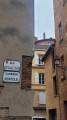
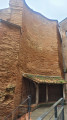
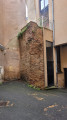
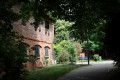
The starting point is at 7 Place du Parlement. (Very close to the Palais de Justice metro and tram stations)
(S) You will find yourself in front of the Seilhan house (blue gate), which was home to Dominique de Guzman (Saint Dominique) and the Dominican Order he founded in 1215. The remains of the Roman rampart are on the left of the gate and consist of part of the surrounding wall which, at this point, joined the banks of the Garonne and against which the Seilhan house was built. Head towards Place Saint Pierre.
- If you wish to visit the Baccrabère Museum, head towards Rue de la Fonderie, turning right when you reach the gate. At number 12, you will pass the façade of the beautiful Chalvert mansion, built in the early17th century in the late Renaissance style. On your right, you can admire a pretty half-timbered façade that has been recently restored.
Take Rue de la Fonderie, where the National Cannon Foundry was established in 1793, and head to number 31. The length of your visit to the Baccrabère Museum will of course depend on your interest and the time you have available. However, you should allow around 30 to 45 minutes. After your visit, return to the Place du Salin and the Place du Parlement where you started, and continue with the tour.
If you would like to explore the remains of the 1st-century ramparts, cross Allée Gisèle Halimi and take the road that runs alongside the courthouse to reach Rue des Fleurs in front of you. On your left, you will see the statue of Jacques Cujas, a great jurist and humanist ofthe 16thcentury, and beyond Allée Gisèle Halimi, the façade of the Protestant temple of Le Salin, a former royal treasury dating from the 13th century. You will then pass the gate of the Assize Court on Rue des Fleurs and, on your right, at number 16, the house of François Garipuy, an 18th-century astronomer who set up one of the first astronomical observatories here. Continue to the Church of the Gesu.
(1) Go around it by turning left and then right and join Rue Furgole. After about 20 metres, you will arrive at Place des Hauts Murats. Take the small passageway that runs along the east side of the Church of the Gesu. You will then see thesecond remnant of the rampart, consisting of part of the base of a tower and a mark on the ground symbolising its footprint. On your left, you will also see part of the surrounding wall. And beyond a section of wall next to the car park, behind the foliage of a tree, you can see the roof of asecond tower. This Roman tower, which was later medieval, has obviously been renovated several times. This tower, called the Tour des Hauts Murats, is thethird remnant of the Roman rampart on our walk.
Take Rue Furgole again and head right towards Rue Ozenne. As you pass by, at number 9 Rue Furgole, notice a pretty mullioned window that has been recently restored. Cross Rue Ozenne and join Rue Escoussières Montgaillard. In the Middle Ages, escoussières were paths that ran along the ramparts of medieval towns, inside the walls, to allow armed men to access the ramparts. In Toulouse, there is also Rue Escoussières Arnaud Bernard, which served the same purpose.
(2) When you reach 8 Rue Escoussières Montgaillard, look up at the roof of the mansion at No. 10 and you will see the roof of the Tour de Rességuier. This tower was rebuilt in the Middle Ages on the foundations of the original Roman tower. It can also be seen from the Jardin Royal, a public garden located on the other side of the houses. You can also see it from a different angle when you arrive at the crossroads of Rue Vélane, Rue Montoulieu Vélane and Rue de la Trihle. To do this, when you reach the crossroads of Rue Escoussières and Rue Vélane, take a few steps to your left and turn around, looking up at the rooftops.
(3) Back on Rue Escoussières, turn left towards Place Montoulieu. Cross the square on the left and join Rue Montoulieu Saint Jacques. The street will take you past the Palais Niel, headquarters of the 11th Parachute Brigade, on your right. When you reach Place Saint-Jacques, turn left. You will pass the Administrative Court of Appeal, housed in the former Hôtel de Lestang (16th century). Cross the square, keeping slightly to your right towards Rue Bida. You will then come to the most complete and representative remains (the fifth on our walk) of the Roman rampart. It consists of part of the base of a Roman tower and part of the base of the curtain wall. It offers a view of the beautiful architecture of this structure, which consists of a lower section of white limestone rubble topped by three layers of bricks, which are also topped by six layers of white rubble. It should be noted that at that time, this Roman rampart did not have a defensive function but was a prestigious rampart intended to magnify the Roman city during the reign of Emperor Augustus (considered to be the founder of Tolosa) inthe 1st century AD.
Head towards Rue Bida. Stop at number 5. Look above the façade with a coat of arms and you will see a beige wall on the third floor of the next house. This is the only part of the remains of a Roman and medieval tower visible from the public space, the remains of which were discovered during the construction of the houses. This is oursixth place of interest.
Take Rue Bida and follow Allées Forain François Verdier. As you cross Rue Bertrand de l'Isle, you will see Saint-Étienne Cathedral on your left, which was located in the Middle Ages just at the foot of the ramparts. You will reach the start of Rue de Metz on your left. Take this street and, after about 50 metres, turn right into Rue du Rempart Saint-Etienne. At the end of this street, pass the Saint Georges shopping centre and turn left into Rue Fonvielle.
(4) When you reach number 26, turn right into Rue Pierre Baudis to reach the entrance to the TNT (which is only open from 2pm to 7pm Tuesday to Saturday). Enter and head towards the balustrade overlooking the restaurant area, which is open to visitors. You will then see part of the base of the Roman rampart on the floor below, which was preserved when the theatre was built. This is theseventh trace of our rampart.
(5) Return to Rue Fonvielle and turn right towards Rue Saint-Antoine. Turn left and then twenty metres further on, turn right into Rue Montardy. Cross Rue Lapeyrouse and join Rue du Poids de l'Huile. Aneighth vestige can be found inside the Uniklo clothing store on the first basement level. Access is free and permitted. Part of the base of the rampart has been preserved and displayed behind protective glass. You will then arrive at Square Charles De Gaulle.
Cross the square diagonally to your right and head to the foot of the Donjon du Capitole, which houses the city's Tourist Office. Turn right onto the path that leads to the outdoor playground for children. You will see red marks on the ground beneath your feet. These are the footprints of the base of the tower known as Charlemagne and the surrounding walls. They were uncovered and then buried again after the square was renovated in 2013. (We will consider them as our ninth set of remains.)
Next, head to Place du Capitole by taking Rue Lafayette to the left. Go to the centre of the square, where you will find the Occitan Cross, installed by the artist Moretti in 1995. You are now at the site of the northern gate of the Roman ramparts, known as the Porterie. The remains of this gate were discovered in 1971 during excavation work for the construction of an underground car park. They were studied by the archaeological services before being completely destroyed.
You are now at the northernmost point of the Roman town. Head to the north-west corner of Place du Capitole towards the Hôtel du Grand Balcon, which you will see to the right of the galleries and terraces. Take Rue Romiguières on the left of the Hôtel du Grand Balcon. This street continues as Rue Pargaminières until it reaches the banks of the Garonne. The Roman rampart actually runs parallel to these two streets and is located on your left, where the houses now stand. You will arrive at Place Saint Pierre.
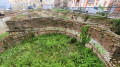
In front of you, on the left bank of the Garonne, you can see the dome of the Hôpital de la Grave. Staying on the pavement, turn left and walk past the Bar Basque and the Saint des Seins. You will then see, to the left of the archway pillar, at number 4, a remnant of the city wall that once ran along the banks of the Garonne. You will find this wall again on your left as you enter the archway. If you continue along this space, which is at the exit of the underground car parks, you will see the continuation of the surrounding wall on your left, as well as a rounded section that is part of the base of a tower. (Please note that the base of this tower is visible from the inside but is not accessible as it is part of a private area. Photographs of this tower can be found on certain websites.) We were at the site ofthe 10th and last remnant still visible today (E).
This concludes our walk in the footsteps of Tolosa's Gallo-Roman past. To return, the nearest metro station is Place du Capitole. Take Rue Pargaminières and Rue Romiguières in the opposite direction to how you came.

 Visorando Member
 Moderate
  Association / Club / Walk leader