

 Country:
 City:


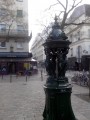
Starting point and access: Rue de Belleville at Porte des Lilas.
- Metro – Lines 3bis and 11, Porte des Lilas station, Exit 3 onto Rue de Belleville. At the top of the metro exit, turn left at the corner of a café-restaurant.
- Tram – Line T3b, Porte des Lilas station. Cross Boulevard Mortier towards the inner city of Paris (west), turn right towards the junction; Rue de Belleville is the second street on the left.
References to the life of Georges Brassens or his songs, as well as the main heritage features to look out for, are indicated in italics within the description.
*Porte des Lilas* is the title of a 1957 film by René Clair, in which Georges Brassens plays the role of a singer and guitarist, and for which he composed *Les lilas*.
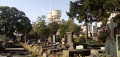
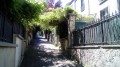
(S) Follow Rue de Belleville west-south-west. Cross Rue Haxo, then walk gently uphill alongside the wall of Belleville Cemetery on your left. At the traffic lights, turn left into Rue du Télégraphe (so named in reference to the Chappe telegraph that was installed there at No. 40). Walk past the cemetery entrance and, before the two water towers, turn right into the Passage du Télégraphe (a cobbled lane signposted as private but open to pedestrians). At the end, turn left into Rue Pelleport.
(1) At the junction, take the second right onto Rue de la Duée. At number 37, turn left into Villa Georgina. At the end, turn right onto Rue Taclet. Walk past a school and turn right as the street bends. Rejoin Rue de la Duée and follow it to the left. Just past No. 27, turn left into Passage des Saint-Simoniens. Turn right along this alleyway, passing a square on your left and a flowerbed (in season) on your right. At the end, turn left and then immediately right into Rue de Ménilmontant.
(2) At the traffic lights, cross Rue des Pyrénées and follow it to the right, staying on the left-hand pavement. Shortly after No. 313, turn left twice in succession to enter Villa de l’Ermitage (red and yellow marker), leaving Cité Leroy on your right (both these lanes are very narrow). Turn right into the alleyway. At the end, turn right into Rue de l’Ermitage (ignore the red and yellow arrow pointing left).
At the corner of No. 47bis, head down to the left along Rue Fernand Raynaud (stairs, street lamps). Turn right into Rue des Cascades. After a few metres, at the corner by the Saint-Martin manhole (a small stone building), turn left into Rue de Savies (downhill). At the three-way junction that follows, turn left into Rue de la Mare and you’ll come to a crossroads.
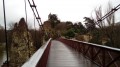
(3) Continue straight on along Rue de la Mare. At the end, take the footbridge over the old Petite Ceinture railway line. Then turn left and walk past the chancel of the Church of Notre Dame de la Coix.
(4) Cross Rue de Ménilmontant. Continue straight ahead along Rue des Amandiers and note, on the left-hand side, an almond tree at the junction with Rue des Plâtrières (the song ‘L’amandier’ was released in 1957). Then turn right into Rue des Panoyaux.
(5) After crossing Rue Duris, which joins from the left, and at the corner of No. 37, turn right into the Cité du Labyrinthe (a cul-de-sac for cars). First turn left then right into the alleyway and, a little further on, pass under a porch to rejoin Rue de Ménilmontant. In the posthumous album (1983) *Georges Brassens chante Bruant, Colpi, Musset, Nadaud, Norge*, the first track is *Belleville-Ménilmontant* (lyrics and music by Aristide Bruant).
Then turn left and stay on the left-hand pavement. Cross Boulevard de Belleville in two stages, passing through Place Jean Ferrat in the middle. In 1963, the singer Jean Ferrat (1930–2010) wrote and composed a song called *À Brassens*. Note the presence of a Wallace fountain: in *Le Bistro*, Brassens envisages “drinking his fill from all the Wallace fountains”.
Continue along Rue Oberkampf. Note the several entrances to ‘cités’ (housing estates) or courtyards of former workshops. At No. 116 is the restaurant “L’Estaminet”, where, in the late 1940s, Brassens accompanied Edith Piaf on the guitar (there’s no sign of this outside, but the restaurant’s website states it). When you reach No. 94, turn right into Rue Saint-Maur (newsagent’s).
(6) At the next junction, turn left into Rue Jean-Pierre Timbaud. Cross Avenue Parmentier, then Rue de Nemours, and walk along Place de la Fontaine Taimbeau (on the Rue de Nemours side, there is a small sculpture of the Virgin and Child on the façade of a restaurant).
Continue along Rue Jean-Pierre Timbaud and cross, in turn, Avenue de la République, Rue de la Folie-Méricourt, Boulevard Richard-Lenoir (in two stages), Rue du Grand Prieuré and Boulevard Voltaire (on the right, a view of the Monument to the Republic). In *Ceux qui ne pensent pas comme nous* (published posthumously), Brassens quotes Voltaire on the subject of freedom of expression.
(7) At the next junction, turn right onto Rue Amelot. At No. 145 is the Anarchist Federation’s bookshop and the headquarters of *Le Monde libertaire*. In the second half of the 1940s, Georges Brassens wrote regularly for *Le Libertaire*, the federation’s newspaper, and also worked there as a proofreader.
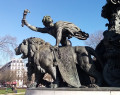
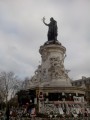
Cross the Passage du Jeu de Boules on the right-hand side (see the song ‘Une partie de pétanque’) and head towards Boulevard Voltaire. Follow the boulevard to the left, staying on the left-hand pavement. At the end, use the pedestrian crossing to cross the circular boulevard at Place de la République and reach the central esplanade. Walk to the foot of the Monument to the Republic (a sculpture by Léopold Morice, dating from 1883).
(8) Then turn right and head down Rue du Faubourg du Temple, which begins between two imposing buildings (a metro entrance on the left-hand pavement; at No. 18, the entrance to the former Cirque Astley). Cross Rue Yves Toudic and emerge at the junction between Quai de Valmy (on the left) and Boulevard Jules Ferry (on the right).
(9) Cross the quai, turn left and immediately enter Square Frédérick Le Maître, walking alongside the canal on your right. Leave the square at the far end on the left and pass a footbridge over the canal on your right. Further on, pass the swing bridge on Rue Dieu on your right (sign). Continue along Quai de Valmy and ignore another footbridge near Rue Beaurepaire.
At the next junction (Rue de Lancry coming from the left; lock on the canal), turn right, either onto the Grange aux Belles swing bridge or the footbridge running parallel to it (the route on the map follows the footbridge).
(10) Turn immediately left onto Quai de Jemmapes, passing the famous “Hôtel du Nord” at No. 102 (the hotel that inspired a novel adapted for the cinema by Marcel Carné in 1938, in which Arletty’s famous line “Atmosphere? Atmosphere? Do I look like ‘atmosphere’ to you?’”). Ignore the next footbridge at Rue Bichat. Then keep as close as possible to the canal, now on your left.
(11) At the next bridge (locks, ‘VHF20’ sign by the canal), cross the quay to the right and then turn left onto Rue des Ecluses Saint-Martin (the map is rather imprecise at this point). Continue for a few metres along the quay and, at the corner of No. 148, turn right onto Rue Georg Friedrich Haendel. Walk under some arbour-like structures, with sports grounds below on the right.
When you reach a small square (Place Robert Desnos on the map), turn immediately left into Rue Francis Jammes (named after the poet – 1868–1938 – who wrote the lyrics to *La prière*, sung by Brassens in 1954). First turn right then left and ignore a lane on the right. When you see an exit archway ahead of you, turn left to pass in front of the entrance to a nursery, then go under another archway. Then turn left into Rue Louis Blanc, cross the Quai de Jemmapes and cross the Canal Saint-Martin.
(12) Turn left onto Quai de Valmy and follow the canal again (on your left). At the next bridge, leave the canal and turn right onto Rue Eugène Varlin. Take the first left, Rue Robert Blache, at the corner of a brasserie.
At the end, turn right into Rue du Terrage, then immediately left (under the “Villien” archway) onto Avenue de Verdun (see the songs *La guerre de 14-18* and *Les deux oncles*). Pass a small square and continue along the avenue under the plane trees. At the end, veer right to cross Rue du Faubourg Saint-Martin. First turn right then left, following the sign for “P1 Alsace”, and you’ll arrive alongside the entrance courtyard of Gare de l’Est (E).
It was from here that, in March 1943, Georges Brassens set off for Germany, to the Berlin area, as part of the Compulsory Labour Service (STO). Having been granted leave in March 1944, he remained in Paris, where he went into hiding until the end of the war. On the station’s façade are statues representing the cities of Verdun (east wing) and Strasbourg (west wing).
To get back home:
- Metro – Lines 4, 5 and 7.
- Transilien – Line P.



 ), I really enjoyed designing this itinerary, creating it and then describing it. I'm delighted to read that you enjoyed these walks, beyond the references to my friend Georges!
 Visorando Member
 Moderate