Castle Trail: from Guebwiller to Orschwihr

A themed walk exploring the castles around Guebwiller.

Details

44634225
Creation:
Last update:
Last review:
  • Walking
    Activity: Walking
  • ↔
    Distance: 16.97 km
  • ◔
    Average duration: 5h 55 
  • ▲
    Difficulty: Moderate

  • ⚐
    Back to start: Yes
  • ↗
    Ascent: + 370 m
  • ↘
    Descent: - 369 m

  • ▲
    Highest point: 554 m
  • ▼
    Lowest point: 238 m

Description of the walk

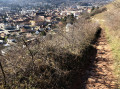
(S/E) Starting from the car park on Avenue Foch and the old station, cross the Lauch and the D430 at the traffic lights. Head uphill and turn right onto the Chemin du Kitterlé (the name given to a grand cru in the area), marked with a Yellow Disc. Take a hairpin bend to the left, then another to the right. Continue straight on, climbing until you reach the edge of the woods. Turn right towards the cross. After a steep climb through the vineyards, you’ll reach the Croix de la Mission.

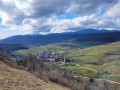
(1) Panoramic view of the Alsace plain, the Grand Ballon, the Black Forest and the Bernese Alps. Take the path behind the cross, then turn left to rejoin the Yellow Disc-marked trail, which you follow to Unterlinger. Walk along the vineyard at the edge of the forest to reach the Lions Club shelter and the Schlumberger Estate’s Open-Air Vineyard Museum. Then climb the upper path, keeping to the right until the next junction.

(2) Turn left then straight on uphill to reach the top of the vineyards. A zigzagging path marked with a Yellow Disc leads to the Oberlinger.

(3) At the top of the climb, turn left then keep to the right to reach the Oberlinger site.

(4) Retrace your steps to the junction of the three paths at the end of the climb.

(3) Turn left, following the Yellow Disc markings. Keep to the right, then right again onto the Red Ring marked path. Follow it to the left towards the Bergholtz Quarries.

(5) At the exit of the quarry, continue straight on to join the path marked with a Red Ring. Pass a descending path and then another ascending one to reach a wider path. Continue straight on and descend to the next bend

(6) Turn left onto the Green Ring-marked path leading to the Orschwihr Quarries and Stettenberg Castle. Continue along the descending path, then turn left to follow the Green Ring markings. Do the same at the next fork to reach a star-shaped junction. Descend, then turn left towards the castle. Approach it from the right.

(7) From the ruins, head down towards the Quirenbach valley (named after the stream flowing from the Val du Pâtre). First turn right then left on the road to rejoin a path marked with the Green Ring. Ignore a path on the right and follow a track, which turns into a street (Rue du Vignoble). Turn right at the end of the road, passing the Saint-Wolfgang Chapel (1850). Continue straight on along the Route de Soultzmatt, then, at the bend, keep left to reach Orschwihr Castle.

(8) Keep going straight. At the next fork, turn right and then right again, following the signs marked ‘Red Diamond’. Turn left onto Rue du Printemps. At the end, turn right then immediately left onto Rue des Jardiniers to reach Bergholtz-Zell and its church. From the church, take a small path between the houses, following the Red Diamond signs. Continue along Rue des Suisses to the Oelberg.

(9) Still following the Red Diamond signs, continue straight on along the road. Pass three tracks on the left, then continue straight on at the crossroads and reach the village of Bergholtz via Etgen.

(10) Head down to the left. Continue straight on until you reach the fountain. Turn left onto Rue Neuve. At the bend, continue along the track until you reach the cross. Turn right to reach a fork at the old motte-and-bailey castle.

(11) Head back up towards the village centre, passing in front of the church. Go straight on at the crossroads after the church, then ignore a path. Immediately after, at the wayside shrine, keep to the right, then take the next two turns straight ahead, staying on the track until the next road at elevation 268.

(12) Turn left, then at the junction, turn left and immediately right. Afterwards, continue to the right and stay on the path going uphill straight ahead to rejoin the Red Diamond-marked track. Turn left. Continue straight ahead on the path that leads back to the car park (S/E).


Waypoints

  1. S/E : km 0 - alt. 287 m - Ancienne gare ferroviaire de Guebwiller
  2. 1 : km 1.12 - alt. 381 m - Croix de Mission (Guebwiller)
  3. 2 : km 1.62 - alt. 426 m - Crossroads
  4. 3 : km 2.1 - alt. 525 m - Return trip to the - Ruines de l'Oberlinger
  5. 4 : km 2.9 - alt. 535 m - Ruines de l'Oberlinger
  6. 5 : km 5.21 - alt. 518 m - Carrière de Bergholtz
  7. 6 : km 6.03 - alt. 482 m - Turn
  8. 7 : km 8.56 - alt. 333 m - Château du Stettenberg
  9. 8 : km 9.85 - alt. 257 m - Château urbain d'Orschwihr
  10. 9 : km 11.01 - alt. 269 m - Mont Calvaire de l'Oelberg
  11. 10 : km 11.82 - alt. 298 m - Etgen
  12. 11 : km 13.19 - alt. 239 m - Castle mound
  13. 12 : km 14.23 - alt. 268 m - Elevation 268
  14. S/E : km 16.97 - alt. 287 m - Ancienne gare ferroviaire de Guebwiller

Worth a visit

Ruins of the Unterlinger:
The fortified site of the Unterlinger, situated nearby and in line with the Mission Cross of 1827, is characterised by the presence of four ditches and several embankments.
This may have been a refuge already in use during prehistoric times and the Roman period. Some historians believe the site was occupied until the Thirty Years’ War. Only scientific excavations could possibly confirm whether this promontory was used for military purposes during the Middle Ages or even earlier periods.

Ruins of the Oberlinger:
Situated at an altitude of 524 m, the Oberlinger, or Kastelberg, with its triangular layout, forms the tip of the Schimberg. This unnamed castle has long been regarded as a Roman castellum.
Experts believe it was a castle abandoned at a very early stage. The archaeologist Jean-Michel Rudrauf, comparing the layout of the Oberlinger (a keep at the centre of the defensive phase and backed by a curtain wall serving as a shield) with other castle sites in Alsace, believes that this fortified castle may have been built in the middle or towards the end ofthe 12th century. The fortress could have belonged to a vassal or a minister of the Abbots of Murbach.
It cannot be ruled out that this is the eponymous castle of the d'Hungerstein family, who served Murbach. Planned excavations could shed more light on the site, where the moat and the location of the keep are still easily identifiable.

Bergholtz Quarry:
This quarry has been in operation since before the16th century. It is currently around 600 metres long and up to 30 metres high. From 1760 to 1770, it was operated by the Murbach chapter for the construction of the Church of Our Lady in Guebwiller, before becoming municipal property in 1790. The last lease for the quarry was signed in 1910. Around fifteen people were still working on the site. The sandstone extracted from this quarry was used to build houses, the church in Bergholtz, paving, fountains and the fortified town of Neuf-Brisach, designed by Vauban.

Stettenberg Castle:
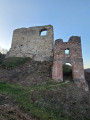
Stettenberg Castle stands at an altitude of 313 metres. Only the remains of the keep are still visible. The opening providing access to the interior of the tower was cut in the18th or19th century at the base of the western face. The interior space measures approximately 3.60 metres on each side. It may have been a residential tower. Traces of the curtain wall of the Hauptburg (the main part of the castle) are visible 4 metres north of the keep. A residential building associated with the tower was likely situated to the south.
The castle appears to have been built around 1200. The name Stettenberg first appears in the13th century thanks to Heinrich of Stettenberg, a canon of Lautenbach. The castle belonged successively to a branch of the Münch family, known as the Stettenbergs, and, around 1333, to the Schœnau family. The mercenaries of Enguerrand de Coucy (known as the ‘English’) destroyed the castle in 1375. The Schœnau family did not rebuild the ruins and ceded them in 1444 to the Antonine monastery of Issenheim.
A dedicated association for the preservation and promotion of the site was established in 2004. The site was stabilised in 2005 on the initiative of the municipality of Orschwihr and with the support of the Haut-Rhin General Council.

Orschwihr Castle:
Located in the heart of the village of Orschwihr, in the immediate vicinity of the parish church of Saint-Nicolas, the town castle has been part of a family-run wine estate since the19th century. According to archaeological excavations carried out in 1974, it appears that the site was occupied inthe 12th century by a motte-and-bailey castle (a mound, probably artificial, with a tower), which was succeeded between 1250 and 1275 by the original part of the present castle. It is not known who the builders were (the names of Alswiller and Rathsamhausen have been suggested), but the castle is first mentioned only in 1334. It belonged to the Andlau family until 1514, the year it was sold to the Bishop of Strasbourg. The bishop ceded the castle to Jean de Rixheim in 1524. Around 1550, it belonged to the Truchsess von Rheinfelden, who converted it around 1580. The castle burned down in 1722 and was subsequently rebuilt by its owners. The winegrower’s cellars contain the remains of the original keep.

Bergholtz-zell Church:
It is dedicated to the Immaculate Conception, whilst the parish is named after Saint Benedict. Construction began in 1873, replacing a Romanesque church demolished around 1860. The latter had been consecrated in 1049 by Pope Leo IX, as evidenced by the columns salvaged and visible in the current sanctuary. The courtyard of the old church, which served as a cemetery, may have been surrounded by a wall ‘6 feet’ (1.80 m) high, whereas the walls of ordinary cemeteries were generally only ‘4 feet’ (1.20 m) high. The historian and castle expert Bernhard Metz believes it may have been a fortified cemetery.

Oelberg:
The Oelberg pilgrimage, a scenic Way of the Cross, was established on the initiative of the parish priest Joseph Doppler from 1872 (the year of the first station). Despite the construction of the new church, work continued and was completed in 1879. Further additions were made later. Sights: the altar and baptismal font of the old church, the Last Supper (after Leonardo da Vinci), the stations and calvaries.

Bergholtz motte:
The motte castrale, an artificial mound that once supported a tower (possibly built of cut stone), is also known as the Wachtturm, or watchtower. The site was in the hands of a family of officials in the service of Murbach Abbey. The castle was owned by the lords of Hungerstein, also in the service of Murbach, who built it. The date of the castle’s destruction is unknown, but the tower was still standing in 1792.

Reviews and comments

4.3 / 5
Based on 5 reviews

Reliability of the description
4.2 / 5
Ease of following the route
4.4 / 5
Route interest
4.2 / 5
User 26156321

Overall rating : 4 / 5

Date of your route : May 11, 2026
Reliability of the description : ★★★★☆ Good
Ease of following the route : ★★★★☆ Good
Route interest : ★★★★☆ Good
Very busy route : No

A lovely walk, but don’t expect to see any beautiful castles.

Machine-translated

binet68
binet68

Overall rating : 5 / 5

Date of your route : Oct 27, 2024
Reliability of the description : ★★★★★ Very good
Ease of following the route : ★★★★★ Very good
Route interest : ★★★★★ Very good
Very busy route : No

A lovely walk, some beautiful views, and a leisurely return through the vineyards – a great way to finish. No particular issues along the way, and passing through the villages was also nice.

Machine-translated

magory
magory

Overall rating : 3.7 / 5

Date of your route : Apr 14, 2024
Reliability of the description : ★★★☆☆ Average
Ease of following the route : ★★★★☆ Good
Route interest : ★★★★☆ Good
Very busy route : No

A pleasant and varied route with no difficulty.
However, the route description isn’t always very clear.
Thanks to the GPS

Machine-translated

Nature57
Nature57

Overall rating : 4.7 / 5

Date of your route : Mar 04, 2024
Reliability of the description : ★★★★★ Very good
Ease of following the route : ★★★★★ Very good
Route interest : ★★★★☆ Good
Very busy route : No

A lovely walk through the Guebwiller forest, passing through Orschwihr and Bergholtz, and finishing up through the vineyards.

Machine-translated

sylvie68
sylvie68

Overall rating : 4 / 5

Date of your route : Feb 27, 2024
Reliability of the description : ★★★★☆ Good
Ease of following the route : ★★★★☆ Good
Route interest : ★★★★☆ Good
Very busy route : No

I couldn’t find the Oberlinger ruins, but the Bergholtz quarries are absolutely stunning – a place that’s still unspoilt. Otherwise, it’s a very pleasant walk

Machine-translated

Other walks in the area

For more walks, use our search engine .

The GPS track and description are the property of this route's author. Please do not copy them without permission.