Country:
 City:
City:


Markings: Dark red on a white background
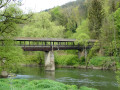
(S) Market Square: cross towards the north-east. Walk past the Denzelt and the Town Hall. At the north-eastern end of the square, turn left onto Porte Saint-Willibrord. Then turn right towards the basilica. Walk past the entrance to the basilica and continue across the courtyard. At the far end, turn right. At the end of the building, turn left and go through the covered entrance. Continue straight ahead and enter the municipal park. You’ll see the Pavillon on your left. Turn right. At the junction, keep to the right and walk alongside the mini-golf course. Leave the park and, a little further on, go under the Pont de la Sûre.
(1) Take thefirst path on the right. Walk past the skate park. Cross over a stream that flows into the Sûre. Carry on straight ahead. Leave the park, heading towards the riverbank. Cross the bridge over asecond stream. Carry on straight ahead. Follow the Sûre. Pass the sewage treatment works. The path leads back up towards the road.
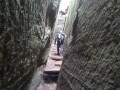
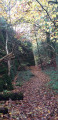
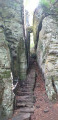
(2) At the steps on your right, where the safety railing is open, climb up, then cross the road carefully and head up the path opposite. Go up a flight of steps and walk between the rocks. Continue up asecond flight of steps. The path becomes a tarmac road.
(3) Ignore the path on your left and head right towards Steinheim. Follow the road for about 400 metres.
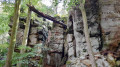
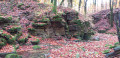
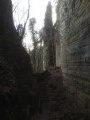
(4) At the end of the road, head up the path on your right. The path winds its way between rock formations. Cross the stream (dry in November). Follow the path, passing some stone steps. Walk alongside a rocky outcrop. Take some more steps and then pass Feitcheslay. Go down the steps on the left, then pass under a rock. More steps, and you’ll come to Rodersschluff. The path winds on. Climb some more steps, then pass Alkummer to finally reach the road. Turn right and go up the hill at the right-hand bend.
(5) After the bend, take the path on the left. A few metres further on, take the path on the left towards Rosport. Follow this path, which consists of tree roots, scree and steps, for about 1.4 km, keeping a general south-easterly direction.
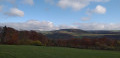
(6) At the T-junction, turn left. Leave the forest. View of the valley. Follow the open farm track. The track curves sharply to the left and becomes a tarmac road.
(7) At thefirst Y-junction, as you enter the forest, turn right towards Rosport. Head downhill. Cross the stream (dry in November). Take the steps. Continue along the path. Take another set of steps. Walk alongside a fence. Pass a viewpoint overlooking Rosport. Carry on and emerge from the woodland. The path becomes a road. Enter the town of Rosport. Go to the end of the street to the junction with Rue Giesenbour.
(8) Turn right. At the junction, carry straight on. At the next junction, turn right onto Rue du Cimetière. When you reach the cemetery car park, take the steps in front of you. At the top, continue along the edge of the street towards the church. When you reach the church, cross the road carefully. There is a fountain on the park’s boundary wall ( water not suitable for drinking). Take the path leading towards the Town Hall and the Tudor Museum. Follow it up to the junction and then turn left. Continue alongside the pond below on your left until you reach the next junction.
(9) At the junction, take the path on the right. Walk alongside a small canal below on your left. At the junction, turn right and head uphill to the road. Turn left and take the forest track on your left for about 1.3 km. Pass the entrance to a gypsum quarry. It is strictly forbidden to enter the tunnel; it serves as a roost for bats and, more importantly, poses a risk of collapse. On the left, further down, you will see walls that were built to transport the gypsum extracted from the underground tunnel via an inclined plane, using mine trolleys, to a loading point.
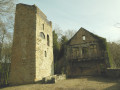
(10) At the Fork in the road (not shown on the map), keep to your right. Leave the forest. There is a view of the valley and the chapel below, along the road. At the road, turn right. Ignore the road branching off to the left and walk past a replica of the Grotto of Lourdes. Further up, the road bends to the left; you’ll pass a fountain with non-potable water. On your left, some steps lead up to the 14th-century Girsterklaus Chapel, built of stone rather than the painted render typically found in Luxembourg. After a round trip to the chapel, continue along the road for about 100 metres until you leave the hamlet.
(11) Take the dirt track on your left. At the road, note a fountain and a memorial stone on your right; cross carefully and take the path opposite. Go down the wooden-step staircase. At the crossroads, carry on straight ahead, go down the stone steps and follow the path as it approaches a stream.
(12) Look out for the stone steps on your right leading down to the stream; take them. Wade across the stream and climb back up on the other side via the wooden and stone steps. At the road, cross carefully and head straight on along the path opposite. This path overlooks the road.
(13) Go down the stairs and turn immediately right. Keep to your right as you enter the meadow. Follow the path. Take the stairs as they go up and down. Wade across the stream three times in a row and then climb the stone steps.
(14) After the last few steps, turn left – do not go straight on under any circumstances. The path zigzags. Climb a few more steps. Once back on a wide forest track, continue to the left.
(15) At the junction, turn right and, about 1.2 km further on, at the road, turn left. After the bend, at the pylon, leave the road to the right. Follow the path through open countryside. At the end of the path, turn left onto a tarmac road. After the bend, continue downhill to the crossroads.
(16) You have two options:
- if you wish to stay at the Born campsite, head straight on towards the village centre,
- otherwise, follow the route shown on the map and turn right onto the track. At the gate in the meadow, turn left. The track becomes a path. Follow the fence; the path then turns right and continues across open ground. Enter the woodland.
(17) At the crossroads, ignore the path on the left and, a few metres further on, turn right uphill. The path winds its way up; climb a few steps and join a forest track, which you follow to the left.
(18) At the junction, ignore the signposted path heading to the right and carry straight on.
No signposting
A few dozen metres further on, ignore thefirst path leading off to your left in a hairpin bend and take thesecond path on the left. The path narrows to a track. Further down, ignore the hairpin bend path to your left (not shown on the map). Carry on straight ahead. At the crossroads, before the viewpoint shelter, turn left and head down to the road, then turn right.
(19) At the T-junction, continue to the right and, at the junction with the CR135, turn left, passing in front of the church entrance; at the next junction, turn right to return to the cemetery car park (E).

 Visorando Member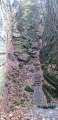
 Difficult