


Refine your search for walks in Parigné-l'Évêque
Parigné-l'Évêque walks


 Loudon Ponds and Wood
 Visorando Member
 2.56 mi
 +177 ft
 -171 ft
 1h 20
1h 20
 Easy
Easy
 Departure from Parigné-l'Évêque (Sarthe)
This circular walk allows you to discover a site not far from Le Mans that is rich in natural beauty. Ponds, peat bogs, wet and dry heathland, and marshy woods... all form a mosaic of landscapes that are home to species rare in the region: harriers, hobby falcons, goshawks, purple herons (among the birds); and royal ferns, marsh marigolds and sundews (among the plants).
Discovering the woods and ponds of Loudon
 4.85 mi
+36 ft
-36 ft
2h 15
Easy
Departure from Saint-Mars-la-Brière (Sarthe)
4.85 mi
+36 ft
-36 ft
2h 15
Easy
Departure from Saint-Mars-la-Brière (Sarthe)
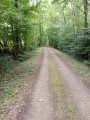
Parigné-Lévêque is a very large and heavily wooded commune: northern pines with sand dunes, and southern chestnut and birch trees. The route allows you to discover the charm of numerous woodlands, vast moors and ponds. The Loudon Stream is crossed in several places.
On the edge of the woods from Volnay
 Tourism professional
 13.34 mi
+502 ft
-492 ft
6h 35
13.34 mi
+502 ft
-492 ft
6h 35
 Difficult
Departure from Volnay (Sarthe) (Sarthe)
Difficult
Departure from Volnay (Sarthe) (Sarthe)
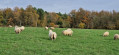
The name Val-de-la-Hune, adopted at the time of the merger, refers to the location of the two villages situated in the valley at the confluence of the Ruisseau de l’Arche and the Hune. The area has been inhabited since ancient times, as evidenced by the dolmen on the border with Tresson, dating from the Neolithic period, and the ancient road, the Via Turniacensis, linking Le Mans to Blois; passing through Volnay and Saint-Mars-de-Locquenay before heading towards the Loir Valley. This facilitated the development of large agricultural estates, explaining the presence of numerous fiefdoms in medieval times, of which few remains are left (Champion, Pois, Le Grand Yvay, Mélève, Sargilet), with the exception of La Chesnaye, which incorporated most of them during the Modern Era (16th–18th centuries).
Around Boulevard Nature: Ruaudin, amidst the pine trees
 4.86 mi
+16 ft
-13 ft
2h 15
Easy
Departure from Ruaudin (Sarthe)
4.86 mi
+16 ft
-13 ft
2h 15
Easy
Departure from Ruaudin (Sarthe)
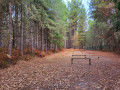
Set off on a walk through the heart of Ruaudin’s countryside! From the town centre, discover the area’s heritage through the church, the wash house and the old tram bridge. You’ll then follow the course of the ‘Le Roule-Crottes’ stream to the beautiful pine forest that gives the town its charm. Along the way, make the most of the facilities: picnic areas, a playground, a fitness trail and benches.
Segrais Castle route
 5.31 mi
+207 ft
-210 ft
2h 35
Easy
Departure from Saint-Mars-d'Outillé (Sarthe)
5.31 mi
+207 ft
-210 ft
2h 35
Easy
Departure from Saint-Mars-d'Outillé (Sarthe)
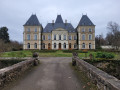
The route runs across agricultural land south of the Rhonne valley and ends by crossing an area of moorland adjacent to the Bercé Forest.
The Sourice Valley
 6.31 mi
+203 ft
-190 ft
3h 05
6.31 mi
+203 ft
-190 ft
3h 05
 Moderate
Departure from Surfonds (Sarthe)
Moderate
Departure from Surfonds (Sarthe)
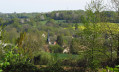
The parish underwent a re-demarcation in 1836: certain farms such as La Bardouillère and houses in the village were part of Volnay. Since then, the south-eastern boundary has been formed by the Ruisseau la Sourice. Under the Ancien Régime, the parish seigneury was annexed to the Château du Coudray, which you will see to the right of the hill as you head towards La Bardouillère. The village still has traditional houses near the church; it has gradually expanded towards the crossing point over the Sourice, where the roads from Surfonds to Bouloire and from Le Breil to Volnay used to meet, later transformed inthe 19th century into the main road from Tuffé to Le Grand-Lucé.
Les Sapins des Pauvres
 11.37 mi
+302 ft
-289 ft
5h 30
Moderate
Departure from Saint-Mars-de-Locquenay (Sarthe)
11.37 mi
+302 ft
-289 ft
5h 30
Moderate
Departure from Saint-Mars-de-Locquenay (Sarthe)
The name adopted at the time of the merger refers to the location of the two villages situated in the valley at the confluence of the Arche and Hune streams. The area has been inhabited since ancient times, as evidenced by the dolmen on the border with Tresson, dating from the Neolithic period, and the ancient road – the Via Turniacensis – linking Le Mans to Blois; passing through Volnay and Saint-Mars-de-Locquenay before heading towards the Loir Valley. This facilitated the development of large agricultural estates, explaining the presence of numerous fiefdoms in medieval times, of which few traces remain (Champion, Pois, Le Grand Yvay, Mèleve, Sargilet), with the exception of La Chesnaye, which incorporated most of them during the Modern Era (16th–18th centuries).
The Holly Route in Mulsanne
4.09 mi
+39 ft
-39 ft
1h 55
Easy
Departure from Mulsanne (Sarthe)
At the foot of the famous 24 Hours of Le Mans route, a pleasant stroll beneath Scots pines and maritime pines where the squirrel reigns supreme.
Lutin route
6.33 mi
+331 ft
-331 ft
3h 10
Moderate
Departure from Soulitré (Sarthe)
This route owes its name to the shape of its route, which evokes the silhouette of a leprechaun for dreamers. It offers a path between Jalais, a bocage plain on the Soulitré side, and the Huisne valley.
Around the Boulevard Nature: Arche de la Nature, amidst heathland and chestnut trees
 7.72 mi
+138 ft
-138 ft
3h 40
Moderate
Departure from Yvré-l'Évêque (Sarthe)
7.72 mi
+138 ft
-138 ft
3h 40
Moderate
Departure from Yvré-l'Évêque (Sarthe)
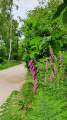
This forest walk from the Arche de la Nature takes you past a variety of tree species.It allows you to explore much of the site, walking along both wide paths and narrow tracks.
Yvré-l'Évêque route and its "Nature Boulevard"
 7.00 mi
+269 ft
-246 ft
3h 25
Moderate
Departure from Yvré-l'Évêque (Sarthe)
7.00 mi
+269 ft
-246 ft
3h 25
Moderate
Departure from Yvré-l'Évêque (Sarthe)
During this hike, you will have the opportunity to admire the Yvré countryside, its Roman bridge, the Gérence fountain and catch a glimpse of the beautiful Château de Vaux as you walk along the trails and part of the "Boulevard Nature".
The Pescheray Estate
 7.19 mi
+174 ft
-174 ft
3h 25
Moderate
Departure from Le Breil-sur-Mérize (Sarthe)
7.19 mi
+174 ft
-174 ft
3h 25
Moderate
Departure from Le Breil-sur-Mérize (Sarthe)
Le Breil and Nuillé are two villages of ancient origin. In the Middle Ages, Le Breil, or Breuil, was a seigneurial hunting ground. Nuillé, first mentioned in the9th century, still has a small Romanesque church.
The Auvours hill in Yvré-l'Evêque
 5.30 mi
+541 ft
-525 ft
2h 55
Easy
Departure from Yvré-l'Évêque (Sarthe)
5.30 mi
+541 ft
-525 ft
2h 55
Easy
Departure from Yvré-l'Évêque (Sarthe)
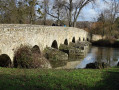
An easy walk, 50% of which follows a path around the Auvours hill, which witnessed the War of 1870, where a tragic battle claimed 617 lives on 10 and 11 January 1871. Many mementoes of this war are housed in the church at Yvre, where one chapel is dedicated to the Papal Zouaves.
The Maquis des Bois de la Croix in Connerré
 3.50 mi
+233 ft
-220 ft
1h 50
Easy
Departure from Connerré (Sarthe)
3.50 mi
+233 ft
-220 ft
1h 50
Easy
Departure from Connerré (Sarthe)
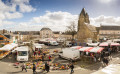
Situated in the Huisne valley, inhabited since prehistoric times, Connerré developed in the Middle Ages around a religious centre comprising the Church of Saint-Symphorien and a priory. The town, enclosed by a wall at the end of the 16th century, opened up at the end of the Ancien Régime thanks to the construction of bridges replacing fords and the expansion of transport links: the construction of the Paris–Nantes royal road around 1780, followed by the opening of a station on the Le Mans–Paris line in 1854. These developments fuelled the economic boom of the 19th century through fairs and markets and the growth of industry. The market town modernised and expanded gradually, then more rapidly from the 1970s onwards. Today, Connerré is an attractive small town, situated halfway between Le Mans and La Ferté-Bernard.
Bird trail from Nuillé-le-Jalais
 4.43 mi
+151 ft
-174 ft
2h 10
Easy
Departure from Nuillé-le-Jalais (Sarthe)
4.43 mi
+151 ft
-174 ft
2h 10
Easy
Departure from Nuillé-le-Jalais (Sarthe)
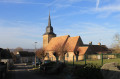
Nuillé-le-Jalais, first mentioned in the9th century , still has a small Romanesque church. Surprisingly, many of the local place-names refer to birds: La Pie qui Couette, La Grande Oiselerie and Le Chardonneret. The route’s signposting is a nod to this unique feature.
More walks in Parigné-l'Évêque
Select a point of interest below: